Mercedes-Benz has never been short of SUVs, but the GLB has always had one particularly easy job to explain: it’s the upright, family-focused one – bigger and boxier than a GLA, more compact than the larger luxury SUVs and designed to squeeze in a third row of seats without turning into something that feels like a minibus.
Where the previous electric seven-seater was called EQB, the battery-powered version now simply joins the rest of the GLB range, which makes the line-up a little easier to understand.
The electric versions arrive first in the UK, with petrol hybrids following later. Every UK electric GLB at launch has seven seats and the same 85kWh battery, while buyers can choose between the rear-wheel-drive GLB 250+ and the quicker, four-wheel-drive GLB 350 4MATIC. Prices start at £46,100 and the longest-range version is claimed to travel 379 miles on a charge, so this is not being pitched as a short-hop school-run special. It is meant to do the school run, sure, as well as the weekly shop, family weekends away and the sort of longer journeys that expose whether a seven-seat electric SUV really works as the household's main car.
At 4,732mm long, 1,861mm wide and 1,687mm tall, the GLB is substantial without being huge, although the 2,889mm wheelbase is 60mm longer than before. That extra distance between the axles has been used where a family will notice it, with more rear legroom, better access to the third row and a sliding middle bench. There is also a lovely panoramic roof fitted as standard, a 127-litre front boot and 540 litres of space behind the second row when the rearmost seats are folded into the floor.
Mercedes-Benz has also stuffed the new GLB full of the latest version of its MBUX infotainment system with AI assistance, Google-based navigation and, on the higher trims, an extra touchscreen for the front passenger. Add charging at a claimed maximum of 320kW (although there’s a bit of a catch with what it can currently handle) and the ingredients look thoroughly modern. However, the basic brief remains pleasingly old-fashioned: carry a family and all its clutter in comfort.
How I tested
I tested the Mercedes-Benz GLB over a week on UK streets in the south of England, driving the car on country roads, clogged urban streets and faster routes. I carried plenty of passengers and tested all three seating rows, checking for ride comfort, efficiency, charging performance, infotainment and family usability.
Mercedes-Benz GLB: £46,100, Mercedes-Benz.co.uk

Independent rating: 8/10
- Pros: Excellent ride comfort, impressive rear space, seven-seat versatility, strong efficiency, clever AI assistance, useful 127-litre front boot
- Cons: Some cheap-feeling plastics, body rattled over bumps, charging disappointed on test, passenger screen feels unnecessary
- Price from: £46,100
- Battery size: 85kWh
- Maximum claimed range: 379 miles
- Maximum charging rate: Up to 320kW DC, 10 to 80 per cent from 22 minutes
Battery, range, charging, performance and drive
Both electric GLBs use the same 85kWh lithium-ion battery and a two-speed transmission on the rear axle – it’s the very latest tech that has already impressed me in the new CLA.

The GLB 250+ has a single rear motor producing 268bhp and 335Nm, giving it a 0-62mph time of 7.4 seconds and a 130mph top speed. The GLB 350 4MATIC adds a motor at the front, taking the totals to 349bhp and 515Nm and cutting the 0-62mph time to 5.5 seconds, although its top speed remains 130mph. The front motor can disconnect when not needed, allowing the car to run as a rear-driver to save energy, before bringing the front axle back into play when extra performance or traction is required.
Range depends on the motor and trim. The GLB 250+ is rated at between 352 and 379 miles, while the GLB 350 4MATIC manages between 342 and 360 miles. Wheel size and equipment explain much of that spread: the entry Sport has 18-inch wheels and the best figure, whereas the heavier, 20-inch AMG Line Premium Plus gives up some of that range. The official consumption numbers convert to roughly 3.5 to 3.8 miles/kWh across the range, and on my test the GLB proved impressively efficient, which is good in a tall seven-seat SUV weighing around 2,200kg before people and luggage are added.
The headline charging figure is 320kW at a suitable 800-volt rapid charger, with a claimed 10 to 80 per cent time of 22 minutes and as much as 160 miles of range added in ten minutes. Those are excellent numbers on paper, but the charging speed I experienced did not live up to that promise. No charging session is controlled by the car alone, of course, because the charger, battery temperature and state of charge all play their part, but the gap was still disappointing.
There is another crucial detail to look out for, and which was responsible for my public charging experience: compatibility with 400-volt rapid chargers is an £850 optional extra – and even after paying that, charge speed is limited to 100kW. The standard car's headline capability is only possible when using an 800-volt charger, so anyone ordering one will need to consider where they are likely to charge, assuming they’re going to regularly use public chargers. Here in the UK, many high-speed public chargers (those offering between around 150 and 200 kW) run on 400 volts, while those advertising rates of 300 kW or even 400 kW are the 800-volt chargers the Mercedes prefers. There is a learning curve here, since chargers tend to display their kilowatt output and not their voltage.
If home charging is the norm, this won’t be a problem. At home, an 11kW AC charger can refill the battery in nine hours, while Mercedes-Benz quotes 13.75 hours on the more commonplace 7kW wall box.
Four energy regeneration settings can be selected, ranging from coasting to stronger energy recovery, with an automatic mode that uses the route, speed limits and traffic ahead to decide when the car should slow – I can never get on with those settings and it was no different in the Merc. It can apparently bring the GLB to a halt in the right circumstances, and the brake system is designed to keep the pedal feel consistent whether the motors or the conventional brakes are doing the work – for me, I don’t like the lack of a consistent feel when you lift off the throttle.
Comfort is the GLB's real forte. This is very much a comfort-orientated family SUV, feeling supple over bumps yet reasonably well controlled when the road starts to twist. It doesn’t wallow around corners or feel so floaty that children in the back are likely to feel sick, which is exactly the balance a car like this needs.
The higher trims combine 20-inch wheels with adaptive dampers, while the less expensive versions use simpler but less sophisticated suspension. There was one unwelcome flaw in the ride character of my test car: although bumps were well damped, they seemed to send a slight shimmy through the body and produce a faint rattle, neither of which felt very Mercedes-like. In an otherwise comfortable and premium-feeling car, that was a shame.
Interior, practicality and boot space

The GLB's cabin makes a strong first impression, with a wide, digital dashboard, a high centre console and the sort of space and light inside that suit a family SUV. The large panoramic roof is standard and was a particular hit with passengers in the back, opening up the view and stopping the cabin feeling gloomy. The overall atmosphere feels premium, but on closer inspection it was less convincing in some places. My test car had a few plastics that did not feel as plush or solid as I would expect in a Merc, and that constant rattle over bumps didn’t help.
The contrasting white panels on the doors and centre console also divided opinion. None of my passengers particularly liked them, and the trim made the interior look busier and cheaper rather than more luxurious. Mercedes-Benz calls the white finish used on AMG Line Premium Plus 'matt white natural fibre silent lines', but the name didn’t win anyone over.
Space is much harder to criticise. Legroom in the second row is impressive, and the 40/20/40 split backrest gives families plenty of ways to juggle people and luggage. The middle bench can slide backward or forward 140mm and its backrests recline in several stages, allowing you to trade second-row room against space in row three. There are child-seat mountings for two seats in the second row and another two in the third, and the rear doors cover the sills to help keep trouser legs clean when climbing in – why doesn’t every car do that?

Those two rearmost seats are genuinely handy, but adults shouldn’t expect limousine treatment. Mercedes says they are designed for anyone up to 1,710mm tall, yet I found them tight for adults even after sliding the middle row forward a little. They’re best viewed as occasional adult seats or a more regular home for children.
Access is easier than in the old car, and when the seats aren’t needed, they fold easily into the boot floor, so their presence doesn’t turn every luggage-loading exercise into a wrestling match.
There’s 327 litres of space with all three rows in use (a useful amount and still in keeping with supermini space), 540 litres with the third row folded and up to 1,715 litres when the second row is folded as well. A 127-litre frunk gives the GLB somewhere sensible to keep charging cables and frees the rear load area for bags.

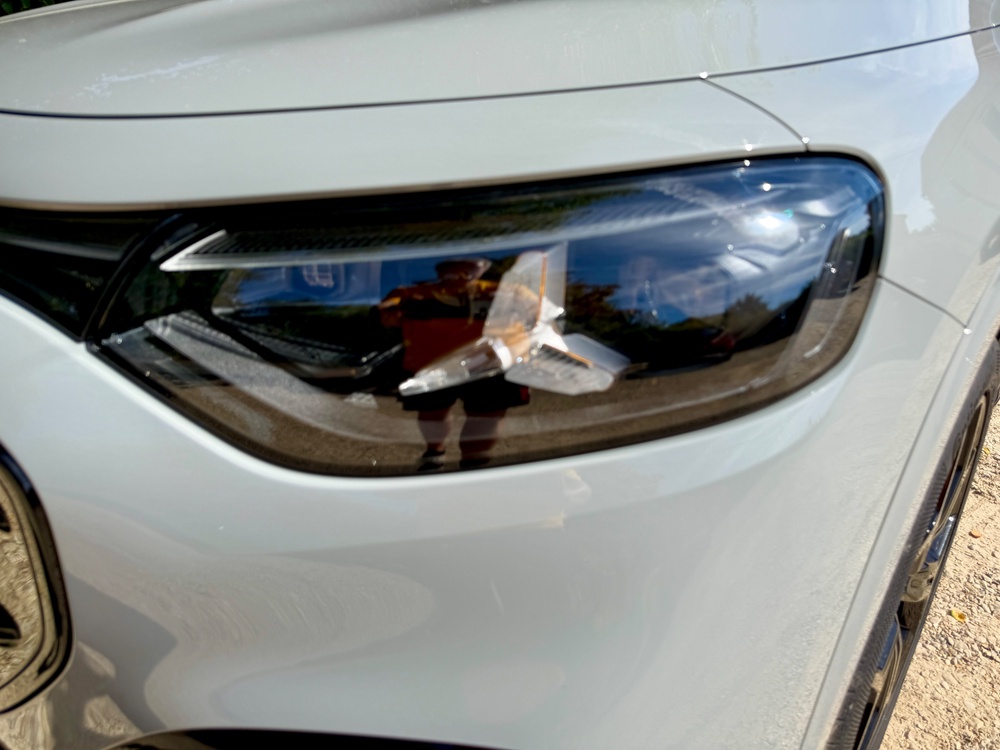
The packaging is clever, then, even if the outside styling is less successful to my eyes. The upright nose, high roof, short overhangs and broad shoulders give it a properly sturdy SUV stance - and while 94 little chrome-look stars fill the front panel, the overall shape looks a bit chubby rather than genuinely handsome.
Technology, stereo and infotainment
There is no shortage of tech in the GLB, and most of it is genuinely useful. Every version gets a 10.25-inch driver display and a clear 14-inch central touchscreen, while AMG Line Premium and Premium Plus add the MBUX Superscreen with another 14-inch display in front of the passenger.

The graphics are sharp, the main information is easy to read, and the home screen keeps commonly used functions and recently opened apps close to hand rather than making the driver dig through endless menus. Mercedes has also brought back a proper physical roller to control the volume and a rocker switch for the cruise-control and speed-limiter functions on the steering wheel.
The AI-powered voice assistant worked well during my time with the car. It can hold a conversation, remember the thread of a follow-up question and deal with normal phrasing instead of demanding a carefully rehearsed command. Behind the scenes, ChatGPT and the Bing search engine handle general questions, while Google Gemini and Google Maps look after navigation-related requests and information about places. When there’s only one person in the car, the assistant can also listen without needing 'Hey Mercedes' before every request, although if you find that a little invasive, that function can also be switched off.
The optional passenger screen was a different story. Not one of the people who travelled with me even thought about using it, other than out of curiosity. That’s despite its ability to run entertainment apps, stream video and support games while the car is moving.
Eye tracking is used to stop the driver watching the passenger screen, but the bigger question is how often anyone will want it. One passenger said the wall of displays made the interior feel like that of a tech-heavy Chinese car, while another wondered whether the GLB was related to the Smart #5, the product of the Mercedes-Benz joint venture with Geely. It’s not related, but the comparison showed how far the screen-heavy cabin has moved from the traditional Mercedes-Benz look.
Phone integration is wireless, and the car has four 100W USB-C ports. Wireless phone charging is standard from Sport Executive upwards. The standard stereo now has a centre speaker and can direct sound towards the second row, so children can listen in the back while the adults enjoy some peace up front. AMG Line Premium Plus adds the 16-speaker, 850-watt Burmester 3D surround system with Dolby Atmos, along with automatic sound focusing based on which seat belts are fastened.

The driver-assistance hardware includes eight cameras, five radar sensors and 12 ultrasonic sensors, with distance control, blind-spot assistance and parking assistance included in the UK range. More advanced steering and lane-change assistance is available through the MB.DRIVE packages, and the car's software can be updated remotely. Some digital extras offer free trial periods and may cost money to extend later, which is worth checking when you’re speccing an GLB – or, in the future, buying one second-hand when those trials might have come to an end.
Prices and running costs
The electric GLB range starts with the rear-wheel-drive GLB 250+ Sport at £46,100. Sport Executive costs £48,050, while AMG Line Executive is £51,050. The GLB 250+ AMG Line Premium is £53,700 and AMG Line Premium Plus is £56,800. The more powerful GLB 350 4MATIC begins with AMG Line Executive at £55,100, rising to £57,800 for AMG Line Premium and £60,900 for AMG Line Premium Plus. That is a wide price spread for cars sharing the same battery, so the trim and motor choice need to be considered separately.

Sport is not a bare-bones starting point. It includes seven seats, the panoramic roof, heated front seats, a 14-inch central screen, Google-based navigation, an 11kW AC charger, 18-inch wheels and the main parking and safety systems. Sport Executive adds 19-inch wheels, ambient lighting, wireless phone charging, flush door handles and keyless access. AMG Line Executive brings the sportier styling and seats, while AMG Line Premium adds 20-inch wheels, adaptive dampers, electrically adjustable memory seats, two-zone climate control, augmented-reality navigation and the full ‘Superscreen’ dashboard treatment. Premium Plus adds the head-up display, 360-degree camera, Burmester stereo, acoustic glass, better headlights and the white trim that split opinion in my car.
Even after all that, the options list might still need attention. The extra converter needed to use 400-volt rapid chargers costs £850 but only allows charging at up to 100kW on those units. A tow bar is £950; the GLB 250+ can tow up to 1,500kg and the GLB 350 4MATIC up to 2,000kg. Paint ranges from no-cost solid colours to £825 finishes. These additions can quickly move a car through the recently revised £50,000 threshold of the Expensive Car Supplement.
The price is easier to justify if the third row, big front boot, strong rear space and supple ride will be used regularly. Buyers who don’t need seven seats can shop from a much wider field of electric SUVs, but the GLB's particular mix of compact dimensions and family flexibility is less common.
The verdict: Mercedes-Benz GLB
The Mercedes-Benz GLB is a roomy, comfortable and useful seven-seat SUV with strong efficiency and clever tech, but disappointing charging, quality niggles and divisive cabin design take some shine off.
Mercedes-Benz GLB rivals:
FAQs
How long does it take to charge?
The Mercedes-Benz GLB can charge from 10 to 80 per cent in a claimed 22 minutes at a suitable 320kW 800-volt rapid charger. A full charge takes nine hours from an 11kW AC supply or 13.75 hours from a 7kW wallbox. Compatibility with 400-volt rapid chargers is an £850 option and is limited to 100kW.
How much does it cost – is it worth it?
The GLB starts at £46,100 for the GLB 250+ Sport and rises to £60,900 for the GLB 350 4MATIC AMG Line Premium Plus. It offers seven-seat flexibility, excellent comfort, impressive space and plenty of useful equipment, but buyers should weigh those strengths against the quality niggles, optional 400-volt charging compatibility and the disappointing charging speed experienced on this test.
Does Mercedes replace batteries for free?
The GLB's battery warranty lasts eight years or 100,000 miles and guarantees at least 70 per cent capacity.
Why trust us
Our team of motoring experts have decades of experience driving, reviewing and reporting on the latest EV cars, and our verdicts are reached with every kind of driver in mind. We thoroughly test drive every car we recommend, so you can be sure our verdicts are honest, unbiased and authentic.
With more than 30 years of experience, Steve Fowler is one of the UK’s best-known automative journalists. Steve has interviewed key industry figures, from Tesla’s Elon Musk to Ford’s Jim Farley, and is a judge for both Germany’s and India’s Car of the Year Awards, as well as being a director of World Car of the Year. When it comes to electric vehicles, Steve reviews all the latest models for The Independent as they launch, from Abarth to Zeekr, and he uses his expert knowledge of car buyers' needs to provide a comprehensive verdict.
Best electric cars 2026: The top 13 EVs on the market
Should you choose a plug-in hybrid or a fully electric car? Here’s my expert view
BMW, Mercedes and Audi face a new challenger – and it’s not Chinese
EVs are part of our high-tech future. Who says? Kids.
Big Chinese BYD Ti7 seven-seat SUV rivals Land Rover
These service robots could be coming to car showrooms – and I met them
Renault 5 jumps to top of EV sales chart as electric car interest soars
These two new SUVs are set to be next Chinese Chery brands in the UK