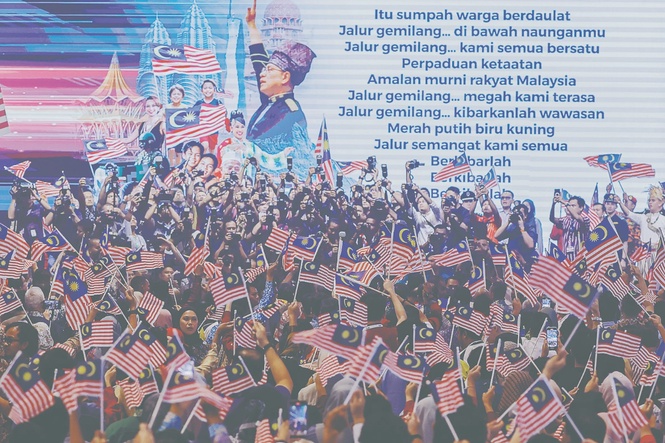
EVERY August, we raise the Jalur Gemilang with pride. We sing Negaraku and feel that familiar swell in our chests. Yet, beneath the celebrations, there remains a nagging question: What does Merdeka truly mean to us today?
At the dawn of independence in 1957, Malaysia’s future was not merely about political freedom from colonial rule. It was also about building a sovereign national identity – one rooted in unity, dignity, a shared sense of belonging and a deep love for the homeland and its people.
These were values that would resonate throughout the work of national laureate Datuk Usman Awang, whose writings championed humanity, national unity, social justice and love for the country.
Sixty-nine years later, his vision remains relevant. What we have built as a nation is genuinely extraordinary. But Merdeka also invites us to look beyond what we have achieved and ask what kind of nation we want to become – and whether the spirit of independence continues to live not only in our flag and celebrations but in the way we treat one another and the country we call home.
In 1957, we were a sleepy agricultural economy defined by rubber, tin and palm oil. Today, we are in the big leagues, with manufacturing, services and the digital economy humming along. Gross national income per capita has risen steadily for six decades. Nearly 36% of our workforce now holds tertiary qualifications while life expectancy has climbed from 59 to more than 75 years.
We have world-class highways, bustling ports and international airports, universities that draw students from across the region and hospitals that save lives and cities that never seem to sleep. Millions have risen out of poverty, while a middle class has emerged – not merely as a statistic but as a lived reality for millions of families.
Politically, we have seen the unthinkable: governments changing hands, fiercely contested elections and a civil society willing to speak up – sometimes loudly enough to make a difference. Young Malaysians are asking harder questions and demanding greater accountability.
Socially, we have lived, worked, traded, studied and celebrated side by side. Our diversity is not a footnote in a census report; it is the vibrant fabric of everyday life – one of the things that makes us genuinely proud to be Malaysian.
Yet, here is the uncomfortable truth: while we have progressed in almost every measurable way, the most fundamental task – becoming one people – remains unfinished and fragile.
Suhakam (Human Rights Commission of Malaysia) has warned that racism and racial discrimination remain embedded in our institutions, public discourse and societal attitudes. This does not mean we have become worse at living together. It means we have yet to complete the harder task of becoming one nation.
Where did we go wrong?
We made ethnic politics permanent
The political bargain at independence made sense for its time. It was a bridge meant to take us somewhere better. But somewhere along the way, we chose to live on that bridge. “Us versus them.” Majority versus minority.” One race against another. These became more than descriptions of our reality; they became the vocabulary of our politics.
We built parallel worlds
When it comes to schools, political parties, the media and social networks, how often do they operate along ethnic and linguistic lines? Children can grow up in the same neighbourhood, just streets apart, yet inhabit different worlds. They learn different histories, consume different news and develop different assumptions about one another.
Politicians found identity easier than policy
Fixing the economy requires hard work, careful planning and difficult decisions. Stirring fear of “the other community”, however, takes only a speech, a slogan or a viral video. It is cheap, effective – and too often, it has been the easier choice.
We forgot the civic soul of education
We have taught our children to pass exams brilliantly, in many cases. But have we taught them how to be Malaysians? Not merely to recite the Rukun Negara but to understand what it means to belong to one another? The Rukun Negara was born from the tragedy of May 13, 1969, when national unity was shattered. But reciting its five principles on command is not the same as living by them.
Unity cannot be achieved through slogans alone; it has to be lived. We need a new national project – one where children from different communities learn together, not merely alongside one another. Where young people serve together, through national service or community projects. Where communities solve local problems side by side, learning that their neighbours are not “the other” but simply us.
We must move beyond merely tolerating diversity to embracing it and, ultimately, trusting one another.
The real test of Merdeka
It is not about our skyscrapers, GDP or technological advances. The real test is whether one Malaysian can look at another and instinctively feel: “That is my fellow citizen, and their success is my country’s success.”
We threw off colonial rule in 1957. That was the easy part. The unfinished task – harder and more important – is freeing Malaysia from the fear, suspicion and political exploitation that keep us psychologically apart. We have built a successful country. Now it is time to finish building one people.
Let’s not keep Usman Awang waiting.
Comments: letters@thesundaily.com