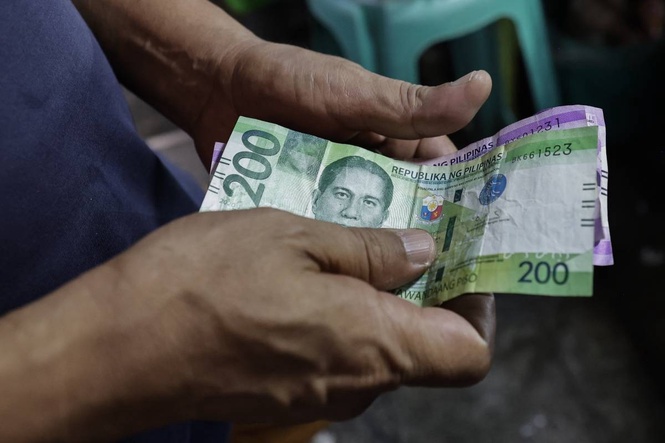
MONEY sent home by overseas Filipinos (OFs) increased in September, with growth hitting almost one-year high, data from the Bangko Sentral ng Pilipinas (BSP) showed.
Personal remittances totaled $3.55 billion during the month, up 2.7 percent from $3.46 billion recorded in the same month last year. It is also higher than the $3.37 billion a month earlier.
Cash remittances, meanwhile, grew 2.6 percent to $3.2 billion from $3.12 billion in September 2025. It is also higher than the $3.04 billion recorded in August.
Both are the highest growth recorded since January 2026’s 3.5 percent.
BSP data showed land-based workers accounted for the bulk of cash remittances at $2.56 billion, up from $2.49 billion a year earlier, while sea-based worker remittances remained at $640 million.
To date, personal remittances were up 2.3 percent to $29.65 billion and cash remittances also rose by 2.3 percent to $26.63 billion.
Union Bank chief economist Ruben Carlo Asuncion said the pickup was “broad-based,” with remittances from land-based and sea-based OFWs rising respectively.
“Still, the year-to-date growth suggests remittances remain resilient rather than sharply accelerating,” Asuncion said.
“We expect remittances to remain firm through year-end, supported by the usual Christmas-season transfers,” he added.
However, he argued that growth may not be sustained every month as higher living costs abroad could constrain OFWs’ capacity to remit.
“Overall, remittances should continue to provide steady support to household consumption and the economy,” Asuncion said.
The central bank expects remittances to grow to $36.6 billion this year.
The United States continued to account for the biggest share with 39.8 percent of the total, followed by Singapore (7.1 percent), Saudi Arabia (6.4 percent), Japan (5.0 percent), and United Kingdom (4.7 percent).
The BSP said there were limitations on data by source, as remittance centers abroad normally send the money through correspondent banks that are mostly located in the US.
Also, remittances sent through couriers are recorded under the country where their main offices are located, which again in many cases is the US.
“The US appears to be the main source of OF remittances by origin, because the remitting or correspondent banks are mostly located in the US,” the central bank said.
“The data does not imply that the funds were generated within the US,” it added.