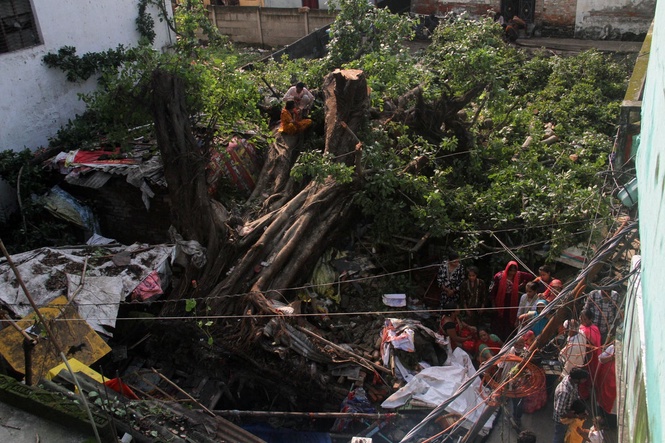
At least 62 people were killed after three days of heavy rain triggered flooding in the northern Indian state of Uttar Pradesh, officials said on Monday.
More than 40 people were injured and nearly 1,000 homes damaged.
The state recorded 775 per cent more rainfall than normal between 25 and 27 September, according to the weather department. It saw 66.5mm of rain compared with the average of 7.6mm for the period.
As many as 56 of the 75 districts received rainfall classified as “large excess”, prompting the closure of schools in several regions, including the capital Lucknow.
Farrukhabad reported the highest departure from normal at 7,385 per cent above average, followed by Kannauj at 5,664 per cent, Shahjahanpur at 4,408 per cent, Hamirpur at 4,240 per cent, and Mahoba at 4,100 per cent.
Sitapur saw the highest number of rain-related deaths at seven. Lakhimpur Kheri, Bahraich and Balrampur reported five each.
Authorities moved people from flooded areas to safer places and urged residents to avoid unnecessary travel and keep away from fast-moving rivers, streams and drains.
The rain is expected to ease from Monday as the weather system responsible for it over the Bay of Bengal weakens, according to Atul Kumar Singh, a senior scientist at the Regional Meteorological Centre in Lucknow. Some parts of eastern and western Uttar Pradesh could still receive light rain through Tuesday.
The Ghagra and Rapti rivers were still rising at several monitoring points, raising the risk of flooding in low-lying areas.
At Elginbridge in Barabanki, the Ghagra was flowing above its danger level, authorities said, while the Rapti had crossed its warning level at Balrampur.
The rain and flooding also killed at least 154 animals across the state, according to The Times of India.
“Assessment of crop losses is still underway as district administrations continue to carry out rescue, relief and damage assessment operations in affected areas,” relief commissioner Hrishikesh Bhaskar Yashod said.
A wavering western disturbance likely to impact Chandigarh, Punjab, Rajasthan, Haryana, Uttarakhand, West Uttar Pradesh, and Delhi-NCR during September 28-30 pic.twitter.com/f9GrLIdKEE
— Prof. (Dr.) Suchintan Singh (@suchintan_singh) September 27, 2026
Flooding also struck the eastern state of Odisha, prompting the evacuation of about 75,000 people.
Authorities warned that many low-lying areas in the state faced a growing flood threat as 800,000 cusecs of water could pass through the Mundali barrage on the Mahanadi river system by Monday.
They also noted that major rivers in the northern districts continued to flow above danger levels.
Across the international border, Nepal reported 21 weather-related deaths between Thursday and Sunday. The national disaster management agency said five were left injured and as many remained missing after floods and landslides damaged 194 homes.
The Himalayan nation is still recovering from the devastating flash floods that killed more than 1,400 people in August and left nearly 6,000 missing.
Read MoreTwo killed and at least 10 missing after avalanche hits climbing camp in Nepal
Nepal’s flooding disaster set to pile billions onto its national debt
At least 33 Britons still missing one month after Nepal flash floods disaster
Nepal’s deadly floods are ‘a warning to the world’, PM tells UN
Why is India’s election body chief under fire?
India allows Ukrainians and American accused of training insurgents to go home