
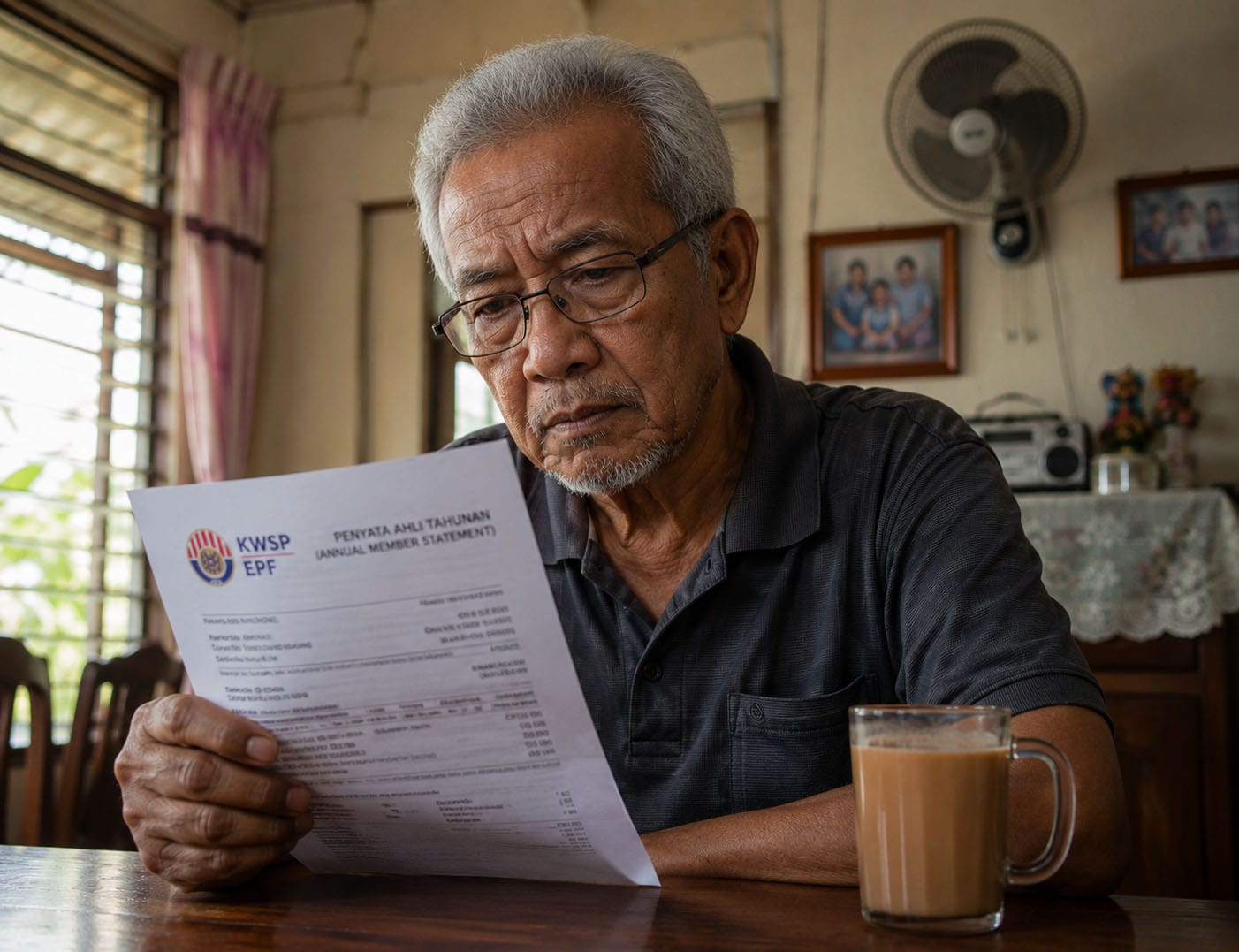
74% of Malaysians will retire with less than RM100,000 in EPF. Is yours enough?
Here is a question most Malaysians never ask themselves until it is almost too late.
If you stopped working tomorrow and had to live off your EPF savings for the rest of your life, how long would the money last?
For most of us, the honest answer is uncomfortable. And the data backs that discomfort up with numbers that should be making headlines every single day but somehow never quite do.
Malaysia has a retirement crisis. It is quiet, slow-moving, and almost entirely invisible until the day it arrives at your door. And by then, it is very difficult to fix.
The Numbers That Should Keep You Up at Night
Let us start with what the data actually says.
As of 2024, only 36% of active formal EPF members have reached the Basic Savings benchmark for their age. That means nearly two thirds of working Malaysians who are actively contributing to EPF right now do not have enough saved relative to where they should be at their current age.
The Basic Savings benchmark itself was revised upward to RM390,000 effective January 2026, reflecting the reality that retirement costs more than previously assumed. EPF's own Retirement Income Adequacy Framework sets three tiers: RM390,000 for basic living needs, RM650,000 for a reasonable standard of living, and RM1.3 million for genuine financial security and independence. A single elderly person, according to the Belanjawanku 2024/2025 guide, needs approximately RM2,690 per month to maintain a reasonable standard of living in retirement. Over a 20-year retirement period, that is over RM645,000.
Most Malaysians are nowhere close to that.
Nearly 74% of active EPF members have accumulated less than RM100,000, enough to last perhaps five to six years at basic living expenses, without even accounting for healthcare costs. Men in Malaysia now live to an average of 74.8 years. Women to 78.9. If you retire at 60, you need your money to last at least 15 to 20 years. For most people, it simply will not.
The Pandemic Made Everything Worse
Between 2020 and 2022, the government allowed three special EPF withdrawal programmes, namely the i-Lestari, i-Sinar, and i-Citra, to help Malaysians cope with the economic devastation of the pandemic.
More than 8.1 million EPF contributors withdrew over RM145 billion from their savings during this period. Half of those aged 55 and below were left with less than RM10,000 in their accounts. The median EPF balance across all members including inactive accounts dropped to just RM10,898.
Before you judge those who withdrew, understand the context. Many of them were retrenched. Many were self-employed with zero income. Many had families depending on them and no other safety net. The choice between keeping money locked in EPF and putting food on the table for your children is not really a choice at all.
The B40 were hit hardest. Around 5 million lower income EPF members saw their total savings drop by 38%, leaving a median balance of just RM1,005. One thousand ringgit. For retirement.
The pandemic withdrawals were necessary in the moment. But the long-term cost to Malaysia's retirement security has been severe and will not be fully felt for another decade or two, when the people who emptied their EPF accounts during the pandemic reach retirement age with almost nothing left.
The Gig Economy Gap Nobody Is Fixing
Here is the part of the retirement conversation that rarely gets enough attention.
EPF currently covers approximately 9 million active formal sector members. Malaysia's total workforce is significantly larger. The gap is filled by gig workers, freelancers, the self-employed, hawkers, small traders, and informal sector workers, people who are not automatically enrolled in any retirement programme at all.
Around 40% of working-age Malaysians are not actively covered by any retirement programme. They have access to i-Saraan, the voluntary EPF contribution scheme for the self-employed, but voluntary participation requires both the discipline and the financial capacity to contribute. For someone running a small business with irregular cash flow, or picking up freelance work between gigs, making voluntary EPF contributions consistently is easier said than done.
This gap is growing, not shrinking. The gig economy is expanding. Platform work, freelancing, and self-employment are increasingly how younger Malaysians earn a living. Every person who exits formal employment and enters the gig economy is one more person slipping through the retirement safety net.
What The New EPF Framework Actually Means
The good news, if you can call it that, is that EPF has been making serious structural reforms.
Since May 2024, EPF restructured member accounts into three components: Akaun Persaraan (75% of contributions, locked for retirement), Akaun Sejahtera (15%, for housing, education, and medical), and Akaun Fleksibel (10%, accessible for any purpose with no restrictions). The idea is to reduce the temptation to raid retirement savings for short-term needs by providing a separate accessible account.
The new Retirement Income Adequacy Framework launched in January 2026 also encourages members to think about retirement as a monthly income stream rather than a lump sum. EPF projects that if members contribute consistently, approximately 60% could reach the RM390,000 Basic Savings benchmark by age 60. That is progress. But 60% also means 40% who will not.
And RM390,000, while the "basic" benchmark, still only provides around RM1,625 per month over a 20-year retirement. That is below the RM2,690 monthly that EPF's own Belanjawanku guide says a single elderly person needs for a reasonable standard of living.
Basic and adequate are not the same thing.
What Needs to Change
The structural solutions are known. They are just politically and practically difficult.
Malaysia needs to seriously consider extending mandatory EPF coverage to gig workers and the self-employed, with contribution models that accommodate irregular income. Singapore's CPF system, for all its rigidity, does a better job of ensuring that more of the working population is covered. Experts have also called for a hybrid pension model that combines EPF savings with a guaranteed monthly payout component, similar to CPF Life in Singapore, to protect retirees who outlive their savings.
Financial literacy needs to be treated as seriously as academic literacy. Most Malaysians do not understand compound interest, do not know what their EPF balance needs to be at retirement, and have never made a retirement projection. This is not laziness. It is the product of a system that does not teach these things and an economy that does not leave most people with much room for saving after covering monthly expenses.
And the government needs to close the special withdrawal door more permanently. Every time an economic crisis arrives and EPF is used as a social safety net of last resort, years of compounding growth get stripped out of millions of accounts in weeks. There needs to be a proper social safety net that handles economic shocks so that retirement savings can remain intact.
My Take
I am self-employed. My EPF contributions have not been active for some time. Like many Malaysians who went through a difficult period financially, I made withdrawals during the pandemic because I had to, not because I wanted to. Looking back, the regret is real. Not because it was the wrong decision at the time, it was the only decision available, but because I understand now what those ringgit would have become if left to compound over the years ahead.
That is the quiet grief of the pandemic withdrawals that nobody really talks about. It was not just money taken out. It was future money that will never exist.
I do not know with certainty whether what I have in EPF today will be enough when retirement comes. What I do know is that the question itself is one that every working Malaysian needs to sit with, seriously and soon. Not when you are 60. Not when you are 55. Now.
The earlier you look at the number, the more time you have to change it. The longer you look away, the closer you get to a retirement that may be more difficult than it needs to be.
EPF is not your enemy. It is one of the best long-term savings instruments available to Malaysians. Tax-free dividends averaging 5 to 6% a year, with over RM1 trillion in assets under management. But it only works if you leave it alone long enough for the compounding to do its job, and if you top it up whenever you can.
If you are self-employed and have not made a voluntary i-Saraan contribution recently, this is your reminder that you can do so through the EPF i-Akaun portal at any time. Even RM200 a month, started today and left untouched, becomes something meaningful in twenty years.
Start. Even if it is small. Even if it feels late. The worst time to think about retirement was yesterday. The second worst time is tomorrow.
Kamarul Azwan (k.azwan@gmail.com) is a content creator under the Newswav Creator programme, where you get to express yourself, be a citizen journalist, and at the same time monetize your content & reach millions of users on Newswav. Log in to creator.newswav.com and become a Newswav Creator now!
The User Content (as defined on Newswav Terms of Use) above including the views expressed and media (pictures, videos, citations etc) were submitted & posted by the author. Newswav is solely an aggregation platform that hosts the User Content. If you have any questions about the content, copyright or other issues of the work, please contact creator@newswav.com.