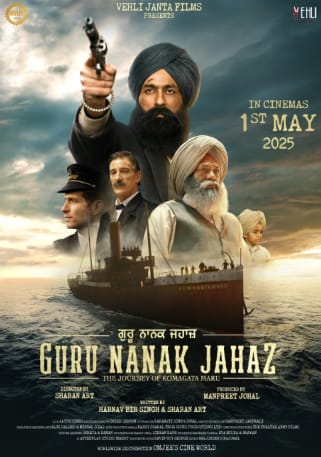
Guru Nanak Jahaz (Canada, Punjabi, 2025)
Director: Sharan Art
They say our life is finite. At the same time, they mention that life on Earth is cyclical. What goes around comes around. A pauper may one day be King. We live in changing times. The Indians and the Chinese, who once ruled much of the world before imperial powers came knocking at their shores, were brought down to their knees and reduced to the level of serfdom. Now the colonial subjects have arisen. The former colonial powers realise their awakening and scramble desperately to protect their interests and ensure their citizens continue enjoying the same privileges they once enjoyed and the same level of affluence they once had.
The story of Komagata Maru reminds us how imperial powers loved the wealth they could usurp and the exotic mysteries associated with the colonies, but could not stand the sight of their natives. It revealed their blatant discriminatory policies against non-whites.
At the turn of the 20th century, as living conditions in India grew increasingly difficult, with frequent famines and civil unrest, more and more Indians sought opportunities elsewhere. As North America saw industrialisation, many Indians made a beeline there. Many Sikhs found employment in the growing railway construction, lumberjacking and agricultural work. They aggregated around Vancouver in British Columbia. The local populace, however, were not keen on having brown-skinned foreigners sharing their living space. They made their resentment quite public. The newcomers found solace in the company of their kind in the then newly erected Gurudwara. Soon ridiculous laws were churned out to keep their immigration at bay. They enacted the Continuous Journey Regulation, which required entrants to reach Canada on a single, continuous journey. The trouble was that no ships travelled directly from India to Canada. Indians had to change ships numerous times to reach Vancouver. Another law required each traveller to Canada to have $200 in Canadian currency.
A Sikh entrepreneur from Malaya, Gurdit Singh, had a clever idea to outsmart the law. He chartered a whole steamship to sail from Calcutta to Vancouver via Yokohama. The steamship, Komagata Maru, was baptised 'Guru Nanak Jahaz' (Guru Nanak's Ship), symbolically implying that the Guru's ship would lead them to liberation. The passengers also included Hindus and Muslims.
On May 23, 1914, Komagata Maru arrived at Vancouver to a rather cold welcome. The immigration officers denied them clearance to disembark. The atmosphere on the ground was hostile. The local white population was out, punching their fists in the air, yelling against Indian immigration. The Indians already settled in Canada came in large numbers to offer solidarity and support to their fellow Indians. They formed the Shore Committee to represent the stranded passengers. In that tinderbox environment, they sought a court injunction. The courts ultimately rejected their appeal. Initially, the courts even refused to hear the case because the people on the ship were non-Canadians. About 20 passengers were allowed to disembark as they were returning Canadian residents.
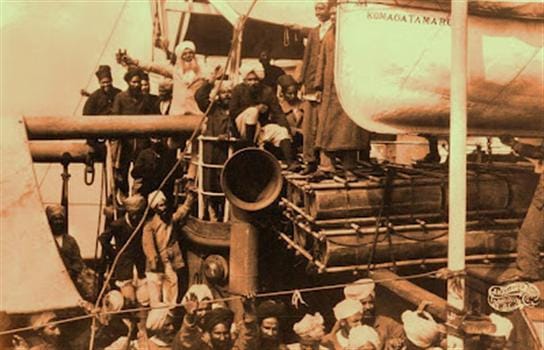
On the ground, widespread unrest also erupted. The Punjabis identified their own kind as informants to the Vancouver police and British officials. Sikhs were killed in the gurdwara, and even a Canadian Immigration Inspector, Hopkinson, was assassinated. Mewa Singh Lopoke, the local leader who helped build the Gurudwara, was convicted of the assassination and sentenced to be hanged. The Ghadar Party, established in 1913 to wage an armed struggle to liberate India, also stepped in to help.
After a two-month standoff with Canada refusing to provide food and water, its Navy essentially shooed them away from its shores to enforce the court decision. In conclusion, the court upheld their discriminatory immigration laws.
Another shock awaited the passengers when Guru Nanak Jahaz reached Calcutta after being barred from disembarking at Hong Kong and Singapore. Komagata Maru had to drop anchor at the mouth of the Hooghly River and was stranded for three days for harbouring anti-colonial passengers. The British tried to bundle the passengers on a train and send them to Punjab. The voyagers insisted on carrying their holy book, the Guru Granth Sahib, which had accompanied them throughout the journey, to the local gurudwara in Calcutta. The British relented. During the high octave march, a scuffle broke out. Violence erupted; the Imperial Police opened fire, and massive violence ensued. 20 passengers died, and over 200 were injured. Gurdit Singh, the businessman who chartered the ship, escaped and went underground for 8 years before surrendering on MK Gandhi's appeal. After serving his prison term, he spent the rest of his years in public service.
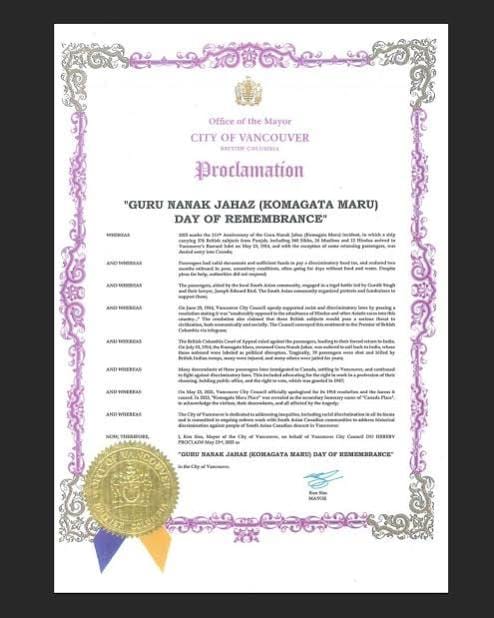
This movie is a presentation from the Sikh community in Canada on an important event in their heritage. It is the event that highlighted the racist stance of the imperial powers against the colonial subjects at the height of the Empire. Much water has flowed under the bridge, but the incident serves as a constant reminder that history teaches us many things. In 2016, Canada's PM, Justin Trudeau, officially apologised to Canada's Indian descendants for the Komagata Maru incident. May 23, the day the ship landed in Vancouver, is commemorated as a day of remembrance for the Komagata Maru passengers.
Farouk Gulsara (asokansham@gmail.com) is a content creator under the Newswav Creator programme, where you get to express yourself, be a citizen journalist, and at the same time monetize your content & reach millions of users on Newswav. Log in to creator.newswav.com and become a Newswav Creator now!
The User Content (as defined on Newswav Terms of Use) above including the views expressed and media (pictures, videos, citations etc) were submitted & posted by the author. Newswav is solely an aggregation platform that hosts the User Content. If you have any questions about the content, copyright or other issues of the work, please contact creator@newswav.com.