.jpeg)
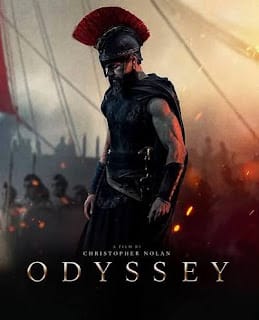
The Odyssey (2026)
Director: Christopher Nolan
The film gives a chance to dive into the dizzying world of Greek mythology. There are so many characters, and their names are so tongue-twisting that they do not stick in the mind.
We all have heard the story of a wooden horse used to trick the enemy and infiltrate their territory somewhere in our school curriculum. But surprise, surprise. Homer, who is credited with writing the poems The Iliad and The Odyssey, only mentioned the wooden horse in passing at the end of The Iliad and the beginning of The Odyssey. It is not the mainstay of these epic poems. It seems that scores of written poems which were transmitted orally through the generations were lost through wars, fires and the passage of time. Some were lost altogether whilst others had patchy retrievals. The epic poem about the Trojan War was completely lost.
For the uninformed, The Iliad narrates the events leading to the Greek-Trojan war, while the Odyssey tells the story of what happens to the victors as they travel back home. Either story spans over ten years each. Ten years fighting the Trojans, and it took another ten years for the protagonist of the story, Odysseus, to return.
The return journey is not merely a narration of sorcery and adventure into unknown lands with scary creatures. It subtly tells us our frailty, our moral dilemmas, our temptations, and the effect wars have on our psyche. In ancient times, there were moral codes to be followed during war and afterwards. Unfortunately, the intoxication of success goes into one's head, and plundering, looting and abuse go unabated. It also warns of the danger of intoxicants (e.g. lotus eaters) where one chooses mindless pleasure over struggles of reality. Repeatedly, Zeus' law is mentioned, emphasising the need to respect visitors as well as for visitors to show decorum. The killing of the Cyclops, son of Poseidon, angered Poseidon. Hence the storm and subsequent loss of ships and crew members.
The final part of the movie tells of how Odysseus sees his kingdom, Ithaca, overrun by opportunistic suitors waiting to pounce on the throne by winning over Penelope, Odysseus' wife.
In many of the Greek poems, they talk about a time when it seems that the Gods interacted quite intimately with humans. They parent children with mortals and somehow pass down certain divine attributes.
There is a curious similarity between the Greek mythologies and those from Ancient India. For a start, there are startling similarities between the Greek Gods and the Hindu Gods. Zeus, the god of thunder, wields a thunderbolt, much like Indra, the Hindu deity of the sky who holds a similar weapon. Both are not devoid of human emotion, like passion, desire and wrath.
The idea of using a wooden animal to infiltrate an enemy's fortress, like the Trojan horse, is also found in the Mahabharata. One of Arjuna's descendants, King Udayana, is said to be famous for taming wild elephants with his veena. One of his rivals built an untameable mechanical elephant for Udayana to tame. He was lured into the jungle, where soldiers hiding in its belly jumped out to apprehend and later imprison him, just like the Trojan Horse, a gift to Athena, allegedly left behind by the fleeing Greeks. Unbeknownst to the Trojans, Greek soldiers hid in the horse, only to terrorise Troy once they were in the fortress.
The Greek-Troy war all arose because Helena, the fairest of them all, who was pledged to be protected by all of Greece, did indeed launch a thousand ships when she eloped with the Trojan prince, Paris. Some accounts say she was abducted by Paris, just like how Sita was abducted by Ravana in the Ramayana.
The Greek soldiers in Troy went on a rampage, burning the whole city down, just like how Hanuman burnt Lanka with his tail.
In one of the later parts of the movie, we are told of Odysseus' uncanny ability to string a bow that no one else could. Such a scene also appears in the Mahabharata. During Sita's Swayamvara (matrimonial tradition), Rama was the only person who could string Shiva's bow.
Odysseus' remarkable shooting of an arrow through a series of targets is reminiscent of Arjuna's similar feat at Draupadi's Swayamvara. Rama too shot a single arrow through seven trees. A Cyclops-like creature also makes an appearance in the Ramayana. Rama and his brother, Lakshmana, encounter Khabanda, who later helps them contact the Vanara Army to rescue Sita.
The Sirens, female-like creatures who could lure men with their high-pitched voices, are compared to the apsaras in ancient Indian mythologies. Unlike their Greek counterparts, who are destructive, apsaras are benevolent. But both put men under a spell.
When Odysseus returns to Ithaca, he has to go under disguise to assess the situation on the ground. He has to find out whether he is still missed, whether his wife has remarried, whether someone else is ruling, and generally assess whether he can return as King. This concept of royalty going incognito seems to be another common thing in the Mahabharata. The Pandavas, as a part of the deal when they went into exile after losing the dice board game, had to spend the thirteenth year in disguise!
To top it all off, Homer, if ever he was an individual bardic poet who wrote the Greek epic poems, may have been blind. He compiled age-old oral tradition songs into long poems and painted an image of how Ancient Greeks used to live and value in his mind. Much in the same way, Sanjaya, the court seer blessed with the 'Sanjaya Gift', perceived a running commentary of the events unfolding at the Kurushetra War telepathically. He then narrated the events as they happened to the blind King of the Kauravas.
With so much similarity between the Greek and Indian mythologies, would it be too much to say they are both cut from the same cultural mould? The vast expanse of trade that occurred between these two countries and the mutual respect they had for each other could have sparked cross-pollination of ideas and social mores.
P.S. The Odyssey has been told and retold many times before. It is said that Nolan's Odyssey is a version that seems to satisfy the appetite of the woke community. The use of a Kenyan face to portray Helen, the face that would indeed launch a thousand ships, and whom Homer described as 'white-armed ', is the woke's way of saying beauty is in the eye of the beholder. Rumour had it, before the release of the film, that a transgender actor would play the role of the man who would come to be the very definition of the modern man, Achilles. It turned out not to be so. Indeed, the actor turned out to play another valiant role. Elliot Page played Sinon, the brave but tragic soldier who became a pawn in Odysseus' and Antonio's (who stayed to woo Odysseus' wife Penelope) power play. Sinon was the one who introduced and convinced the Trojans that the Wooden Horse was a gift to Goddess Athena.
P.S.S. The Zeus Law, which was mentioned in the film where guests are treated with utmost respect as the guest may be the gods doing a spot-check, probably died after the Trojan War. The Mycenaeans of the Late Bronze Age did not respect the law when they infiltrated Troy in a wooden horse. The Indians, on the other hand, must have stuck with their own Zeus Law. When the first sailors from Europe landed on their shores, they were treated like gods. We know what happened afterwards.
Farouk Gulsara (asokansham@gmail.com) is a content creator under the Newswav Creator programme, where you get to express yourself, be a citizen journalist, and at the same time monetize your content & reach millions of users on Newswav. Log in to creator.newswav.com and become a Newswav Creator now!
The User Content (as defined on Newswav Terms of Use) above including the views expressed and media (pictures, videos, citations etc) were submitted & posted by the author. Newswav is solely an aggregation platform that hosts the User Content. If you have any questions about the content, copyright or other issues of the work, please contact creator@newswav.com.