.jpeg)
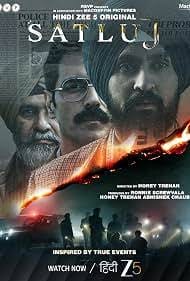
Satluj (@Punjab 95, Hindi, 2026)
Director: Honey Trehan
Unlike Dhrandhar and Kashmir Files, this movie is not propaganda. The narration presented and the chain of events said to have occurred are documented in the court files. Hence, its authenticity can be verified, as the legal system of any country is held in the highest esteem. The story is not anyone's figment of imagination or the result of a group brainstorming session to create fiction.
It tells of the heady times of the Punjab insurgency that plagued the State in the 1980s and 1990s. The prevailing reason for the unrest was probably a class clash. It can be traced back to the mid-1960s, when the Indian Government started the Green Revolution. For the longest time, famine had been plaguing India, and Lal Bahadur Shastri's Government, around the Indo-Pak war of 1965, promoted the 'Jai Jawan, Jai Kishan' rebel yell to promote nationalistic spirit and to aim towards food self-sufficiency. The fertile Punjab land soon came to be nicknamed 'Grain Basket of India' for its contribution to India's food security. As finances were distributed centrally, Punjabis accused the Central Government of taking more than it gave to the State.
Mechanisation of farming and the widespread use of chemical pesticides and fertilisers made farming an expensive affair. This led to rich farmers prospering and poor farmers winding up. Modern farming also demands a large amount of water, depleting groundwater tables and making the land arid. The carving out of Haryana from Punjab made the division of water between the states problematic. The delay in building canals worsened the situation. It soon led to a generation of unemployed youngsters and poor farmers.
Shiromani Akali Dal (SAD), Punjab's leading political party and the second-oldest in India after Congress, has had many factions since its inception. During these uncertain times, some of its leaders took a very communal stance to usurp power. They talked about a state for Sikhs with Sikh values, where only Gurmukhi is used, Western clothing is banned, and a Taliban-esque country. The Hindi language was to be banned, and Hindi newspapers were to be removed from shelves. Radical leaders like Bindrawale used the Golden Temple to store arms and ammunition. This led to Operation Blue Star, when the Indian Army, under the orders of Prime Minister Indira Gandhi, laid siege to the temple premises in 1985. As it was Guru Arjun Ji's martyrdom celebration, the casualties during the attack were steep; figures range from 300 to 8,000, depending on whether Indian officials or the human rights movement are cited.
Dissatisfaction with the Central Government reached fever pitch as the Indian Army continued its surveillance of Sikh temples during Operation Black Thunder and other operations. This only further fuelled the dissatisfaction among radical Sikh leaders. Later, the Chief Minister of Punjab, Baint Singh, was assassinated by a suicide bomber.
Delhi brought in powerful police officers such as Julio Ribeiro and, later, KPS Gill, to take charge of security in Punjab. They were given the authority to confront the raging insurgency by the horns. Their approach, though it helped to stamp out terror, was deemed uncivil. During KPS Gill's tenure, reports of extrajudicial killings and an extremely high number of unclaimed bodies in mortuaries surfaced.
This is the premise of this movie. Jaswant Singh Khalra, a banker, took it upon himself to report the sudden increase in unclaimed bodies in morgues and crematoria. He discovered this while trying to track down his missing friend and his mother. Rather than sitting idle, he decided to pursue the matter. He drew the attention of the courts and international human rights watchdogs. He eventually met the same fate as the people he was trying to speak out for. He went missing, too. The CBI (Central Bureau of Investigation) arrives on the scene, but wherever they go to ascertain his whereabouts, they hit a dead end. After much arm-twisting and emotional turmoil, a police informant is identified. The crux of the movie is finding out what happened to Jaswant Singh Khalra.
So, where is the controversy if it is all just court records? In life, things are not so straightforward. Using artistic licence, the storytellers may have overstretched themselves by portraying the police in a very poor light. Maintaining law and order is a thankless job, but they were tasked with the dirty work of bringing peace. They appear as the bad ones on either side when they wield their authority. They may also have omitted the fact that non-Sikhs suffered heavy casualties during this period.
The Government of the day may fear that this film could create an aversion to the police. Maintaining law and order may become more difficult than it already is. Furthermore, some of the police officials involved during this period are still alive today, and their lives or their families may be in peril. On the other hand, many anti-Central forces have taken the effort to hold free screenings of pirated copies of 'Sutlaj' in villages to stir Sikh sentiments in the State, as the licence to screen this film in cinemas and on OTT has been revoked.
It is quite humiliating to hear that even though the Supreme Court had given life imprisonment to six out of the seven policemen accused in Khalra's disappearance, the public alleges that they remain almost as free men. Walking in and out of prison as they pleased, they never failed to attend family functions, including Diwali. They were never sacked from the police force and continue to receive their salaries. The irony is that one of the prisoners went AWOL after taking home leave. The address given in the prison records turned out to be fake. He is currently untraceable, probably out of the country. Perhaps, in Canada!
P.S. The working title of this film was 'Ghallughara' (genocide). In the Sikh pantheon, Ghallughara means holocaust. Three events are linked to Ghallughara: the 1746 massacre of Sikhs by the Mughal Army (Chotta Ghallughara), the 1762 attack by the Afghan army (Vadda Ghallughara), and the 1984 Ghallughara during Operation Blue Star. The title was naturally rejected by the Censor Board. It was then renamed Punjab 95. Again, the Board rejected it and advised of 127 scene cuts. The Satluj (Sutlej) River, an iconic and symbolic body of water that flows through Punjab, was finally honoured. After three years of a censorship battle, the filmmakers quietly released it uncut on streaming platforms, only to be clamped down upon.
Farouk Gulsara (asokansham@gmail.com) is a content creator under the Newswav Creator programme, where you get to express yourself, be a citizen journalist, and at the same time monetize your content & reach millions of users on Newswav. Log in to creator.newswav.com and become a Newswav Creator now!
The User Content (as defined on Newswav Terms of Use) above including the views expressed and media (pictures, videos, citations etc) were submitted & posted by the author. Newswav is solely an aggregation platform that hosts the User Content. If you have any questions about the content, copyright or other issues of the work, please contact creator@newswav.com.