.jpeg)
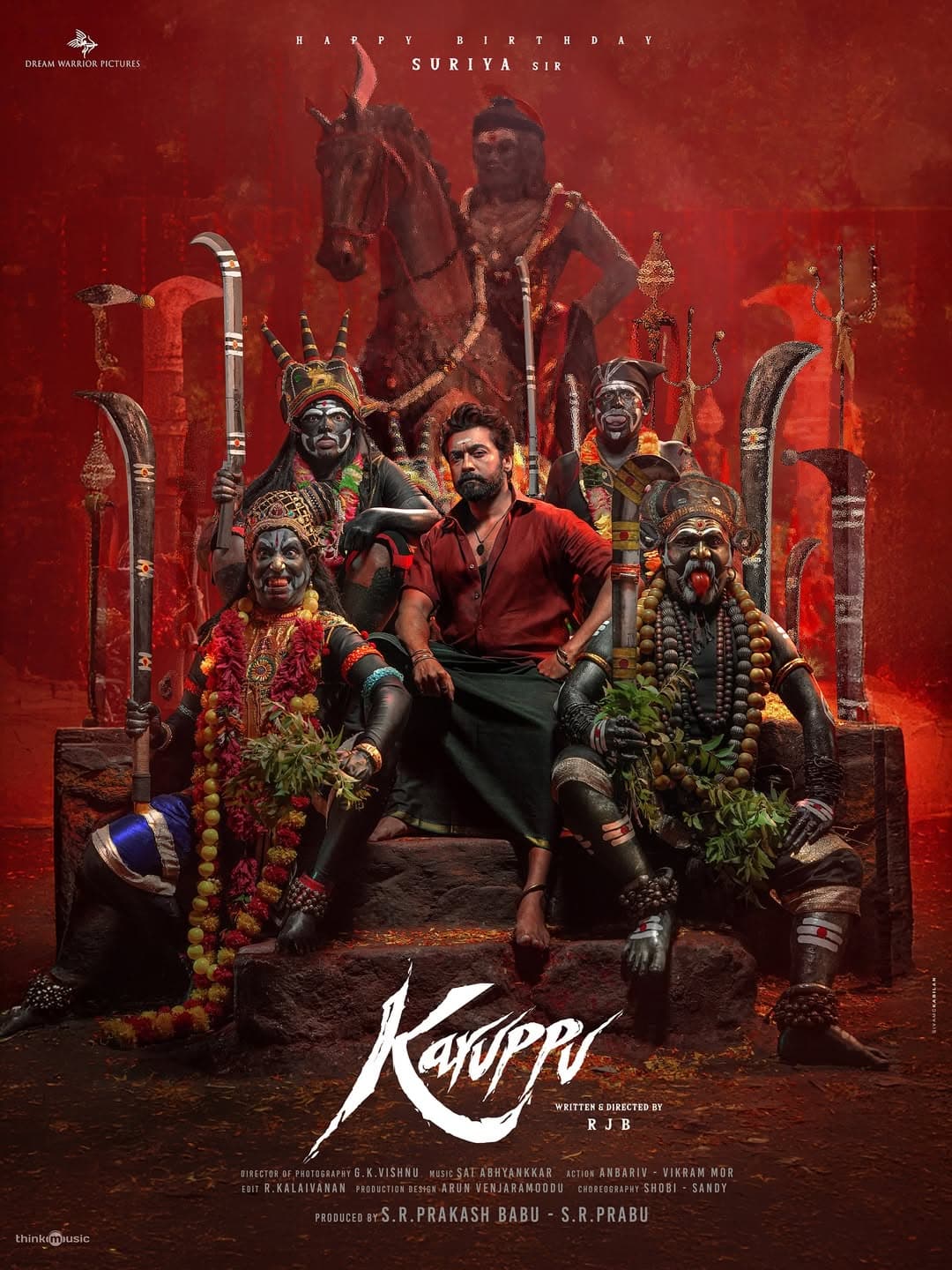
Karruppu (Black, Tamil; 2026)
Director: RJ Balaji
If the people from the Tullu region could come up with Kanthara and Kerala had Theyyam worship, the Tamils thought they could show off their own Karuppu Samy. Karuppu Samy belongs to a pantheon of local deities which forms the Dravidian folk religions. Their practices are said to predate Vedic teachings. Unlike the Vedic scriptures, which were written in Sanskrit, the Dravidian folk practices were transmitted orally and performed by families and villagers in the locality.
When Sanathana Dharma teachings stamped its foot on this land, these traditional practices continued, not in competition but in tandem. At a time when nature was hostile and humans were precariously exposed to its elements, the agrarian society found solace in their favourite deities, such as Karuppusamy. They put their trust in these demigods to protect them from evil forces and territorial autonomy. When savage beasts were less of a threat and greedy zamindars terrorised over the lands, the simple folks knew the local deities would mete out justice in a fair manner. Before long, these local deities came to be associated with the Brahminical Gods, such as Shiva and Vishnu. It is said that Shaktism has deeper roots in South India.
Some local deities may be in memory of revered strong leaders who fought for their cause. Muneeswar (aka Muniandy) may be one such person. He is linked to Shiva and to other manifestations of Sakthi, such as Mariamman. Padaiachi is another form of Sakthi who came to protect newborns from the tyranny of a mad king who killed newborns. Padaiachi is still prayed to after childbirth amongst the Tamils, even in Malaysia. Madurai Veeran is said to have protected the folk of Madurai from bandits and is still revered at the Madurai Meenachi Temple. The Tamil diaspora has brought their worship to their communities wherever they go.
An interesting example of how temples are erected is the Vettuudaiyar Kali Amman Temple in Sivaganga, Tamil Nadu, where Udayal is the local deity. Udayal was a cowherdess during the time of Queen Velu Nachiyar. Queen Nachiyar was fighting the British around 1780 to avenge her husband's killing. When the British were hot on the Queen's trail, they stopped a cowherdess, Udayal, to ask whether she had seen the Queen and which direction she was headed. Udayal boldly told the invaders, “Yes, I saw her going this way. But I refuse to tell the direction she went!”
The angry British soldiers slashed her to death. After Queen Nachiyar's victory, Udayal's sacrifice reached the ears of the palace. Queen Nachiyar herself laid the foundation stone of the temple, which stands today. This is how society remembers its heroes and finds comfort in believing they would still be protected by the fallen.
Nachiyar went on to establish the first all-women army regiment, whose espionage capabilities helped dismantle British defences. The regiment was named the Udayal Regiment in her honour and went on to record the first known suicide bombing. On Vijayathasami, under the guise of worship, ladies immersed themselves in ghee and oil and set themselves alight when they were near the ammunition stockpile, decimating the East India Company's defences.
Some experts link Karuppu Swamy to Aiyanar and his retinue of 21 gods, who served as protectors of communities against diseases, natural calamities, and evil spirits. It is said that Seyyon, another name for Lord Muruga, is also a local Tamil guardian. Muruga is not only the youthful, valiant protector of the Tamil people but also the patron of the Tamil language, grammar, cultural identity, and literature. Some regard Seyyon as a great King in the South who defeated a band of demonic tribes.
Unlike the intricate temples built in South India for their gods, those erected for these guardian deities are simple. They may be little more than rock constructions or be housed under a simple roof. This simplicity may be in keeping with their clientele, who are mostly working-class people. Any respected leader can be a Karuppu Samy, the generic local diety who would tip the balance to maintain order.
The movie tells of the deity under the courthouse tree. The deity quietly watches worshippers attending court for their cases, who cry their hearts out over delays and unjust verdicts. There exists an unholy corporate mafia comprising lawyers, judges, police, and supporting court staff who delay cases, extract the maximum retainer fees, and siphon off corrupt funds. Many frustrated clients pour out their disappointment to the deity, Karuppu Samy. One day, Karuppu decides to come out as a lawyer to right the wrongs.
Do not expect too much from this outing. 2.5/5. It is just to sharpen knowledge of folk religions, which is essentially what all religions do. It gives hope for a better tomorrow. What we do today will determine how tomorrow turns out.
Farouk Gulsara (asokansham@gmail.com) is a content creator under the Newswav Creator programme, where you get to express yourself, be a citizen journalist, and at the same time monetize your content & reach millions of users on Newswav. Log in to creator.newswav.com and become a Newswav Creator now!
The User Content (as defined on Newswav Terms of Use) above including the views expressed and media (pictures, videos, citations etc) were submitted & posted by the author. Newswav is solely an aggregation platform that hosts the User Content. If you have any questions about the content, copyright or other issues of the work, please contact creator@newswav.com.