.jpeg)
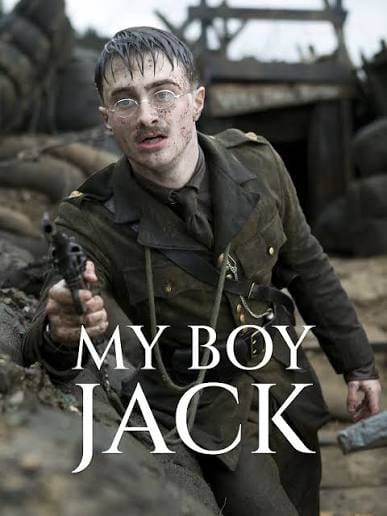
My Boy Jack (2007)
Director: Brian Kirk
We all know of Rudyard Kipling. We literally grew up listening to stories about Mowgli, Sher Khan and Baboo in the 'Jungle Book'. As we grew older (and wiser), we began to see another side to his writings. The poem 'The White Man's Burden' revealed his rather dark thoughts. He opined that the white race had a moral duty to civilise the natives. He pinned this legitimacy seal to imperial powers to advance their colonising ambitions.
As World War I drew closer, Kipling was busy pushing for Britain to mobilise its forces to fight the Germans for their invasion of Belgium. He was vehemently loud in the speeches that he prepared for Britain's propaganda messages to its citizens.
Naturally, his only son, his 17-year-old John, took up the idea of enrolling in the Navy. Rudyard had two daughters before John; the elder of them died young with pneumonia.
Now, the problem is that John keeps failing his medical entry examinations into the Navy and Army because of his shortsightedness. Wearing glasses is considered a liability and is automatically rejected.
Rudyard uses his influence to secure a place for John, not in the Navy, but in the Army. John starts his training with great difficulty but is eventually commissioned as a Second Lieutenant and later as a Lieutenant. He is much liked by his contemporaries. Unfortunately, in a gruelling trench war, just a few days after his 18th birthday, John is reported as missing in action at the Battle of Loos in France.
That uncertainty started the avalanche of emotions in the Kipling household. Months of enquiries and pestering the Army brought no closure. That led Rudyard to become active in the Imperial War Graves Commission (later renamed the Commonwealth War Graves Commission) to ensure that fallen British Empire heroes are given due recognition and are named, and that their graves are marked correctly. Only after three years, it became clear that John Kipling was shot by German gunfire after losing his glasses in the mud during an assault.
Rudyard Kipling, his wife and his remaining daughter spent the next years heartbroken. The Kipling heritage ended with him, as his daughter never had a child.
At the turn of the century, objections were raised as the Commission failed to honour the thousands of non-British soldiers, especially Indian warriors who took the bullet for their faux pas in Gallipoli. In 2026, it was announced that close to 10,000 names of fallen Indian soldiers under the banner of the British Empire were to be mentioned too.
A quite stirring story complemented by a sterling performance by Daniel Radcliffe of Harry Potter fame. Rudyard Kipling wrote a poem titled 'My Boy Jack' in 1916. Even though the poem mirrors his personal grief over the loss of a son, it was written as a prelude to his story 'Sea Warfare' about the Battle of Jutland. It was based on a celebrated fallen young naval hero, Jack Cornwell. John Kipling was never referred to as Jack in official documents, but was sometimes called Jack in the family.
Farouk Gulsara (asokansham@gmail.com) is a content creator under the Newswav Creator programme, where you get to express yourself, be a citizen journalist, and at the same time monetize your content & reach millions of users on Newswav. Log in to creator.newswav.com and become a Newswav Creator now!
The User Content (as defined on Newswav Terms of Use) above including the views expressed and media (pictures, videos, citations etc) were submitted & posted by the author. Newswav is solely an aggregation platform that hosts the User Content. If you have any questions about the content, copyright or other issues of the work, please contact creator@newswav.com.