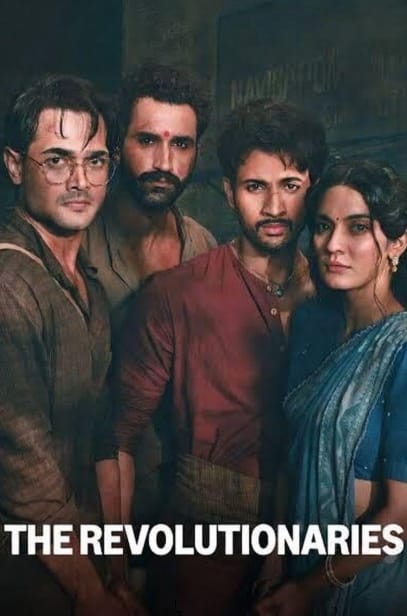
The Revolutionaries (Hindi, Miniseries, Season 1; 2026)
Director: Nikkhil Advani
We were taught that MK Gandhi and his brand of passive resistance eventually earned Indians their independence. The truth of the matter is much different from that. A British pro-India civil servant, Allan Octavian Hume, mooted the idea of a pan-Indian nationalist organisation in 1883. The Indian National Congress held its first session in 1885 in Bombay. Initially, like-minded individuals came together to propose reforms in British India. Over time, two factions began to emerge: the loyalists, who remained subservient to the British and at most wanted to be a Dominion of the British, and the nationalists, who were thinking along the lines of self-rule, Swaraj, and total independence.
A few events led nationalists to pursue a more violent path to achieve their ambitions. Initially, everyone agreed that non-cooperation against British legislation was acceptable. Pretty soon after, Indians were being harmed and instead were blamed for fighting back, as in the Moplah Rebellion; their paths diverged. Gandhi and his loyalists opted for satyagraha, while the nationalists became revolutionaries and turned to armed struggle.
This miniseries is probably the beginning of one of their stories. I reckon more seasons may follow. The miniseries is based on Sanjeev Sanyal's book 'Revolutionaries: The Other Story Of How India Won Its Freedom'.
We are often told that revolutionaries' attempts are all at the individual level and that the attacks are purely the work of lone wolves. In actual context, these attacks are carefully planned, with a wide network behind them. The network extends into major Indian towns like Benares, Calcutta, and Lahore, and into other countries including Britain, France, Italy, Russia, Persia, Ireland, Germany, Japan, the US, Thailand, and Singapore.
The first generation of Indian freedom fighters must surely be Vinayak Savarkar and Aurobindo Ghosh. Savarkar went on to study law in London and became involved in anti-colonial activities at India House. He was arrested and sent back to India to be charged. His journey back is another adventure altogether, an escape attempt from the ship transporting him, followed by his apprehension. He was jailed in Cellular Jail on Andaman Island, a frequent rendezvous for revolutionaries. Sachindra Sanyal was also sentenced to Cellular Jail twice, a record by itself. Aurobindo gave up armed resistance after a stint in the Andamans, but he contributed to the cause through his newspaper, Bande Mataram, and by trying to unify the masses through a religious path. Rabindranath Tagore did so through social awakening, cultural awakening and educational innovations.
Another subtle way to inculcate nationalist fervour among the people was through the old Indian practice of the gymkhana, for recreation and fitness. Here, youngsters practised bodybuilding, martial arts, and other necessary skills. They went by names like Anushilan Samiti. Secret societies with anti-colonial agendas evolved into groups such as the Jugantar Party, established by Ghosh and others.
The second wave of revolutionaries included Rash Behari Bose, Sachindra Nath Sanyal and Jatindranath Mukherjee. Mukherjee earned the nickname Bagha Jatin (Tiger Jatin) after killing a Bengal tiger with his bare hands. Tilak, Rai, Bal, Bhagat Singh and Netaji must have formed the subsequent wave.
This season mainly revolves around 1915 during World War 1 and follows the lives of Rash Behari Bose (not related to Netaji, but was his later contact in Japan), Sachindra Nath Sanyal (author's great-uncle), Pratibha Lahiri (Sanyal's wife) and Bagha Jatin (whose primary skill was organising revolutionaries under the guise of running recreational centres). Together they organised many underground rebellions against the colonial masters.
In this series, the villain appears to be General Dyer, who seems to be everywhere, foiling their efforts. He becomes infamous later with the Jallianwala Bagh massacre.
It starts with the 1912 foiled assassination attempt on Viceroy Lord Hardinge at Chandni Chowk in Delhi. The British were moving the imperial capital from Calcutta to Delhi, and the Viceroy was to attend the ceremony. Harbinger survived the homemade bomb but sustained many injuries that incapacitated him. Sanyal was the mastermind behind this attempt, but escaped captivity. Sanyal later founded the Hindu Republican Association/Army (HRA). This name shows how close the Indian revolutionaries were to the Irish freedom fighters, as their party was the Irish Republican Army (IRA).
Another point to note in Indian history is the massive migration of Indians, especially to the USA and Canada, in search of a better life through education and employment in the railways, agriculture and lumber industries. There was a media scare in British Columbia that the state would be 'overrun' by Indians. In reality, they were less than 1% of the local population. A key figure who spurred Indian nationalism in Canada and the USA through his writings was Lala Har Dyal Mathur, a polymath who earned a double scholarship to Oxford University but later migrated to North America. Disgruntled expatriates, students, and intellectuals started the Ghadar Party here in 1913. Its main aim was to end British rule in India.
The whites in Canada drafted ridiculous laws to curb the influx of Indians to their country. One of these laws required inbound passengers to travel to Canada on a single, continuous journey. The trouble was that no shipping line offered this service.
So, in May 1914, Gurdit Singh, a contractor from Malaya, chartered the Komagata Maru, an entire ship, from Japan to sail from Calcutta to Vancouver via Yokohama, carrying 340 Indians, mainly Sikhs. The Komagata Maru sparked an international standoff when authorities denied it permission to dock. After the Court of Appeal denied the request, Canadian authorities denied the passengers food and water and intimidated them with the Royal Canadian Navy; the Komagata Maru was sent back to Calcutta.
The Miniseries re-enacts the events that eventually took place at Budge Budge Ghat, 17 miles from Calcutta. The passengers were told to board a special train to Punjab. Most, if not all, of the vessel's passengers became sympathetic to the Ghadar Party's cause after the turmoil they had endured off the Canadian shores. The passengers insisted on marching to a gurudwara in Calcutta to deposit their holy book, the Grant Sahib. The book was apparently carried by Gurdit Singh himself, and in the melee that ensued, the barricades were breached, and 20 were killed; Gurdit escaped and went into hiding for almost 8 years. He later surrendered in 1921 after MK Gandhi appealed to him to do so. Baba Gurdit Singh stayed back and was martyred in India.
Another episode featured in this season is the failed attempt to procure arms from Germany. After getting into trouble with the law in the USA, Lala Har Dyal made a dash (jumped bail, actually) to Europe. He used his contacts to form the Berlin Committee, which the German Intelligence Bureau for the East supported and that helped sustain agitations in British colonies.
Bagha Jatin used his contacts to arrange the delivery of German arms to Indian shores. An elaborate plan was devised for SS Maverick to bring the shipment to Balasore in Odisha. Superior British intelligence foiled the plan. The British intercepted it. Jatin and his men were defeated, and he subsequently succumbed to his injuries.
The Ghadar movement was quite convinced that the British soldiers were exhausted by the Great War. The plan was to stage a 1857-like mutiny by Indian soldiers in the British Indian Army and take over the country. February 21, 1915, was set as the date to stage a pan-India takeover of the British Raj. Again, the whole plan was derailed with a little help from British intelligence, double agents and Indian turncoats.
The failure of the mutiny brought about further draconian laws which eventually led to the Jallianwala Bagh massacre. The masterminds behind the Ghadar Mutiny and the Budge Budge Massacre were tried in the 1915 Lahore Conspiracy Case Trial. Sanyal, a key figure in the Ghadar Conspiracy, escaped arrest and went underground. Rash Behari Bose escaped to Calcutta, then to Japan, under a pseudonym. In Japan, he married a Japanese woman and later laid the groundwork for the Indian National Army.
An engaging miniseries with high production value. I cannot wait for the next season.
Farouk Gulsara (asokansham@gmail.com) is a content creator under the Newswav Creator programme, where you get to express yourself, be a citizen journalist, and at the same time monetize your content & reach millions of users on Newswav. Log in to creator.newswav.com and become a Newswav Creator now!
The User Content (as defined on Newswav Terms of Use) above including the views expressed and media (pictures, videos, citations etc) were submitted & posted by the author. Newswav is solely an aggregation platform that hosts the User Content. If you have any questions about the content, copyright or other issues of the work, please contact creator@newswav.com.