
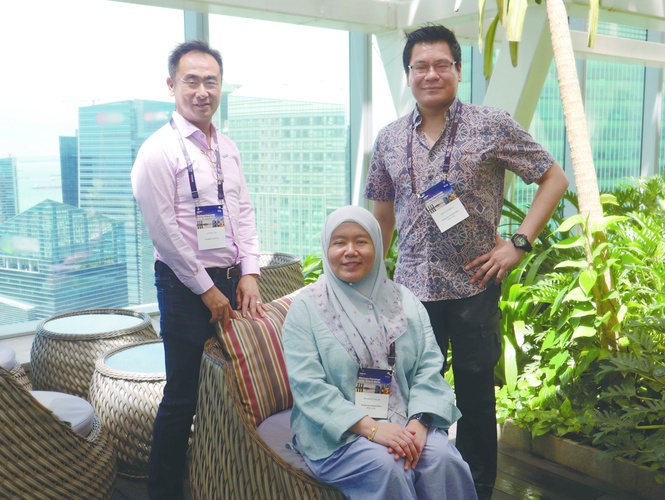
KUALA LUMPUR: nanoSkunkWorkX (nSWX), a Malaysian deep tech startup engineering performance-critical interfaces for advanced packaging, green hydrogen and rapid diagnostics, has raised US$2 million (RM8.1 million) in a seed round led by regional technology venture capital firm Tin Men Capital.
The startup engineers thin-film interfaces that improve how energy, heat and electronic signals move across the components in advanced devices and packaging.
Its lead product nSD-I meaningfully reduces heat while carrying more current in AI chip packaging, ultimately reducing AI inference, build, and operating costs.
nanoSkunkWorkX has built its core platform, three product lines, peer-reviewed semiconductor data and first revenue with less than US$1.5 million in cumulative external pre-seed capital.
The funding will move the startup into semiconductor partner qualification, scale the company’s interface-engineering process platform, advance hydrogen validation and diagnostic programmes across Asia, and support strategic hires.
nanoSkunkWorkX co-founder and CEO Iqbal Shamsul said the cost of building and operating AI infrastructure can be dramatically reduced through small efficiency gains at the process step level.
“For us, the opportunity lies in improving how the copper inside the packaging carries current, heat, and signals.
“This round will allow us to prove to industry partners just how transformative that small step can be,” he said.
As AI chip packages grow denser, their ability to carry more current and shed more heat has become increasingly critical to global compute supply.
nSD-I’s interface was designed to improve both without replacing copper or the surrounding manufacturing process.
Peer-reviewed work has shown that nSWX’s graphene-copper films can move heat across their surface more than twice as effectively as the copper baseline.
Follow-up tests also found that the material retains its performance advantage after use in pre-qualification test components, presenting a promising case for reducing throttling and cooling overhead, improved compute per watt, and lower AI inference costs.
In green hydrogen, nanoSkunkWorkX is improving charge transfer and reducing reliance on platinum-group metals.
In diagnostics, their work is advancing through joint R&D with US Navy Namru Indopac under a paid agreement for biosensors.
Co-founders Dr Amani Salim, a former Nasa principal investigator, and Iqbal Shamsul, an MIT-trained computer scientist and former Morgan Stanley commodities vice president, returned to Malaysia to build the company on the conviction that the country’s materials base, manufacturing depth, and sovereign appetite for deep tech could support genuine frontier hardware work.
Malaysia handles around 13% of the world’s chip assembly, testing, and packaging and ranks as the sixth-largest semiconductor exporter.
Through its Dana Impak mandate, Khazanah Nasional Bhd has made an initial RM1 billion allocation for strategic investments, including in AI and semiconductor technologies.
“At scale, performance breaks at the boundaries between materials. Heat, charge, and signals concentrate where one material meets another, and that is where many critical losses in modern systems occur.
“Our thesis is that improving a small, critical interface can unlock much larger system gains while preserving the materials, equipment and manufacturing base already around it,” said Dr Amani, who is also the chief technology officer.
Tin Men Capital co-founder and managing partner Jeremy Tan said the company has spent considerable time in Malaysia’s tech ecosystem and is delighted to make its first investment in a startup like nanoSkunkWorkX.
“This is a rare team that understands the physics, has built with exceptional capital efficiency, and engages customers at the senior technical level required to actually deploy.
“The backing assembled across Malaysia and Singapore shows what regional capital can do for frontier technology emerging from Southeast Asia,” he said.
nanoSkunkWorkX was selected for the inaugural SemiconStart Malaysia cohort, led by MTDC with Silicon Catalyst UK, to advance package qualification and access to the global semiconductor industry.
The company was also a finalist in the Baker Hughes Energy Ideas Generation Program Apac in 2025.
