
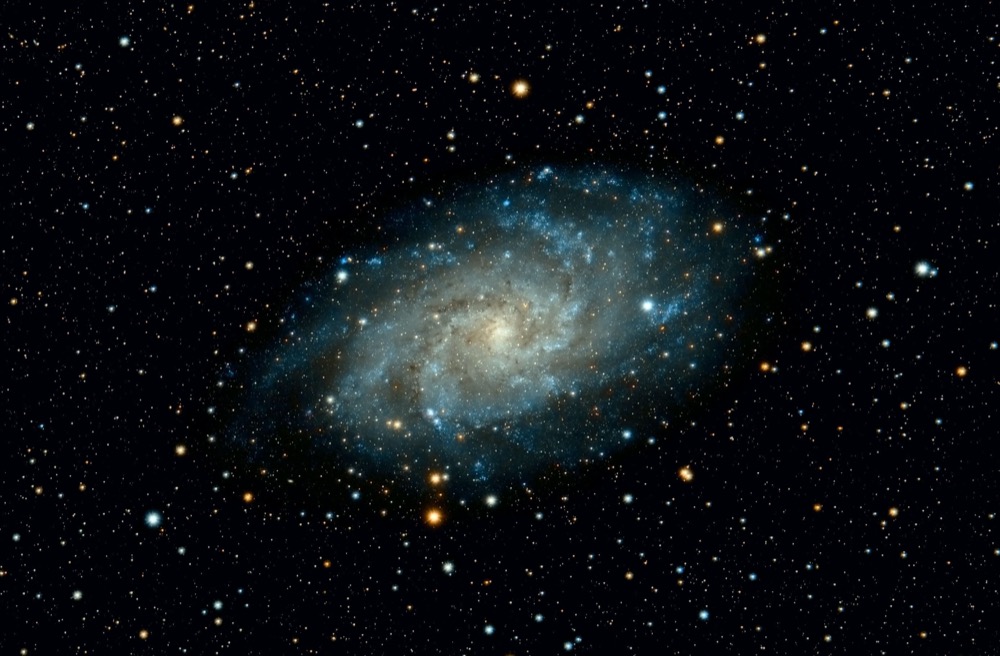
A remarkable new image released by NASA offers one of the clearest views yet of Messier 64, better known as the Black Eye Galaxy, a spiral galaxy famous for both its striking appearance and its unusual behavior. By combining observations from the James Webb Space Telescope and the Hubble Space Telescope, astronomers have created a detailed portrait that exposes a rare cosmic phenomenon: different regions of the galaxy are rotating in opposite directions. The image provides a fresh look at a system that may still carry the scars of a dramatic galactic encounter that occurred more than a billion years ago.
A Galaxy Unlike Most Others In The Universe
At first glance, the Black Eye Galaxy appears to be a relatively ordinary spiral galaxy. Located roughly17 million light-years from Earth in the constellation Coma Berenices, it has long attracted the attention of astronomers because of the dark band of dust near its bright nucleus, a feature that gives the galaxy its distinctive nickname. Yet beneath this visually striking appearance lies a far more intriguing story. Unlike the overwhelming majority of spiral galaxies, Messier 64 exhibits a rare internal motion pattern that has puzzled researchers for decades.
Gas located in the outer portions of the galaxy rotates in the opposite direction from the gas and stars found closer to the center. This unusual arrangement creates a dynamic environment where different regions of the galaxy follow conflicting paths around the galactic core. Such behavior is exceptionally uncommon and offers valuable clues about the events that shaped the galaxy’s history. The latest observations reveal these structures with extraordinary clarity, allowing astronomers to study the consequences of this cosmic anomaly in greater detail than ever before.
Webb And Hubble Combine Their Strengths
The newly released image showcases the power of combining data from two of humanity’s most advanced space observatories. The James Webb Space Telescope observed Messier 64 at near-infrared and mid-infrared wavelengths, enabling scientists to peer through clouds of dust and reveal structures that are often hidden from visible-light observations. Meanwhile, the Hubble Space Telescope contributed data collected in ultraviolet, visible, and near-infrared light, highlighting different populations of stars and energetic regions throughout the galaxy.
Together, the two observatories provide a more complete view of the Black Eye Galaxy than either could achieve independently. The resulting composite image captures both the intricate dust lanes and the distribution of stars across the galaxy, creating a multidimensional portrait of its structure and evolution. By examining the galaxy across multiple wavelengths, researchers can trace how gas, dust, and stars interact over time, helping them reconstruct the sequence of events that produced its unusual rotational behavior.
NASA Highlights Evidence Of An Ancient Galactic Merger
According to NASA, the most likely explanation for the Black Eye Galaxy’s contradictory rotation involves a long-ago collision with a smaller companion galaxy. Astronomers believe that more than a billion years ago, Messier 64 may have absorbed a satellite galaxy whose material was orbiting in a different direction.
As the merger unfolded, gas from the smaller system became incorporated into the outer regions of the larger galaxy. Rather than aligning perfectly with the existing rotation, some of this material retained its original motion, creating the counter-rotating structure observed today.
Galactic mergers are common throughout the universe and play a major role in shaping the evolution of galaxies. What makes Messier 64 particularly valuable to researchers is that it preserves visible evidence of this process long after the event occurred. The galaxy serves as a natural laboratory where scientists can examine how mergers influence star formation, redistribute gas, and alter the long-term dynamics of galactic systems.
What The Black Eye Galaxy Can Teach Us About Cosmic Evolution
The significance of these observations extends far beyond a single galaxy. Understanding how systems like Messier 64 evolve helps astronomers refine broader models of galaxy formation across the universe. Counter-rotating structures provide direct evidence that galaxies are not static objects but rather dynamic systems constantly reshaped by interactions with their surroundings. Every merger, collision, or gravitational encounter leaves behind signatures that can remain detectable for billions of years.
The Black Eye Galaxy demonstrates how those signatures can survive across vast stretches of cosmic time. By studying galaxies with unusual internal motions, scientists gain insight into the mechanisms that govern the growth of galaxies and the distribution of matter on large scales. As observatories such as Webb continue to deliver increasingly detailed observations, researchers expect to uncover more examples of these complex interactions, helping to build a clearer picture of how galaxies transform throughout the history of the universe.
A Rare Window Into A Billion-Year-Old Cosmic Event
The new composite image of Messier 64 is more than a visually stunning portrait of a distant spiral galaxy. It is a record of a dramatic event that likely reshaped an entire galactic system over a billion years ago. Through the combined capabilities of Webb and Hubble, astronomers can now examine the lingering consequences of that encounter with unprecedented precision.
The Black Eye Galaxy remains one of the most compelling examples of how past collisions continue to influence galaxies long after the original impact has faded. Each new observation adds another piece to the puzzle, revealing a universe where even seemingly stable galaxies can conceal histories marked by upheaval, transformation, and extraordinary complexity.