
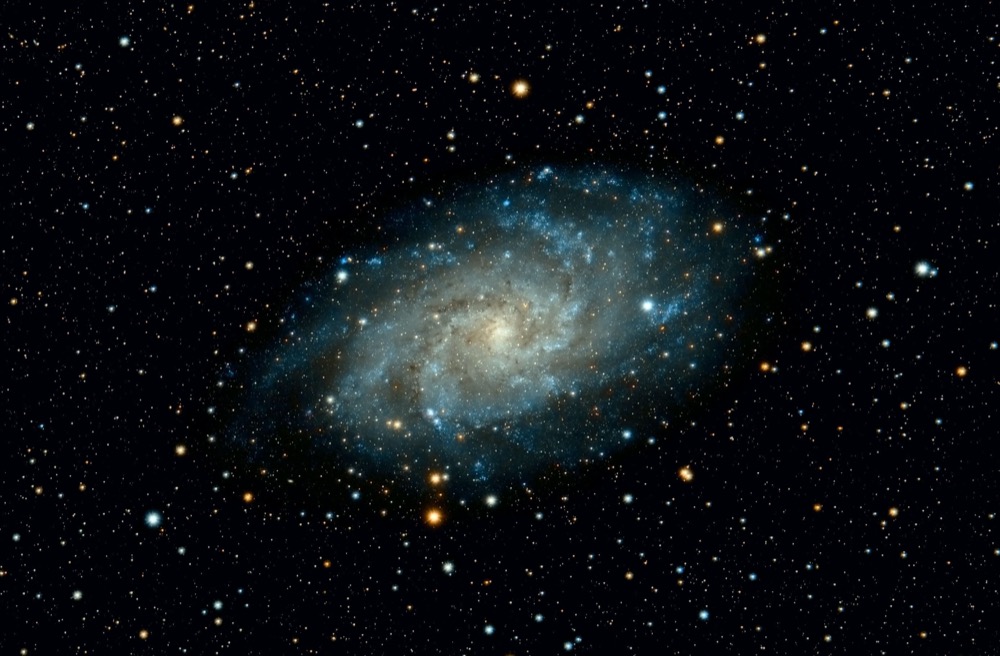
NASA’s upcoming Nancy Grace Roman Space Telescope has crossed one of its last major hurdles before launch. According to NASA, engineers have completed the final inspection of the observatory’s massive primary mirror, confirming that the centerpiece of the mission remains flawlessly aligned and free of defects. The achievement keeps Roman on schedule for an early September launch and marks a pivotal moment for a telescope expected to deliver some of the most expansive views of the cosmos ever captured.
A Defining Moment For NASA’s Next Great Observatory
Inside NASA Goddard Space Flight Center in Greenbelt, Maryland, engineers recently carried out the last direct visual inspection of the Roman observatory’s primary mirror before the telescope begins its journey toward space. The 7.9-foot (2.4-meter) mirror is the heart of the mission, responsible for gathering and focusing faint light from galaxies, stars, and other distant cosmic structures across the universe. To conduct the inspection, the observatory was carefully rotated onto its side and its protective launch hood was deployed, allowing specialists to examine the optical system in remarkable detail.
The process was designed to ensure that no particles had settled on the mirrors during testing and that the coatings, surfaces, and alignments remained exactly as required. For the team that has spent years developing the telescope, the inspection represented far more than a routine technical procedure. It marked the transition from assembly and testing to launch preparation, bringing one of NASA’s most anticipated astronomy missions into its final phase.
“The Roman engineering team laid eyes on the telescope for the final time before it, in turn, becomes the eyes of humanity, revealing the wonders of the cosmos,” said J. Scott Smith, the Roman telescope manager at NASA Goddard. “It is a profoundly humbling moment to witness the culmination of hard work from so many dedicated individuals, teams, and partner organizations, including L3Harris.”
The Extraordinary Precision Behind Roman’s Mirror
The success of Roman depends on an optical system engineered to operate at an astonishing level of precision. Engineers used specialized inspection techniques to verify that every optical element remained perfectly aligned following extensive environmental testing, including vibration and shake tests designed to simulate launch conditions. Among the most important checks was confirming that the path of incoming light remains precisely directed toward the telescope’s Wide Field Instrument detector array. Any deviation, even at microscopic scales, could compromise the quality of scientific observations once the spacecraft reaches orbit. To support this effort, the team relied on advanced imaging equipment capable of capturing extremely detailed views of the mirror and surrounding optical components.
“We developed a method of using a high-resolution camera equipped with a very powerful zoom lens to do a multi-purpose inspection,” said Bente Eegholm, optics lead for Roman’s Optical Telescope Assembly at NASA Goddard. “The mirror passed with flying colors, keeping the mission on track for an early September launch.”
The results confirmed that the optical assembly remained in excellent condition after testing, reinforcing confidence that the observatory is ready to proceed toward launch operations. For a mission designed to detect subtle cosmic signals across immense distances, maintaining this level of optical accuracy is fundamental to achieving its scientific goals.
Why This Mirror Is Unlike Any Other
Roman’s primary mirror combines advanced materials engineering with extraordinary manufacturing precision. Its reflective surface is coated with a layer of silver less than 400 nanometers thick, roughly 200 times thinner than a human hair. The choice of silver is deliberate, maximizing reflectivity in the near-infrared wavelengths that Roman will use to study the universe. This approach differs from other iconic observatories. The Hubble Space Telescope relies on aluminum and magnesium fluoride coatings optimized for visible and ultraviolet observations, while the James Webb Space Telescope uses gold-coated mirrors to enhance performance at longer infrared wavelengths.
The mirror’s surface quality is equally remarkable. Engineers report that the average bump across its polished surface measures only 1.2 nanometers in height, making it more than twice as smooth as mission requirements demand. To put that figure into perspective, if the mirror were scaled up to the size of Earth, those imperfections would rise only about a quarter of an inch above the surface. The mirror is also manufactured from a specialized ultralow-expansion glass that resists deformation as temperatures change dramatically between Earth and the cold environment of space. Preserving the mirror’s shape is essential because even tiny distortions could blur images and reduce the telescope’s ability to make highly sensitive measurements.
“In order to gather very sensitive measurements of objects strewn throughout space, all of Roman’s components have to be ultraprecise,” Eegholm said. “The primary mirror certainly delivers on that precision.”
Preparing For Launch And A New Era Of Discovery
With the inspection complete, attention is now shifting toward the final stages of mission preparation. According to NASA, the observatory will soon be shipped to Kennedy Space Center in Florida, where launch processing activities will begin ahead of its planned early September liftoff. Once in space, Roman is expected to provide sweeping panoramic views of the universe that complement and expand upon the discoveries made by Hubble and Webb. Its powerful wide-field capabilities will allow astronomers to survey vast regions of space with unprecedented efficiency, helping scientists investigate dark energy, search for exoplanets, and map large-scale cosmic structures.
The completion of the optical system represents one of the most significant milestones in the mission’s development. Years of engineering, testing, and refinement have now produced a telescope capable of tackling some of astronomy’s biggest unanswered questions. For the team that brought Roman to this point, the successful inspection serves as confirmation that the observatory is ready for the challenges ahead.
“We’re really proud of the amazing optical system we’ve delivered for the Roman mission alongside our partners at L3Harris,” said Josh Abel, lead Optical Telescope Assembly systems engineer at NASA Goddard. “Now that it’s assembled, aligned, and all shined up, we’re ready to go.”