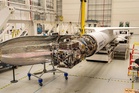
Nasa has given up on trying to save a troubled space telescope and it will now plunge back down to Earth.
The Swift Observatory has been slowly sinking out of its orbit, but Nasa said that attempts to push it back up had failed and that it will instead burn up in the atmosphere.
Nasa and Katalyst Space Technologies announced the news more than a month after the startup's Link spacecraft rocketed away to the telescope's rescue.
Katalyst said Link will not attempt to capture Swift and boost it to a higher orbit because of problems with controlling the spacecraft. NASA said this means the telescope will plunge through the atmosphere after more than 20 years of tracking some of the biggest explosions in the universe like gamma ray bursts and exploding stars. Its demise is not expected before October.
NASA paid $30 million to Katalyst in an attempt to raise the telescope to a safer, longer-lasting orbit. Intense solar activity caused it to lose altitude faster than expected. The rescue spacecraft went into an uncontrollable spin a few weeks after its liftoff in early July. While flight controllers managed to slow Link's tumble, issues continued to plague its pointing and positioning in orbit.
“This is not the outcome we were working toward, but it does not change why this mission was worth attempting,” Nasa Administrator Jared Isaacman said in a statement.
As a consolation prize, Katalyst will continue to operate Link in proximity with the telescope to demonstrate capabilities for future rescue operations.
Katalyst chief executive Ghonhee Lee said it was an ambitious mission on an aggressive timeline that was thrown together in under a year.
“We took on this high-risk, high-reward challenge and are proud of the milestones we reached along the way,” Lee said in a statement. “We have already learned a tremendous amount.”
Launched in 2004, Swift's science instruments were turned off earlier this year to slow its descent. It was orbiting 214 miles (345 kilometers) high as of Wednesday. Katalyst had hoped to lift the telescope back to its original orbit of 373 miles (600 kilometers), allowing for many more years of cosmic observations.
Nasa’s Hubble Space Telescope could benefit from an orbital boost and had been next in line for a rescue attempt had this mission gone well. The 36-year-old Hubble is also dropping in orbit because of all the sun's recent outbursts. It wasn't immediately known whether Hubble is now out of luck.
Additional reporting by agencies
Read MoreChina to launch a Moon mission that is unlike anything NASA has done
NASA calls off rescue mission for falling space telescope
Nasa images show huge hole left by SpaceX rocket that slammed into the Moon