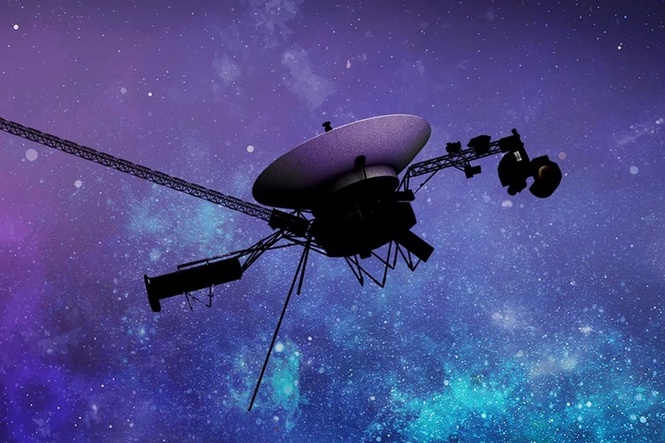
NASA’s Voyager 1 probe is believed to have reached a milestone achieved by nothing else ever created by humanity.
The probe is already further away from Earth than any other spacecraft. But it is now thought to have crossed another important distance, according to Nasa – though the space agency will not know for sure for about a day
Launched in 1977, the robotic probe was calculated by NASA to have reached a light-day from Earth – the distance that light travels in 24 hours – on Wednesday at 5:16 a.m. ET (10:16 GMT). It equals roughly 16 billion miles (26 billion km).
However, officials at NASA's Jet Propulsion Laboratory, California, will need to wait around a day to receive a signal from the probe, confirming it has reached this distance.
They have scheduled an event for Thursday to discuss the milestone.
Voyager project manager Suzanne Dodd said: "Reaching one light-day is an astounding feat, one that I never expected to see.”
Voyager 1, the most distant human-made object, is flying at almost 38,000 miles per hour (61,000 kph).
It crossed the outer edge of the heliosphere, a protective bubble of particles and magnetic fields produced by the sun, to enter interstellar space in 2012.
Its twin, Voyager 2, was also launched in 1977 and entered interstellar space in 2018.
A Jet Propulsion Laboratory representative said recent power-saving measures could give the two Voyager spacecraft enough power to stay in communication with Earth for three to four more years.
"But the goal of the mission is to do science, and there is enough power to keep the current suite of instruments going through the 50th launch anniversary next year. Beyond that is hard to predict, and of course these are nearly 50-year-old spacecraft, and there are always things the team cannot anticipate that might happen," the JPL representative said.
Voyager 1 journeyed past Jupiter and Saturn, the solar system's two largest planets, earlier in its mission. It continues to gather scientific data.
For example, its instruments have detected the faint monotonous hum caused by the constant vibrations of the small amounts of gas present in interstellar space.
"Voyager is sending back continuous measurements of magnetic fields, cosmic rays and of plasma waves that we receive on Earth whenever the Deep Space Network points its antenna at Voyager," Dodd said.
The Deep Space Network is NASA's international array of giant radio antennas supporting interplanetary spacecraft missions.
"After the heliopause crossing, the magnetic field direction did not rotate into the interstellar direction as expected, but has maintained the direction it had when both Voyagers crossed the heliopause, a direction governed by our sun. We are watching to see when that rotation might occur," Dodd said.
"We also are still observing effects from our sun, including strong solar storms like coronal mass ejections, that generate shocks and pressure fronts that reach as far away as Voyager 1 and beyond," Dodd said. "Where does the sun's influence end and pristine interstellar space begin? Perhaps Voyager may last long enough to answer that question."
Read MoreStarship launch today is ‘profound’ test for Nasa’s Moon mission
Astrophysicists discover the best locations for life in the universe