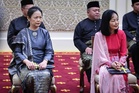
Kota Kinabalu: Former Chief Justice Tun Richard Malanjum called for political will by the Madani Federal Government to resolve Sabah’s longstanding illegal immigrant problem by resettling them in more economically vibrant peninsula.
Malanjum noted many large construction projects going on there that need labour but being met by hiring more and more foreigners.
He made the call when launching Session Court Judge Dr Melissa Chia Pui Fung’s book “Citizenship in Crisis: The Ripple Effect of the Undocumented Migrants in Sabah” at the State Library on Saturday.
Malanjum quoted the 2012 Royal Commission of Inquiry (RCI) on illegal immigrants in Sabah, which stated that political will is vital to resolving problems relating to citizenship and immigrants arising from Sabah’s infamous “Project IC” during a previous federal administration.
“This population was created, in large part, by decisions taken in Putrajaya decades ago for the benefit of parties headquartered there.
“It was a federal project. Yet it placed the entire human, fiscal and social burden on one state: the poorest state, Sabah.
“That is not merely unjust; it is the reason the problem is politically unsolvable, because Sabah bears the cost but has no power to fix it, and the Federal Government that has the power bears none of the cost.”Malanjum said there should be a national settlement in which those found eligible for lawful status are not automatically concentrated in Sabah but are, with proper incentives and by proper agreement, distributed across Malaysia in proportion to capacity, with the funding to match.
“A construction worker regularised under a federal scheme can work in Johor or Selangor as readily as in Tawau, and those economies are the ones that, in fact, absorb foreign labour by the millions.
He said Sabah has carried this problem alone for half a century and that sharing the burden is not radical. “It is what a federation is for.” He commended Dr Melissa for the book that was part of her PhD and called on MPs and assemblymen to read it, among others.
“Dr Melissa, thank you. You have done what a Royal Commission with all the powers of the Federation could not bring itself to do: you have said clearly what happened, what it has cost, and what should now be done. You have given us a reform agenda. The rest is on us.”Malanjum said simply issuing MyKads to them is not a solution; it would be akin to a second Project IC with better public relations.
“Nor is ‘send them all home’ a solution; for a child born in Semporna or Tawau to parents who arrived 40 years ago, there is no home to be sent to.
“Many of these people caught up in it (Project IC) were never actually made citizens at all.
“They were given receipts. Slips of paper that were good enough to cast a vote, and then good for nothing. But they stayed. They raised families. And their children, born on Sabah soil, now stand before our National Registration Department and our courts, unable to prove who they are.
“That is the ripple effect in the book’s title. A scheme that was designed to manufacture voters has, instead, manufactured a permanent underclass of stateless children.
“The people who profited from it have long since moved on. The people it damaged are still here, and they are our neighbours.
“The undocumented population of Sabah has never been a problem our politicians wanted to solve.
“It has been an asset they wanted to keep. Think about how this issue has been used. At election time, it is a threat: ‘Vote for us or the foreigners will take over’.
“Between elections, it is a bargaining chip: give us this Ministry, that allocation, and we will act. In Kuala Lumpur, it is a lever against Sabah’s demands for its rights under the Malaysia Agreement 1963.
“In Sabah, it is a stick with which each side beats the other for having been in power when the numbers grew. And, as the RCI heard in testimony, in its origins, it was a machine for changing who gets to decide who governs this State.
He said whatever the mechanism suggested in the book – A Truth and Reconciliation Commission, an independent tribunal, or a burden-sharing settlement – it must do three things the RCI did not.
“It must name what happened. It must produce a determinate legal status for every person, including the status of being lawfully removable.
“And it must be binding, so that no future government can un-solve it for electoral convenience. I said at the outset that almost no one in authority has been willing to finish this.
“Dr Melissa’s final chapter explains why she still has hope. She has met a new generation of Sabahans and she believes they are different. They did not create this problem.
“They have grown up beside the children of it. They are less interested in who is to blame.
“They are, in her words, willing to practise inclusion, under a clear legal framework and to seek genuine peace in Sabah.”Malanjum exhorted the younger generations of Sabah: “You are the ones who should take the RCI’s Notes of Proceedings off the shelf, and this book with you as well as Dr Chong’s (Eng Leong) publications and refuse to let them be forgotten.”He said according to the RCI, the resolution of this problem depends on political will. “Political will, in a democracy, is not something we wait for.
“It is something we manufacture, by making the cost of inaction higher than the cost of action, and by refusing to reward those who profit from leaving the wound open.
“A problem that is never solved is a problem that is always available. That is the political economy of this Mother of All Issues, and it is why Dr Melissa is right when she says the resolution can only begin when the political establishment takes responsibility for its own wrongdoing.” “Citizenship in Crisis” comprises 10 chapters and 208 pages built on actual court cases, the Notes of Proceedings of the Royal Commission of Inquiry, archival material from the Sabah Archives and the Sabah Government and field interviews that Dr Melissa and a team of volunteers conducted on the ground.