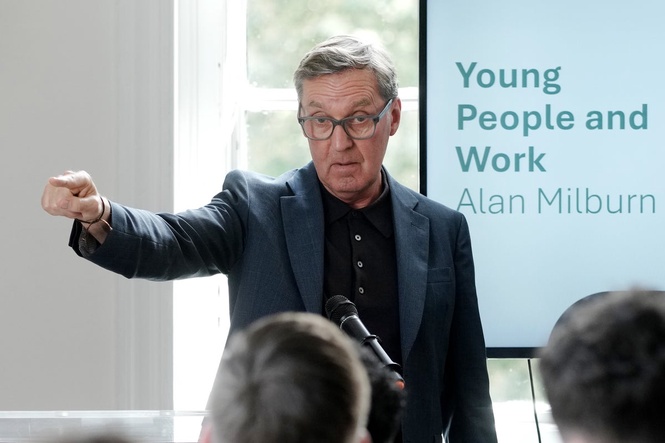
More than 450,000 teenagers and young adults could be affected if under-25s are no longer able to claim existing benefits for health and disability conditions, figures show.
Former Labour health secretary Alan Milburn is expected to propose that 16- to 24-year-olds should stop receiving personal independence payments (Pip) and the health element of Universal Credit (UC) in a government-commissioned review on youth unemployment on Tuesday.
Pip is the main benefit paid to someone who has a long-term physical or mental health condition or disability, and is intended to help with everyday tasks and extra living costs.
A total of 453,495 16 to 24-year-olds in England and Wales were entitled to receive Pip as of July 31 2026, according to the latest available figures from the Department for Work & Pensions (DWP). This is more than double the number when current data began in January 2019, which was 195,899.
There has been a steady rise in Pip claimants aged 16 to 24 for much of this decade.
The increase accelerated after the Covid-19 pandemic, with claimants jumping by 13 per cent in the year to July 2023 and by 14 per cent in the year to July 2024, before slowing to a rise of 11 per cent in the year ending July 2025 and 9 per cent in the latest 12 months.
Four in five of the 453,495 claimants who were under-25 in July 2026 had psychiatric disorders listed as their main disability (362,377 or 80 per cent).
More than a third of the total had autism spectrum disorders as their main condition (166,269 or 37 per cent), while nearly one in seven had the hyperkinetic disorders ADHD or ADD (59, 920 or 13 per cent).
The second benefit that could be removed from 16-24 year-olds under proposals in the Milburn review is the health element of universal credit (UC).
Universal credit is a payment to help with living costs and is available for people in work who are on low incomes, as well as those who are out of work or cannot work.
It is the main form of means-tested social security in the UK and replaced the mixture of benefits previously in place such as income support, jobseeker’s allowance, housing benefit and tax credits.
The health element of UC is an additional payment on top of the standard UC allowance and is for people who have limited capability for work and work-related activity.
A total of 257,987 16 to 24-year-olds in Britain were claiming UC health payments as of June 2026, DWP figures show.
Many of these people are also likely to be receiving Pip, as both benefits can be claimed at the same time.
As such, the two separate totals – for Pip and for UC health – should not be added together, as this will involve double-counting the same individuals.
The number of under-25s claiming health payments has increased over time, as more people were moved from the old benefits and on to universal credit, but has levelled off in recent months.
Of the 257,987 UC health claimants aged 16-24 in June, the vast majority – 240,734 – were listed as having a non-severe condition, while 17,257 had a severe condition.
Around four in five (210,193 or 81 per cent) had limited capability for work, or for both work and work-related activity.
Read MoreBurnham hits out at Brexit failure as crunch EU summit looms
Cut national insurance for under-25s to help tackle Neets crisis, Milburn to say
Forecasters warn of disruption as snow warnings set to come into force
All of the UK regions under snow weather warning this week
Scottish Tories urge Burnham to ‘ignore the growing noise’ and back Rosebank
Dublin riots: How violence unfolded after attack on children