
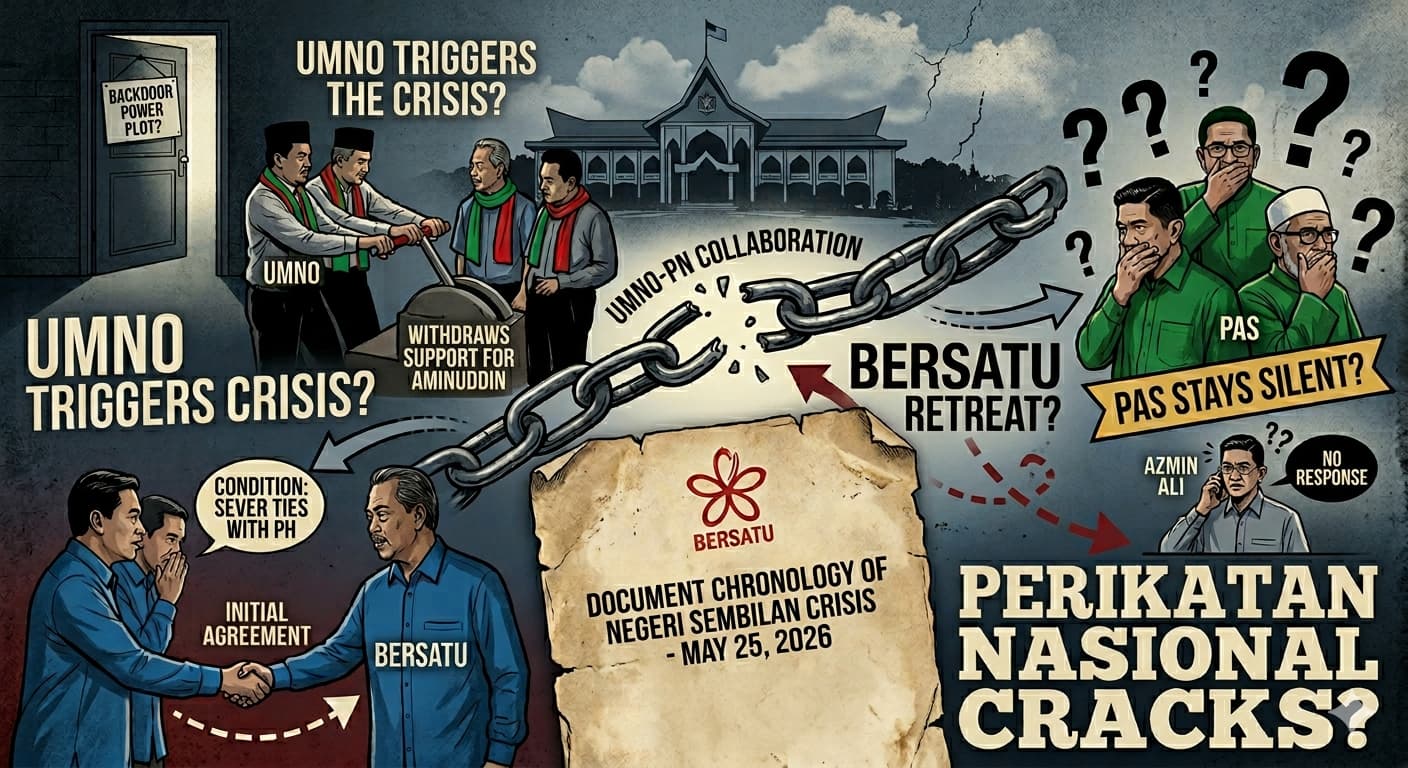
The political crisis that recently rocked Negeri Sembilan is turning into an increasingly complex saga, with a newly surfaced 13-page letter purportedly written by Bersatu president Tan Sri Muhyiddin Yassin raising uncomfortable questions about the roles played by Umno, Bersatu, and PAS.
The letter, reportedly addressed to PAS leaders and dated May 25, 2026, provides a detailed chronology of events leading up to the attempt to challenge the administration of Negeri Sembilan Menteri Besar Datuk Aminuddin Harun. More significantly, it suggests that discussions involving opposition parties and Umno took place well before the public fallout became visible.
According to the document, several rounds of meetings were held involving representatives from PAS, Bersatu, and Umno. One key meeting allegedly took place on April 24 at Bersatu headquarters, attended by PAS secretary-general Dato' Seri Takiyuddin Hassan, Bersatu secretary-general Dato' Seri Azmin Ali, and several state assemblymen from both parties.
The letter claims that discussions later expanded to include Negeri Sembilan Umno chief Datuk Seri Jalaluddin Alias and other Umno representatives. A strategy was reportedly agreed upon whereby Umno’s 14 assemblymen would first withdraw support for Aminuddin before PN’s five assemblymen publicly declared their position.
The reasoning behind the sequence was particularly revealing. The letter states that PN wanted to avoid accusations of orchestrating a “backdoor” takeover of the state government. By allowing Umno to make the first move, PN could position itself as merely responding to a political development rather than initiating one.
However, events took an unexpected turn.
Following Umno’s dramatic announcement on April 27 that its assemblymen no longer supported Aminuddin, PN publicly expressed its readiness to cooperate with the 14 Umno assemblymen to establish a new administration. At the time, the move appeared to signal a major political realignment in Negeri Sembilan.
Yet the alliance proved short-lived.
The letter reveals that Bersatu’s willingness to cooperate with Umno was never unconditional. The party maintained that any broader cooperation would only be possible if Umno severed ties with Pakatan Harapan. When reports emerged that the Umno assemblymen intended to remain aligned with the PH-led state government, Bersatu’s political bureau reportedly concluded that continued cooperation was no longer appropriate.
This triggered what critics may view as a political U-turn. Bersatu subsequently sought to withdraw support for the Umno assemblymen, arguing that the original premise for cooperation had fundamentally changed.
Perhaps the most intriguing aspect of the letter concerns PAS.
Muhyiddin’s account suggests that Azmin repeatedly contacted Takiyuddin to discuss Bersatu’s proposed withdrawal of support from the Umno bloc. However, despite several attempts and assurances that the matter would be discussed at PAS leadership level, Bersatu allegedly received no formal response.
That silence now sits at the centre of a growing debate within PN.
PAS president Tan Sri Abdul Hadi Awang has previously cited Bersatu’s withdrawal of support for the Umno assemblymen in Gemas and Labu as one reason his party was reassessing its relationship with Bersatu. Yet the letter appears to suggest that Bersatu had sought consultation and coordination before making its move.
The emerging narrative raises several political questions. Was Umno genuinely exploring an alternative government before reversing course?
Did Bersatu simply adapt to changing realities, or did it retreat from a bold political gamble? And perhaps most importantly, why did PAS remain silent when crucial decisions were being debated within the coalition?
As the correspondence between PAS and Bersatu comes under scrutiny, the Negeri Sembilan episode may become more than just a state-level controversy. It could expose deeper tensions within Perikatan Nasional itself, revealing competing strategies, communication breakdowns, and differing visions for how opposition politics should be conducted in Malaysia.
With Muhyiddin now expected to present PAS’s response to Bersatu’s Supreme Council, the next chapter of this political drama may determine whether the crisis strengthens the unity of the opposition bloc - or exposes fractures that are becoming increasingly difficult to conceal.
By: Kpost
Information Source:
Kpost (ckhorsk@gmail.com) is a content creator under the Newswav Creator programme, where you get to express yourself, be a citizen journalist, and at the same time monetize your content & reach millions of users on Newswav. Log in to creator.newswav.com and become a Newswav Creator now!
The User Content (as defined on Newswav Terms of Use) above including the views expressed and media (pictures, videos, citations etc) were submitted & posted by the author. Newswav is solely an aggregation platform that hosts the User Content. If you have any questions about the content, copyright or other issues of the work, please contact creator@newswav.com.
