
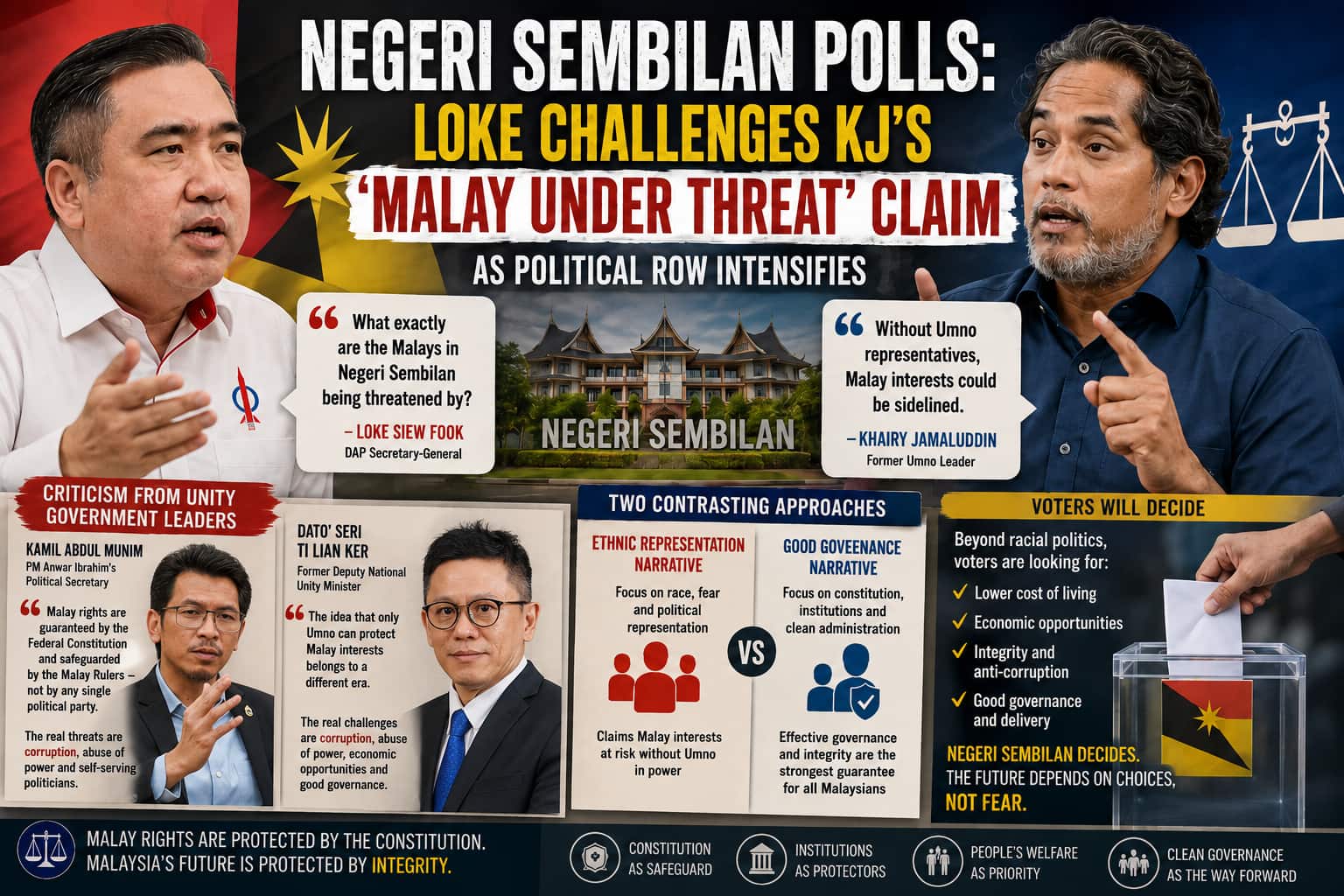
With the Negeri Sembilan state election campaign gathering momentum, a fresh war of words has erupted over the issue of Malay rights, highlighting how race-based narratives remain a central feature of Malaysian politics despite repeated calls for more policy-driven debates.
DAP secretary-general Loke Siew Fook has strongly challenged former Khairy Jamaluddin over his claim that the interests of Malays in Negeri Sembilan would be at risk under a Pakatan Harapan (PH) state government.
Questioning the basis of the allegation, Loke described the argument as an outdated political tactic designed to stir racial fears rather than address real issues affecting voters.
"What exactly are the Malays in Negeri Sembilan being threatened by?" Loke asked, pointing out that the state has been led since 2018 by Menteri Besar Dato' Seri Aminuddin Harun, who is himself Malay and has introduced various programmes aimed at improving the welfare of the Malay community.
Loke also expressed disappointment over what he described as Khairy's return to "old politics" after rejoining Umno earlier this year. He said Khairy had projected a more progressive image after leaving frontline politics in 2023 but appeared to have reverted to racial narratives upon his return to active politics.
The DAP leader further remarked that Khairy may have been away from Rembau for too long, suggesting that he was no longer familiar with developments on the ground.
The exchange began after Khairy urged Malay voters to support Barisan Nasional (BN) in the upcoming state election, arguing that Umno remained the strongest defender of Malay interests.
Speaking at a Seremban Umno Youth event, Khairy claimed the community had been "fortunate" that BN previously held 14 seats in the Negeri Sembilan state government. Without those Umno representatives, he argued, Malay interests could have been sidelined.
He also alleged that Aminuddin was "under the control of DAP" because DAP holds the largest number of seats among PH's component parties in the state assembly.
Khairy argued that while representatives from every community naturally fight for their respective constituents, Malay representation within the government would weaken if Umno's presence diminished.
The remarks immediately drew criticism from leaders within the Unity Government.
Prime Minister Dato' Seri Anwar Ibrahim's political secretary, Kamil Abdul Munim, rejected Khairy's argument, stressing that Malay rights are protected under the Federal Constitution and safeguarded by the Malay Rulers - not by any single political party.
Kamil challenged Khairy to identify which specific Malay rights had supposedly been eroded during Aminuddin's administration.
Instead, he argued that the greatest threats to Malays come from corruption, abuse of power and self-serving politicians rather than from political representation.
"The Malay rights that are truly under threat are those of corrupt Malays, project-hungry Malays and Umno Malays - not ordinary Malays in Negeri Sembilan," Kamil said.
He also criticised Khairy for abandoning what he had hoped would be a more progressive style of politics based on governance, performance and accountability.
According to Kamil, racial fearmongering distracts voters from more pressing concerns such as integrity, economic management and good governance. He cited the 1MDB scandal as an example of how corruption has caused greater harm to the country's reputation than any perceived threat arising from political representation.
Former deputy national unity minister Dato' Seri Ti Lian Ker also criticised Khairy's remarks, arguing that the idea that only Umno can protect Malay interests belongs to a different era.
Ti said Malaysia today possesses stronger institutions, a larger Malay middle class and constitutional safeguards that make such claims increasingly difficult to justify.
He further argued that Umno's decades of political dominance had contributed to excessive concentration of power, patronage and corruption, ultimately weakening public confidence in the party.
According to Ti, the real challenges facing Malays today are not political representation but corruption, abuse of power, economic opportunities and governance.
The latest exchanges suggest that despite repeated calls for campaigns centred on policy, cost of living and economic development, questions surrounding race and ethnic representation continue to dominate political discourse.
As Johor and Negeri Sembilan voters prepare to cast their ballots, the debate reflects two sharply contrasting campaign approaches: one emphasising ethnic representation as the key safeguard for community interests, and the other arguing that effective governance, constitutional protections and clean administration - not racial politics - offer the strongest guarantee for all Malaysians.
By: Kpost
Information Source:
Fmt , Malaysiakini , Malaysiakini
Kpost (ckhorsk@gmail.com) is a content creator under the Newswav Creator programme, where you get to express yourself, be a citizen journalist, and at the same time monetize your content & reach millions of users on Newswav. Log in to creator.newswav.com and become a Newswav Creator now!
The User Content (as defined on Newswav Terms of Use) above including the views expressed and media (pictures, videos, citations etc) were submitted & posted by the author. Newswav is solely an aggregation platform that hosts the User Content. If you have any questions about the content, copyright or other issues of the work, please contact creator@newswav.com.
