
KUALA LUMPUR: Negeri Sembilan remains in focus as the royal crisis deepens, with uncertainty growing over the legitimacy of the ruler’s position and the authority of the Undang Yang Empat amid an ongoing deadlock.
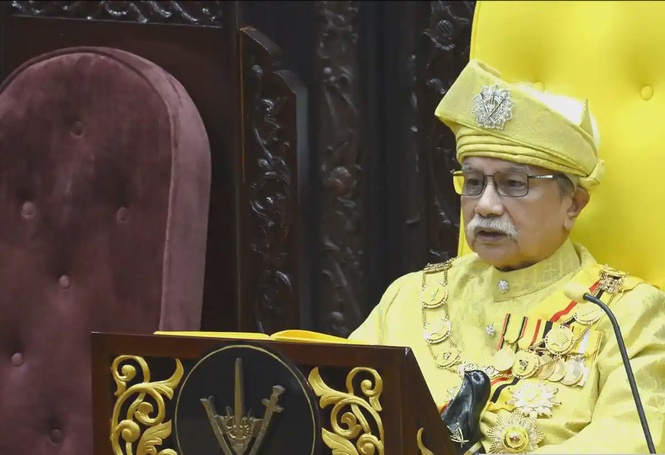
Despite calls by the state’s four ruling chieftains for the legislative assembly to be postponed, Yang di-Pertuan Besar Tuanku Muhriz Tuanku Munawir proceeded with the opening ceremony today, underscoring the constitutional impasse gripping the state.
The ceremony, however, quickly gave way to further uncertainty as the sitting was adjourned without a new date after the Undang Yang Empat boycotted the proceedings.
Their absence was conspicuous. Seats traditionally occupied by the chieftains flanking the ruler were left empty, breaking with long-standing convention.
In his royal address, Tuanku Muhriz said the absence of the Undang would not affect the legitimacy of the assembly, urging the government to continue functioning in the interest of public welfare and to act within the bounds of the law and established rules.
Outside the chamber, however, the deadlock appeared far from resolved.
A crisis without precedent
The standoff stems from an unprecedented move on April 19, when the four Undang declared that Tuanku Muhriz had been deposed over alleged “misconduct”, without publicly detailing the claims, and named Tunku Nadzaruddin Tuanku Ja’afar as his successor.
Menteri Besar Datuk Seri Aminuddin Harun swiftly rejected the declaration, setting the stage for a rare confrontation involving the state’s royal institution, its traditional custodians, and the elected government.
Complicating matters further is an unresolved dispute over the status of one of the Undang, Datuk Mubarak Dohak, whose earlier removal remains contested.
Legal pathways – and limits
Legal practitioners say that while an amicable resolution remains the preferred outcome, the crisis could ultimately be tested in court.
Former Malaysian Bar president Salim Bashir Bhaskaran said recourse may lie with the Special Court established under Article 182 of the Federal Constitution, which has jurisdiction over matters involving rulers.
“The Special Court is not part of the ordinary judicial hierarchy, but is specifically empowered to hear cases by or against rulers,” he told Twentytwo13.
He added that constitutional provisions also allow the ruler to seek judicial interpretation on questions arising from the Negeri Sembilan Constitution.
Such a move, however, would not be straightforward.
Lawyer Mohd Zainuddin Omar described the situation as a “deadlock”, noting that while a new ruler has been proclaimed, the incumbent has not vacated Istana Seri Menanti, and the Menteri Besar has declined to sign the required proclamation.
“The only way to break the stalemate,” he said, “may be for the Undang Yang Empat or the newly named ruler to seek a mandamus order compelling the Menteri Besar to sign.”
For Tuanku Muhriz, any legal challenge against the Undang’s decision would likely involve applying to quash the order, potentially through the Special Court or via judicial review in the High Court.
“But the complication,” Zainuddin added, “is that this matter involves Adat.”
He noted that courts have historically been reluctant to intervene in such questions.
The weight of custom
That tension between constitutional law and customary authority lies at the heart of the crisis.
Under Negeri Sembilan’s unique system, the Undang Yang Empat are empowered to appoint and remove the Yang di-Pertuan Besar, though that authority is not absolute.
Former Court of Appeal judge Datuk Seri Mohd Hishamudin Yunus has cautioned that any removal must comply strictly with due process, including a “full and complete enquiry” and adherence to principles of natural justice.
Questions remain as to whether such an enquiry was conducted, whether the ruler was informed of the allegations, and whether he was given an opportunity to be heard.
If due process was not followed, the validity of the proclamation could be called into question.
In an opinion piece published in The Edge today, Hishamudin also highlighted a separate issue – the participation of Mubarak in the decision-making process despite disputes over his status, which could raise concerns over bias and procedural integrity.
Separately, constitutional lawyer Malik Imtiaz Sarwar said the framework governing the removal of a ruler is designed to safeguard both the dignity of the institution and the stability of the state.
He noted that the Negeri Sembilan Constitution requires clear grounds, a formal enquiry, and proper procedure before any removal can take effect.
“The seriousness of such action demands a process that is transparent, fair, and consistent with the rule of law,” he wrote in a letter published by Free Malaysia Today, warning that any deviation risks undermining constitutional order and public confidence.
Not just a legal battle
Beyond the legal complexities, the crisis has exposed deeper institutional tensions.
Zainuddin said the Menteri Besar has no authority in the appointment or removal of the Yang di-Pertuan Besar or the Undang, underscoring the limited role of the executive in matters rooted in custom.
At the same time, the refusal to sign the proclamation has effectively stalled the process, leaving the state in a constitutional grey area.
Adding to the complexity is the alignment of key customary figures, including the Tunku Besar of Tampin and other traditional office holders, many of whom are seen as backing the Undang’s position.
“This is not just a legal challenge,” Zainuddin said. “It is also a question of institutional balance.”
What’s next?
For now, the path forward remains uncertain.
The possibility of court intervention remains, but legal experts caution that any judicial process would have to navigate the delicate intersection of constitutional law and Adat, an area where precedent is limited and sensitivities run deep.
Alternatively, a resolution may yet emerge through negotiation within the Dewan Keadilan dan Undang, the advisory body on customary matters.
What is clear is that the crisis has already tested the resilience of Negeri Sembilan’s hybrid system, where tradition and modern governance are meant to operate in tandem.
As Tuanku Muhriz reminded in his address, decisions must be guided not by emotion, but by law.
Whether the state’s competing centres of authority can converge on that principle may determine how, and how soon, this extraordinary chapter comes to a close.
Main image: Information Department Malaysia