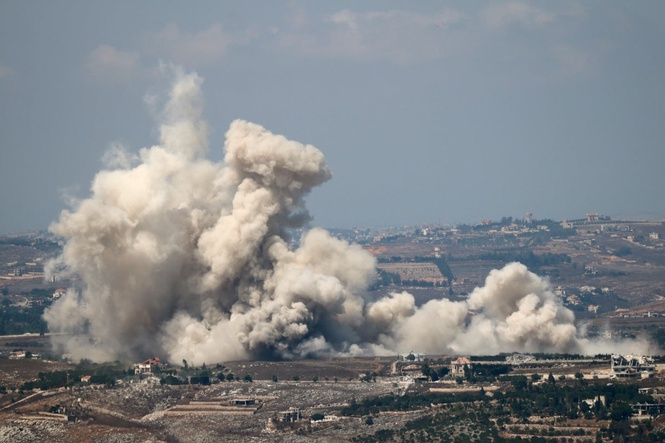
Promoted by its manufacturer as the next generation of ballistic rocketry, Lockheed Martin’s Precision Strike Missile has drawn billions in U.S. military funding to modernize American weapons.
However, a closer look at what’s thought to be its first use in combat, on the first day of the Iran war, underscores the grave risks of firing the long-range munition near populated areas, where it appears to disperse a cloud of deadly shrapnel across broad distances.
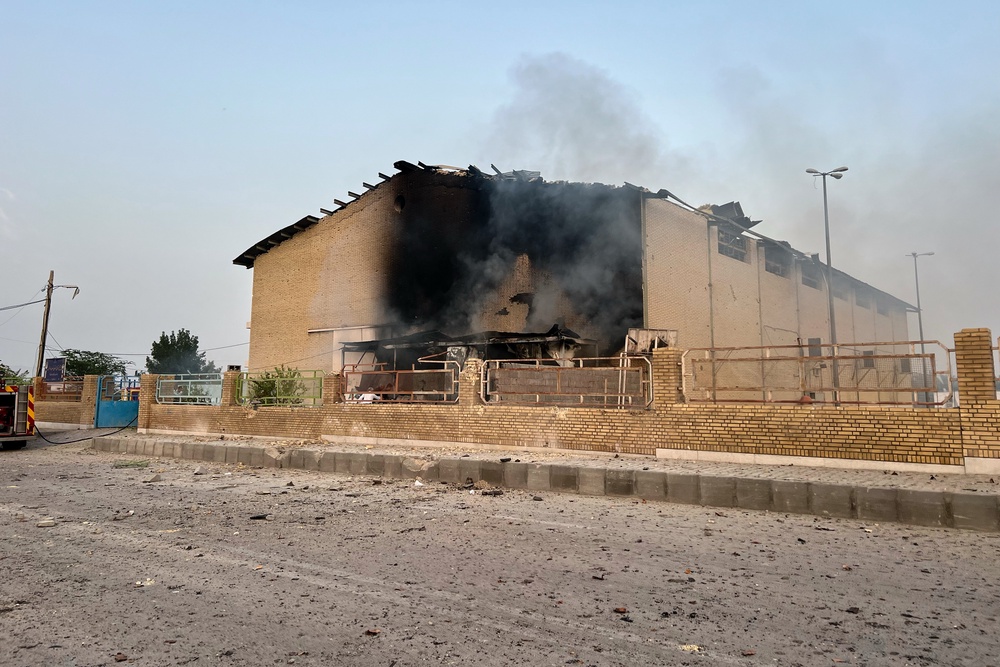
A review conducted by the conflict monitoring organization Airwars, alongside insights from defense analysts and former military personnel, indicates that three missiles hitting the southern city of Lamerd on Feb. 28 killed civilians as far as 164 feet (50 meters) from the points of airburst detonation.
Structural damage extended more than three times beyond that distance.
Detonating over an athletic center and two residential neighborhoods, the strikes claimed at least 21 people’s lives, among them seven children, according to figures provided by Iranian officials.
Airwars is the first body to map the casualty and damage perimeter of the Lamerd strikes while determining the weapon's effective lethal range.
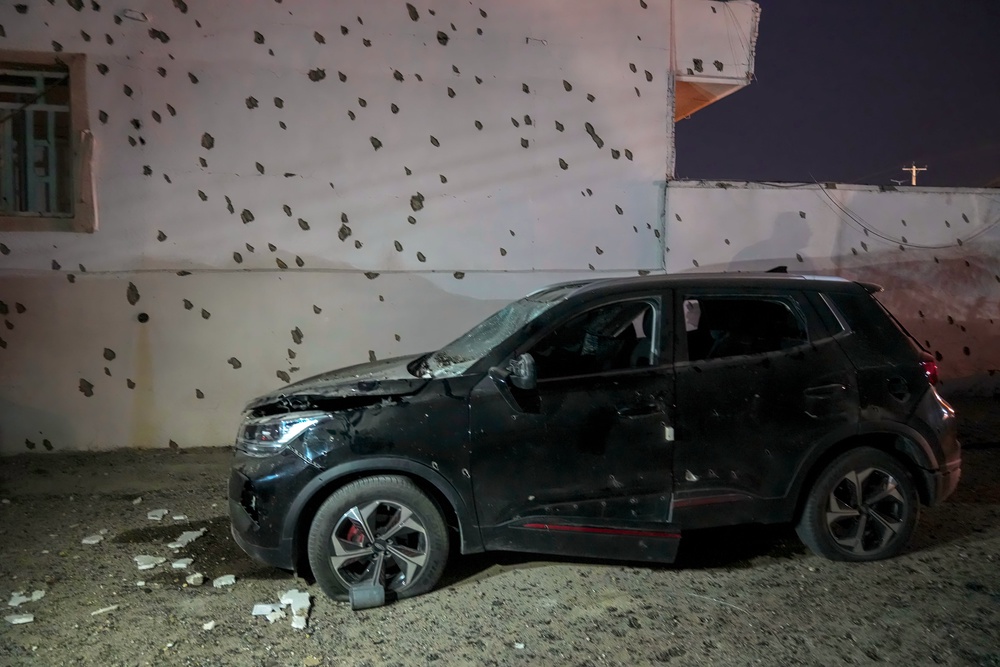
Engineered to explode in midair, the PrSM propels tens of thousands of dense metallic pellets at extreme velocity in every direction.
Visual evidence, including photographs, recordings, and orbital imagery analyzed by Airwars and cross-referenced by The Associated Press, reveals extensive surface pitting across structures, roads, and automobiles, reflecting a blast footprint that experts identify as signature to the PrSM's capabilities.
While American defense authorities have acknowledged launching PrSMs within Iran, they have explicitly rejected involvement in the Lamerd strikes.
The intended target in Lamerd remains unknown.
Although an Islamic Revolutionary Guard Corps facility stands in the vicinity, satellite imagery showed no signs of impact or structural harm there.
Six armament specialists, including two former military officers, informed AP that they assess PrSMs were responsible for the Lamerd strikes, deeming involvement by Iranian or Israeli munitions improbable.
All advised against deploying the system anywhere near noncombatant populations.
"You would be hard-pressed to find a reason to use the PrSM in a densely populated area," said Michael Meier, a former U.S. Army adviser on the laws of war.
Airwars, an independent watchdog based in London, was established over a decade ago to document noncombatant casualties resulting from American air operations in Syria and Iraq, subsequently expanding its scope to Gaza, Ukraine, and other conflict regions.
The group synthesizes open-source material, such as media reports, social posts, imagery, and security camera footage, using geolocation technology to evaluate evidence.
To reconstruct the Lamerd strikes, Airwars mapped projected airburst coordinates alongside reported civilian fatalities and visible blast degradation. By calculating the distances between these points, researchers estimated the weapon's lethal sphere.
AP validated these findings by comparing reported casualty locations against security camera footage of the midair explosions and examining satellite imagery.
Lockheed Martin, which did not respond to queries, has not published official blast radius specifications, though it previously released an animation depicting a PrSM detonation.
On March 1, the day following the Lamerd strikes, U.S. Central Command published a photograph on X showing what ordnance analysts identified as a PrSM launch during operations in Iran.
Three days later, CENTCOM announced that the weapon had seen its "historic first" operational deployment in the country, without specifying target locations.
As reports of the Lamerd fatalities gained international attention, a Central Command representative issued a statement asserting that U.S. forces did not fire PrSMs or other munitions into Lamerd on Feb. 28, adding that American forces do not target civilians.
The official suggested available video indicated an Iranian Hoveyzeh cruise missile was involved. Munitions experts disputed this assessment, noting the missile captured on local security footage lacked the rounded engine configuration characteristic of the Hoveyzeh model.
Israeli military officials stated to AP that their forces conducted no operations as far south as Lamerd on the war's opening day, while analysts noted Israel possesses no known midair-detonating missiles of this type. Confronted with the findings from Airwars and AP, CENTCOM reiterated its initial denial, citing an internal review. In May, Adm. Brad Cooper told Congress that military authorities were assessing only one case of civilian casualties linked to U.S. fire—a strike involving an Iranian school in Minab.
Developed to replace the Army Tactical Missile System used for decades, the PrSM offers extended range capabilities. While ATACMS reaches approximately 300 kilometers (186 miles), the PrSM can strike targets exceeding 499 kilometers (310 miles), according to Lockheed Martin.
The munitions also differ fundamentally in their warhead design. Unlike ATACMS, which releases steel casing fragments or submunitions, the PrSM discharges tens of thousands of tungsten pellets.
Despite its tactical advantages, defense experts urge restrictions on where the weapon is fielded.
"Its proper use should be reserved for things like large concentrations of enemy personnel with hard and soft armor," said Wes Bryant, a former Pentagon adviser on precision warfare and civilian harm mitigation.
Trevor Ball, a former explosives expert for the U.S. Army, also urged caution.
"It will kill people outside their homes who aren't protected by walls," he said.
Read MoreIsrael and Greece sign huge multi-billion-dollar ‘Achilles Shield’ weapons deal
US Patriot missile stocks in Europe ‘beyond critical’ due to Iran war, report says
Mapped: The UK military bases threatened by Russia
A 29-foot-tall Jesus could stop Trump’s relentless claims of eminent domain
Gina Hinojosa bets backlash over Flock cams and data centers will make her governor
Trump official blasts ‘name calling’ by Canada despite the president’s go-to attack