
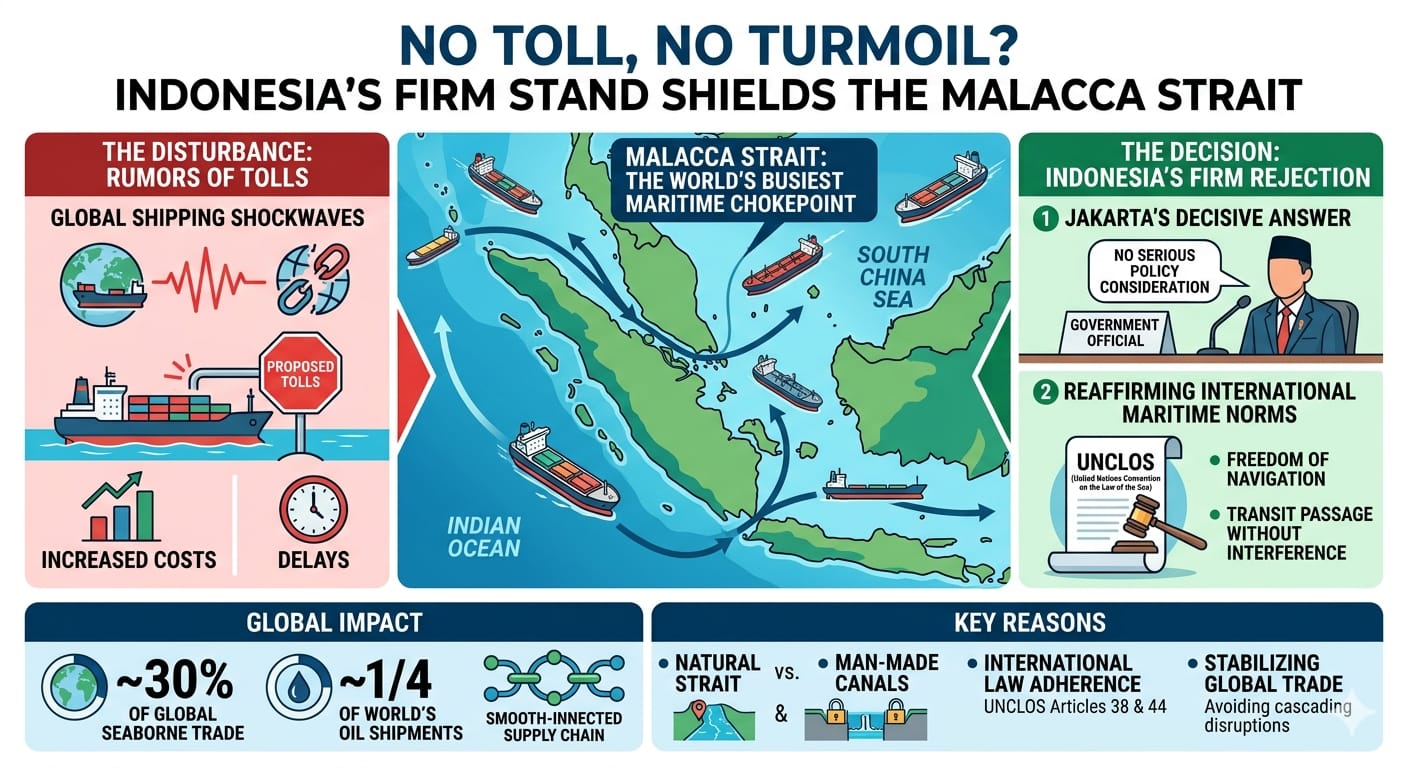
For days, a troubling question rippled across global shipping lanes: would Indonesia impose tolls on vessels crossing the Strait of Malacca, echoing geopolitical tactics seen elsewhere?
In an era already strained by conflict and economic fragility, even the suggestion of such a move sent tremors through diplomatic and trade circles.
Then came Jakarta’s decisive answer.
Indonesia has firmly rejected any plan to tax or charge transit fees for ships navigating one of the world’s busiest maritime chokepoints. Indonesia's Finance Minister Purbaya Yudhi Sadewa moved quickly to quash speculation, clarifying that the idea had never been a serious policy consideration. His statement not only restored calm but reaffirmed Indonesia’s commitment to long-standing international maritime norms.
At the heart of this decision lies the United Nations Convention on the Law of the Sea (UNCLOS), the legal backbone governing global waters. The convention enshrines the principle of freedom of navigation, ensuring that international shipping lanes - especially critical straits like Malacca - remain open and unobstructed. For Indonesia, a nation deeply invested in maritime sovereignty, adherence to UNCLOS is both a legal obligation and a strategic necessity.
The Strait of Malacca is no ordinary waterway. Stretching roughly 900 kilometers and linking the Indian Ocean to the South China Sea, it carries nearly 30% of global seaborne trade and about a quarter of the world’s oil shipments. Any disruption here would not merely inconvenience shipping - it would reverberate across energy markets, manufacturing hubs, and consumer prices worldwide.
Indonesia lawmakers such as TB Hasanuddin were quick to highlight a crucial distinction: unlike man-made canals such as Suez or Panama, the Malacca Strait is a natural maritime passage. Imposing tolls, therefore, would not only defy legal norms but risk diplomatic backlash and economic retaliation. Under UNCLOS provisions, particularly Articles 38 and 44, vessels are guaranteed the right of transit passage without interference - a principle that underpins the modern global trading system.
Indonesia’s Foreign Minister Sugiono reinforced this stance, emphasizing that the country will not, under any circumstances, violate international law by introducing tariffs in the strait. The message was unequivocal: continuity, not disruption, will define Indonesia’s maritime policy.
The broader implications of this reassurance cannot be overstated. With tensions already simmering in key chokepoints like the Strait of Hormuz, the global shipping network is under unprecedented strain. Any additional friction in the Malacca Strait could trigger a domino effect - delaying shipments, increasing insurance premiums, and pushing up global commodity prices.
Experts warn that the stakes extend beyond economics. Maritime scholar Nazery Khalid notes that disruptions in one corridor quickly cascade into others due to the deeply interconnected nature of global logistics. Ports such as Port Klang and Singapore, which rely heavily on smooth flows through both the Malacca Strait and Middle Eastern routes, are already feeling secondary pressures from geopolitical instability.
Similarly, industry voices like Datuk Dr Tony Chia Han Teu point to a growing “dual chokepoint pressure” as conflicts force vessels to reroute, adding up to two weeks in transit time and significantly raising freight costs. These compounding disruptions highlight just how fragile the global supply chain has become.
Against this backdrop, Indonesia’s decision is more than a policy clarification - it is a stabilizing signal. It reassures trading partners, calms markets, and reinforces ASEAN’s collective responsibility to keep vital sea lanes open.
Indeed, regional cooperation is now more critical than ever. Malaysia, Indonesia, Singapore, and Thailand - custodians of the strait - must resist any attempt to weaponise this strategic artery. The Malacca Strait is not merely a passage of trade, it is a lifeline of the global economy.
In a world increasingly defined by fragmentation and uncertainty, Indonesia’s firm stance offers a rare note of clarity. There will be no toll booths in the Malacca Strait - only the uninterrupted flow of global trade that keeps the world moving.
By: Kpost
Information Source:
Kpost (ckhorsk@gmail.com) is a content creator under the Newswav Creator programme, where you get to express yourself, be a citizen journalist, and at the same time monetize your content & reach millions of users on Newswav. Log in to creator.newswav.com and become a Newswav Creator now!
The User Content (as defined on Newswav Terms of Use) above including the views expressed and media (pictures, videos, citations etc) were submitted & posted by the author. Newswav is solely an aggregation platform that hosts the User Content. If you have any questions about the content, copyright or other issues of the work, please contact creator@newswav.com.