AS he nears the end of his nine-year tenure as United Nations secretary-general, António Guterres remains unwavering in warning the world against the normalization of the use of force.
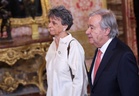
“The unlawful use of force is becoming normalized,” Guterres said last week after receiving an honorary doctorate from a university in Spain. “Borders are being redrawn by force of arms. Too many states take an à la carte approach to international law.”
During the opening of the UN Human Rights Council’s annual session in February, Guterres lamented that the “rule of law is being outmuscled by the rule of force,” and, as a consequence, “human rights are under a full-scale attack around the world.”
What appalls him is “this assault is not coming from the shadows or by surprise. It is happening in plain sight — and often by those who hold the greatest power.”
The jaded outlook is that force has long been wielded as a weapon by humans seeking to dominate others. It is the basic instrument of offensive or defensive aggression, a natural compulsion to attack or defend.
Analysts say that in the larger sphere of politics, the line between attack and defend has faded, creating a “security dilemma” in which a country is locked in a cycle of building weapons to defend itself against the threat of being attacked.
The UN Charter codifies the use of force by requiring member-states to refrain from using military action to annex territory, redraw borders, or forcibly overthrow a foreign government.
This global legal framework has been challenged and violated with increasing frequency, and international law is treated as a “mere inconvenience,” Guterres noted. When powerful states choose influence over legal adherence, it creates a climate of impunity where every unpunished violation opens the door to the next, destabilizing global cooperation and eroding trust between nations.
Guterres has criticized countries for applying double standards in abiding by the UN Charter. When they do, it is the civilian population that suffers the most.
Wars in Ukraine, Gaza, the West Bank, and Sudan have triggered humanitarian crises affecting millions of civilians. Localized conflicts can also severely affect the global economy, triggering worldwide supply-chain disruptions and food and energy crises.
Throughout his term, Guterres has looked into the UN’s internal mechanisms for solutions to arrest the normalization of the illegal use of force. He is convinced that the key lies in the Security Council.
The Security Council is the UN agency mandated by the UN Charter to call disputing parties to negotiate a settlement.
During its early decades, the council successfully negotiated an end to wars in a number of countries, the most serious of them in the Middle East.
Today’s conflicts are more difficult to resolve because of their geopolitical repercussions. The world’s superpowers — United States, China, and Russia — are deeply involved in local wars. They also happen to be the council’s dominant members. Each one wields the power of the veto, and can reject any initiative that runs counter to their interests.
The council’s permanent members have invoked the veto power more than 300 times, with Russia (and the former Soviet Union) leading the list.
The US has used the veto 93 times, most of them to block resolutions critical to its staunch ally, Israel.
The council’s power structure has calcified, with the same countries still holding court. Guterres wants to end the “old club” exclusivity and extend representation to the billions of people in Africa and Latin America.
“Power relations no longer correspond to the realities of the world,” he added.
“The Security Council is not a closed club,” one political observer said. “It is not a space reserved only for those who have more power.”
When the enforcement of international laws depends on the geopolitical interests of the elitists in the council, the prohibition on force wears down.
The new council must be expunged of “veto paralysis” and anchored instead on dialogue, balance and cooperation.
The need to reverse the trend toward the normalization of force cannot be overlooked. Guterres has put it plainly but emphatically: “It is more than past time to end the bloodshed.”