A North Carolina teenager is critically ill after being infected with a rare brain-eating amoeba commonly found in ponds, lakes and rivers.
Naegleria fowleri cases can result in a brain infection known as “primary amebic meningoencephalitis.” This causes severe headaches, fever, nausea, vomiting, stiff neck, seizures, a coma, and usually leads to death in around five days. Fewer than 10 people are infected each year in the U.S. but 97 percent die.
An investigation into the source of exposure is ongoing and the teen was not identified by state health officials.
No further information will be released to protect the privacy of the patient and their family, North Carolina’s Department of Health and Human Services said last week.
"While these infections are very rare, this is an important reminder that this amoeba is present in our state and across the U.S. There are steps people can take to reduce their risk of infection while swimming during the warmer months,” the state epidemiologist Dr. Zack Moore said in a statement last Thursday.
Lillian Smart, an eight-year-old from Louisiana, died earlier this month after she likely contracted Naegleria fowleri while swimming in a lake.
Infections typically occur when it’s been hot for prolonged periods of time. Most of the 157 cases diagnosed from 1937-2025 occurring in July and August, federal data shows.
North Carolina was recently threatened by another sweltering heat dome with triple-digit temperatures. Naegleria fowleri proliferates at higher temperatures, up to 115 degrees Fahrenheit.
Meteorologists have warned that more scorching heat is on the way to close out what may be the hottest American summer on record. These conditions are only expected to become more frequent and severe due to human-caused climate change.
Unfortunately, there is no way to eliminate the amoeba from the environment but there are steps people can take to stay safe during peak times.
Avoid entering warm fresh water, for one. Scientists have found the amoeba in recreational waters at several national parks, with the highest levels in Arizona and Nevada’s Lake Mead, Wyoming’s Grand Teton and Yellowstone.
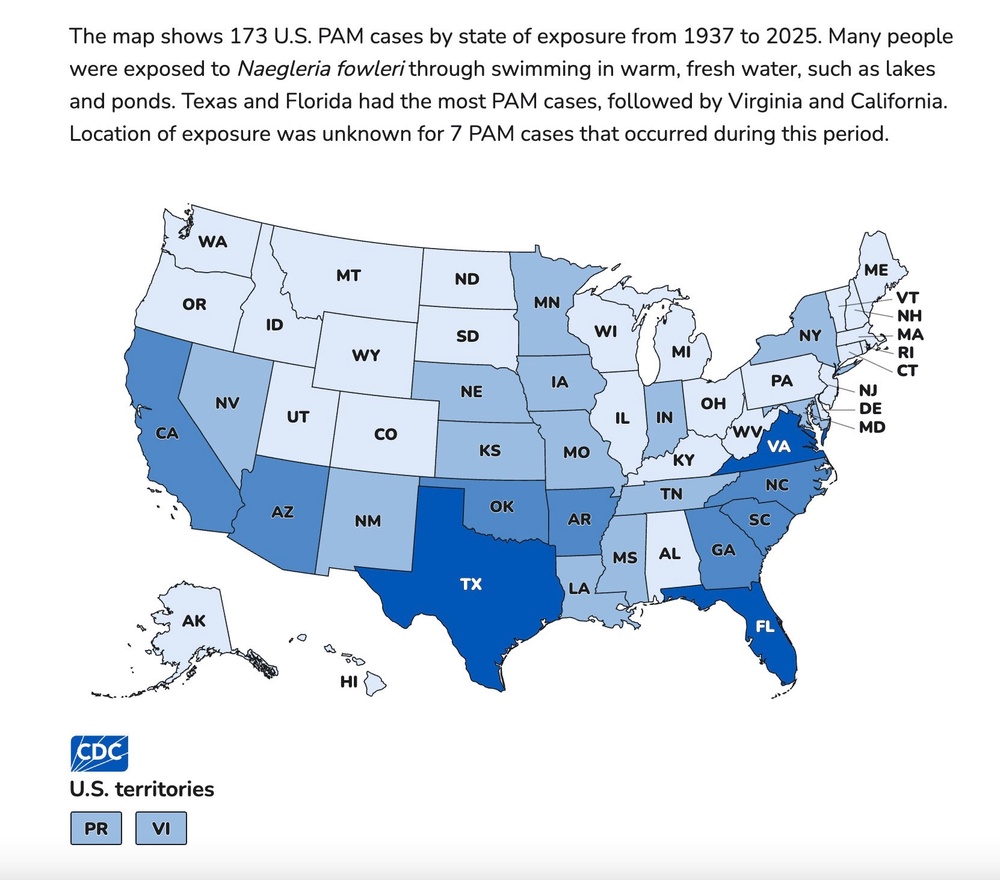
The majority of cases occur in the South and Mid-Atlantic, a U.S. Centers for Disease Control and Prevention map shows.
If you do go into freshwater, avoid dunking your head under or hold your nose before jumping in to prevent water rushing up your nose.
“The amoeba does not cause illness if swallowed but can be fatal if water with the amoeba in it is forced up the nose into the brain, which can occur by jumping into water, diving, water-skiing or other water activities,” health officials warn.
A new generation of elm trees could be equipped to beat the disease that killed the parents
Bank of England governor: AI risks forcing global economic downturn
United Arab Emirates says it has intercepted an Iranian drone over its territorial waters
I met the darkest parts of myself during postpartum psychosis
Gas station chain praised by Trump sold ‘stolen’ fuel, lawsuit claims
Iran’s Achilles Heel: Why Trump has his sights on the tiny oil hub Kharg Island