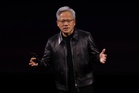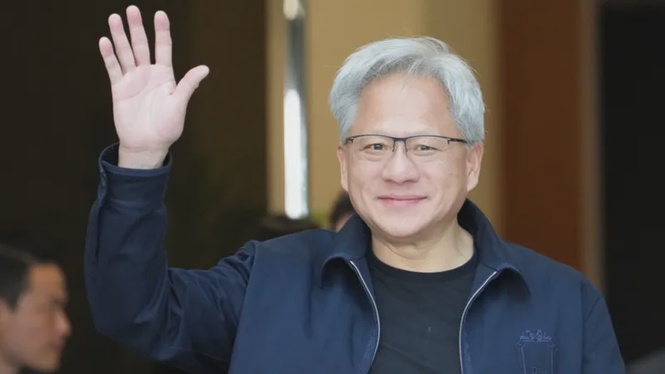
Nvidia's board has no plans to bring back co-founder Jensen Huang. The board's chair said so on November 17, hours after Huang said publicly that he would return as CEO if directors asked him to. The same day, the chipmaker reported quarterly results that beat Wall Street forecasts, its first without Huang in charge.
The two events show the pressure on the world's most valuable AI chip company. Its business is still growing very fast, but it now faces a leadership crisis, a widening set of investigations and new limits on its trade with China.
Huang Admits Serious Mistakes And Offers To Return
Huang, who was born in Taiwan and co-founded Nvidia in 1993, posted a personal statement on X on November 17, US time. It was his first public comment since Nvidia announced on November 12 that he had resigned as president, CEO and director with immediate effect. The resignation followed reports of extramarital relationships. One was with Alice Huang, a former executive at Singapore cloud company Megaspeed whom US intelligence officials reportedly suspect of working for China. The other was with a senior executive who reported directly to him. Alice Huang is not related to Jensen Huang.
"I did not live up to the standards expected of everyone at NVIDIA, and I have made serious mistakes in my personal life," he wrote. "I created problems for the Board that I deeply regret. I own my mistakes completely, and I am committed to cooperating with the Board's independent investigation."
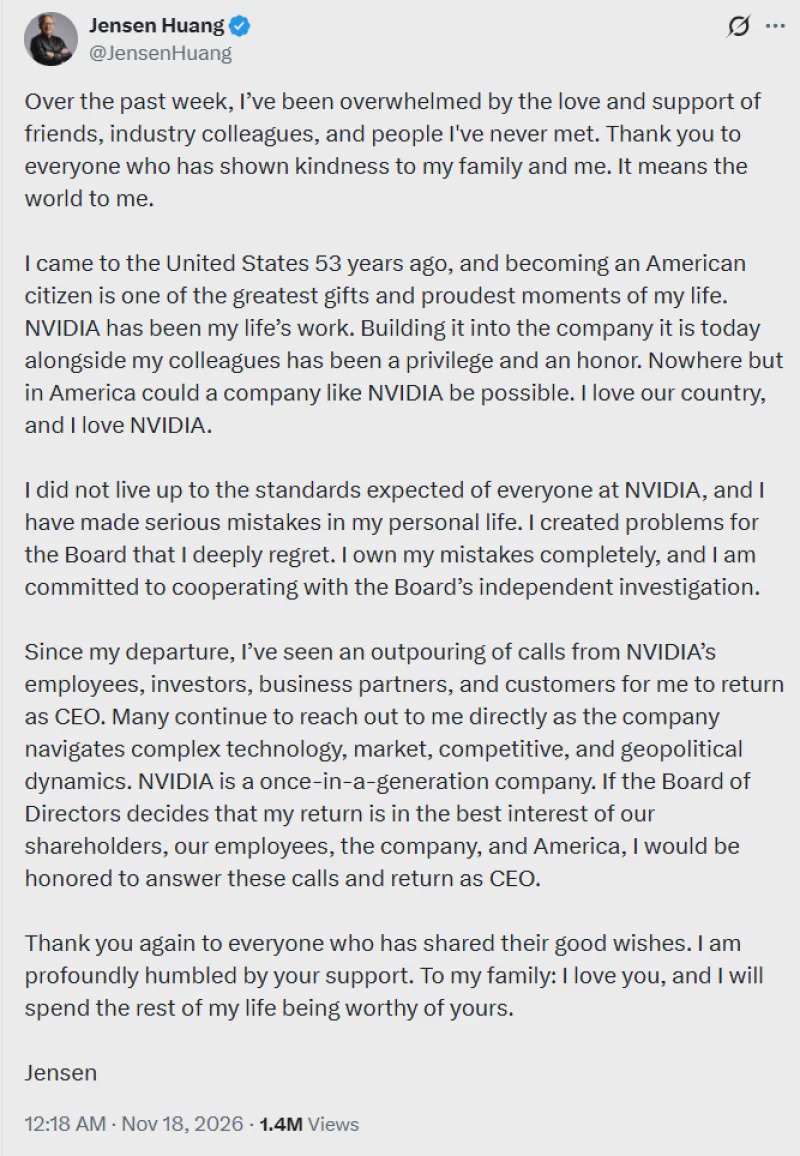
Huang said employees, investors, partners and customers had urged him to come back. "If the Board of Directors decides that my return is in the best interest of our shareholders, our employees, the company, and America, I would be honored to answer these calls and return as CEO," he wrote.
He also recalled arriving in the United States 53 years ago, calling his US citizenship "one of the greatest gifts and proudest moments of my life," and added: "Nowhere but in America could a company like NVIDIA be possible."
Board Chair Harvey Jones Rules Out Huang's Return
At the start of the earnings call, Harvey Jones, the first board chair in Nvidia's history, said the board does not intend to bring Huang back as CEO, CNBC reported. Jones described the resignation as voluntary and said the company would not take questions about the circumstances or the investigation.
The search for a permanent CEO will look at internal and external candidates and will not be rushed until the board finds the right person, Jones said, according to Bloomberg's live coverage of the call. He added that advanced chips and national security are reshaping the market, and that the next CEO will need to handle them very carefully. The board has also created a new committee to oversee national security and export controls.
Not everyone wants the matter closed. Elon Musk said on X that he had signed a "Stand with Jensen" petition. Investors Brad Gerstner of Altimeter Capital and Gavin Baker of Atreides Management wrote to the board asking for a slow, deliberate decision on Nvidia's leadership that includes the possibility of Huang's return, Bloomberg reported. The Associated Press reported that President Donald Trump said he would not mind if Huang came back. House Democratic leader Hakeem Jeffries said the board should not rehire him, calling his conduct unacceptable.
Revenue Doubles To $115.8 Billion As Outlook Rises
The fiscal third quarter ended October 25. Revenue was $115.84 billion, more than double the $57 billion of a year earlier and well above the $109.10 billion analysts had expected, according to LSEG data cited by CNBC. Adjusted earnings per share were $2.68, compared with forecasts of $2.48.
Data center sales, which come mostly from AI chips and server systems, roughly doubled to $107.6 billion, the Associated Press reported.
Nvidia expects revenue of about $130 billion in the current quarter, up roughly 90% from a year earlier and above the average analyst estimate of $125.1 billion. Investors had worried that the company might cut its forecast of 70% growth for the fiscal year ending in January 2028. Instead, it raised the forecast to 75%.
Colette Kress, the chief financial officer who is now also interim CEO, led the call. She said it is "business as usual at Nvidia."
"Our leadership has stood up so strongly over the last week to support both what we are doing here at earnings, but also supporting all of our different employees around the world," Kress said. "Remember, we have the best technologists on the planet with a world-class multi-year roadmap."
The shares rose more than 3% in after-hours trading. Before the results, the stock had fallen 24% in November and had dropped for six weeks in a row, its longest losing streak since 2012. It was trading at its lowest level since July 2025.
China Sales Left Out Of The Outlook
China remains the biggest risk. On November 16, the US Commerce Department announced rules requiring US licenses before overseas data centers can rent large amounts of advanced AI computing power to Chinese companies. "We are not assuming any Data Center compute revenue from China in our outlook," Nvidia told investors.
Kress also said Nvidia no longer ships its Hopper chips to China and did not give a reason, according to Bloomberg. Hopper shipments to China were $2.4 billion in the third quarter. Bloomberg reporters said the change may signal a more cautious approach to US national security policy after the scandal.
Investigations And A December Hearing Lie Ahead
Nvidia's legal problems are growing. The US Securities and Exchange Commission has opened a civil investigation into the company, The Wall Street Journal reported. Its focus is not clear, but it could include whether Nvidia's disclosures misled investors. The newspaper noted that Nvidia had earlier denied any unusual relationship between Huang and Alice Huang, and that it stopped listing Singapore sales separately last year. Megaspeed is based in Singapore. The Justice Department is leading several inquiries involving Alice Huang.
Treasury Secretary Scott Bessent has also questioned whether Nvidia knowingly sold advanced chips to China to boost revenue and profit, and said he expected answers from the board and its outside lawyers within about 10 days, the Journal reported.
Jensen Huang has agreed to appear before a joint session of the House Intelligence Committee, the Foreign Affairs Committee and the Select Committee on China on December 1. Nvidia General Counsel Tim Teter is scheduled to appear the next day.
Taiwan's Chip Suppliers Are Watching Closely
Huang's fall is being followed closely in Taiwan, where many of Nvidia's key suppliers are based. On October 21, three weeks before he resigned, Nvidia announced capacity deals with six suppliers, three of them Taiwanese: Siliconware Precision Industries (SPIL), King Yuan Electronics (KYEC) and Unimicron Technology.
Under that plan, KYEC will build new US facilities backed by a $1.1 billion capacity reservation advance from Nvidia. SPIL aims to raise its optical engine capacity for co-packaged optics 15-fold by mid-2027, and Nvidia is supporting Unimicron's substrate expansion in Taiwan.
The latest results suggest those orders are not slowing. But with Washington now asking where Nvidia's chips end up, the company's Taiwanese partners are likely to face more questions about their own role in the supply chain.
Jensen Huang and the Alleged Chinese Spy: Full Timeline
From the first reports on Alice Huang's visits to Taipei to Jensen Huang's resignation as Nvidia's chief executive, Storm Media tracks every development in the case and updates the page regularly.
► See the full timeline and latest updates
You've read it. Now join the conversation — follow us on X, Facebook and IG. Editor: Penny Wang