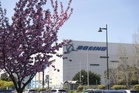
SEATTLE — Boeing posted contractor positions for engineering and technical roles on job sites on Tuesday, in what appears to be the latest escalation in its labor dispute with its white-collar union at its commercial airplane division.
After members of the Society of Professional Engineering Employees in Aerospace overwhelmingly rejected Boeing’s contract offer on Friday, the company said it would begin implementing a contingency plan in case of a strike after the current contract ends on Oct. 6.
A strike by SPEEA’s 17,000 members could further delay certification of Boeing’s 737 MAX 10 and 777-9, both of which are already years behind schedule.
The certification delays have kept two of Boeing’s most important new commercial jets from entering airline service, and a work stoppage by the engineers and technical workers responsible for that effort would be a blow to a company still recovering from quality and safety problems that followed a mid-air accident on a nearly new 737 MAX in January 2024.
SPEEA is “hopeful” that the planemaker and its members can agree to a new four-year contract while avoiding a strike, union spokesman Bryan Corliss said.
“It appears, however, that both sides are preparing for the possibility of a strike,” he said. “In our case, that includes preparing information for our members on what they could expect should there be a work stoppage. For its part, Boeing seems to be looking for 17,000 individuals who don’t care if they undercut worker solidarity.”
“We want to reach an agreement before the current contract expires and look forward to finding a solution with SPEEA at the table. To protect business continuity and support our customers, we’re implementing our contingency planning which will leverage a wide range of qualified resources with a continued emphasis on safety and quality,” a company spokesman told Reuters.
Boeing’s last two major union contract negotiations ended in extended strikes — a seven-week walkout by roughly 33,000 members of the International Association of Machinists and Aerospace Workers (IAM) at Boeing’s commercial airplanes division in 2024 and a 101-day strike by about 3,200 IAM members at Boeing’s defense division in 2025.
Bringing in thousands of contractors could set back progress Boeing has made addressing widespread quality and safety problems in its commercial aircraft production programs after the 737 MAX accident, Corliss said. reuters
NVIDIA’S latest quarterly results once again blew past Wall Street’s expectations as revenue for the computer chip company’s high-end artificial intelligence chips soared, the latest sign that AI infrastructure spending remains strong.
The company reported on Wednesday net income of $59.69 billion, or $2.46 per share, for the May–July period. That compares to net income of $26.42 billion, or $1.08 per share, in the same quarter last year.
Excluding certain items, earnings were $2.22 per share, well above the $2.09 per share consensus forecast by Wall Street analysts, according to FactSet.
Revenue more than doubled from a year earlier to $96.22 billion, surpassing analysts’ average forecast of $92.27 billion.
“AI has reached its inflection point. It’s doing useful work. Its tokens are productive and profitable. Now, compute is revenue,” said CEO Jensen Huang in a statement.
The Santa Clara, California, company’s results have regularly cleared the bar set by analysts in the past three years, often by a wide margin, since Nvidia’s high-end chips emerged as AI’s best building blocks.
Along with higher profit and revenue, however, Nvidia’s operating expenses surged 55 percent to $8.41 billion.
For the current quarter, Nvidia forecast revenue of about $108 billion. Analysts are forecasting $104.86 billion.
If Nvidia hits its revenue target for the August-October period, it will translate into a roughly 89 percent increase from last year — an indication that Nvidia’s phenomenal growth rate is still accelerating.
Nvidia expects to grow its revenue in its fiscal year ending January 2028 by about 70 percent, citing surging demand for its AI-powering chips. In fact, the company’s growth outlook would be closer to double, based on its customers’ own forecasts, if it weren’t for challenges in sourcing enough supplies to meet the chip production demand, noted CFO Colette Kress in a call with Wall Street analysts.
Huang also emphasized the supply limitations the company is grappling with.
“Our entire supply chain is challenged,” he told analysts. “At this point we have supply for 70 percent.... Our demand is much higher than that.”
Nvidia’s data center segment, which includes its AI data centers and factories business, as well as chip demand from hyperscalers — operators of huge cloud-computing data centers — reported revenue of $89 billion, up more than twofold from a year earlier.
Capital spending by the top five hyperscalers is expected to reach nearly $800 billion this year and $1.3 trillion in 2027, Kress noted.
On Wednesday, Nvidia and Amazon Web Services announced a plan to deploy 2 million additional Nvidia graphic processing units, and will incorporate Nvidia chips to power its fleet of warehouse robots.
Kress also said the company expects that its computer processing unit revenue will more than double in fiscal 2028, “positioning us as one of the world’s leading server CPU suppliers.”
Nvidia’s shares rose 4.1 percent in after-hours trading following the earnings call. The stock ended the regular trading session 1.6 percent lower and is up 12.4 percent so far this year.
The company’s edge computing segment, which includes chips bringing AI-powered features to computers, game consoles and robotics, among others, posted revenue of $7.2 billion, up 27 percent from the same period last year.
Despite the stellar results and still-rosy outlook, many investors worry about a jarring comedown after a three-year boom that has seen Nvidia’s market value soar from $400 billion at the end of 2022 to roughly $5.2 trillion now.
While AI has powered stock market gains and US economic growth in recent years, there’s been growing skepticism about whether AI will justify the trillions of dollars that are being spent to develop the technology.
The AI industry is also increasingly facing pushback amid objections to the expansion in data centers and fears that the speed with which AI is being adopted could lead to widespread job losses for many Americans. ap
SINGAPORE’S United Overseas Bank (UOB) said on Thursday it intended to issue two euro-covered bonds totaling €1 billion ($1.17 billion) under its $15 billion global covered bond program.
This is considered to be the first such offering to be executed by an Asian issuer, according to UOB.
Southeast Asia’s third-largest bank by assets said it planned to issue euro fixed-rate covered bonds with an issue size of €500 million ($582.80 million) at a coupon rate of 3.118 percent per annum payable annually in arrears.
The bonds — with two-year and five-year tenors — were offered under the lender’s $15 billion Global Covered Bond Program to capture demand from a wider range of investors while at the same time optimizing maturity management for the bank.
The lender also said the offering saw an “exceptionally strong” demand among investors, which underscored a strong support from high-quality institutional investors.
The covered bonds are expected to mature on Sept. 8, 2028.
In a separate statement, the lender said it intended to issue another euro fixed-rate covered bond with an issue size of €500 million ($582.80 million), with a maturity date of Sept. 8, 2031.
The coupon rate for the bond maturing in 2031 is 3.342 percent per annum payable annually in arrears.
Both covered bonds are expected to be rated “Aaa” by Moody’s Investors Service and “AAA” by Standard & Poor’s Rating Services, UOB said. reuters