

Passengers access and stairs in the Titanic
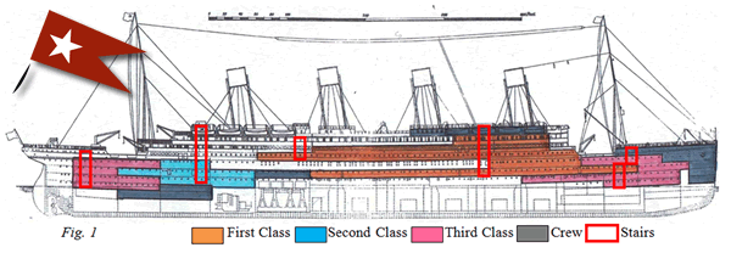
1st, 2nd and 3rd-class passengers on the Titanic had separate access and stairs to reach different areas onboard the Titanic and this had impacted their survival rate when the Titanic sank after collision with an iceberg on the night of 14 April 1912 at 11.40pm (Fig 1).
Titanic’s Grand Staircase for 1st Class Passengers
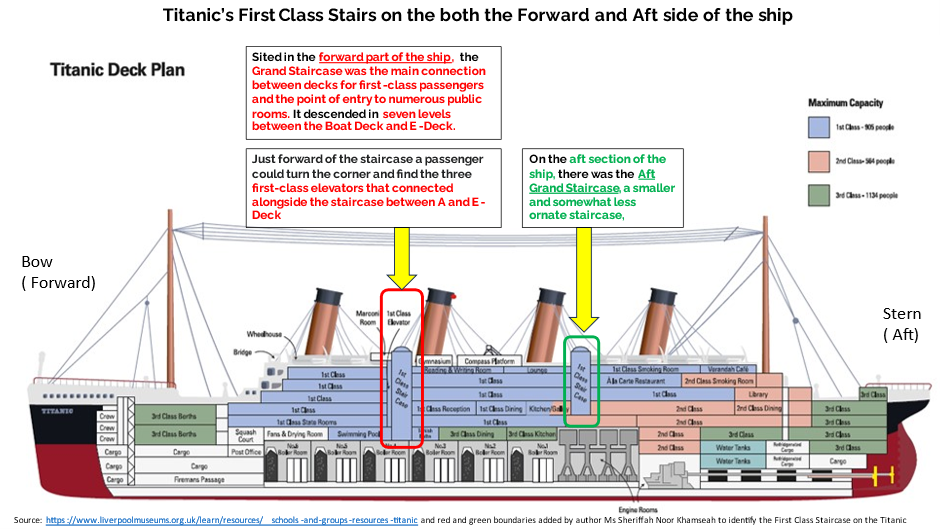
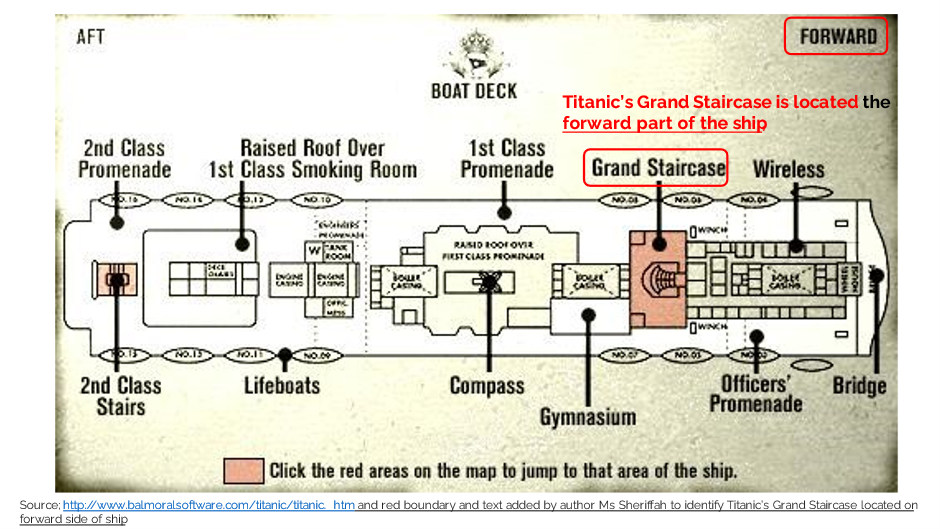
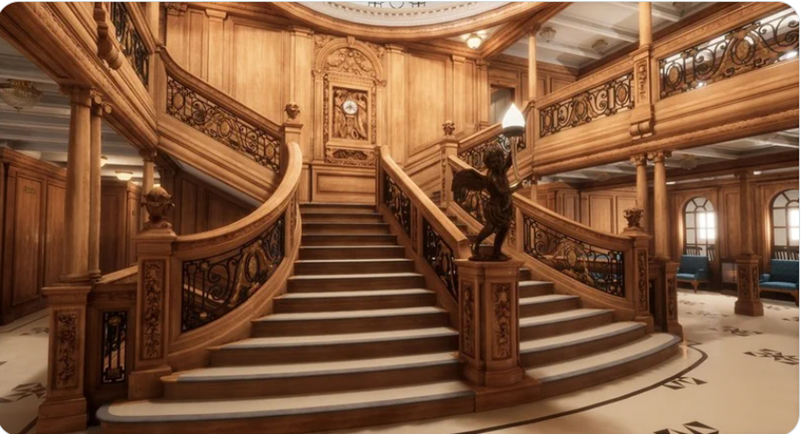
Sited in the forward part of the ship, (Fig 2 and Fig 3) the Grand Staircase (Fig 4) was the main connection between decks for first-class passengers and the point of entry to numerous public rooms. It descended in seven levels between the Boat Deck and E-Deck (Fig 5). Just forward of the staircase a passenger could turn the corner and find the three first-class elevators that connected alongside the staircase between A and E-Deck (Fig 6).
On the aft section of the ship, there was the Aft Grand Staircase, a smaller and somewhat less ornate staircase, but otherwise strongly resembling the forward Grand Staircase (Fig 2 and Fig 4).
Titanic’s Staircase for the Second class Passengers
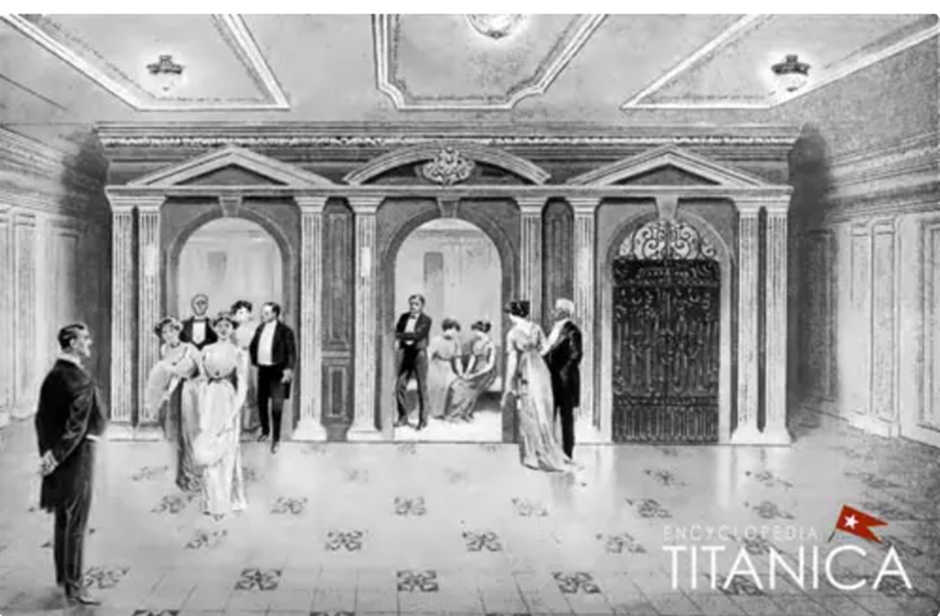
There were two staircases for second-class passengers—the main forward one communicated between the boat deck all the way down to F-Deck and featured an elevator, the first to be featured in second class aboard an ocean liner. The second ran between F and B-Decks and directly accessed the Library and Smoking Room. Both stairways were more modestly designed than their first-class counterparts; the balustrades were made entirely of oak and the flooring was in white and red patterned linoleum.
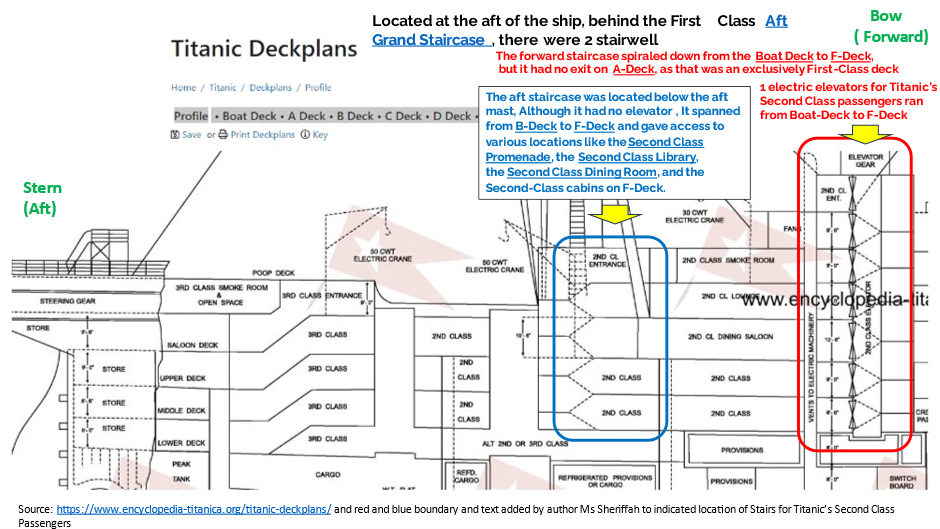
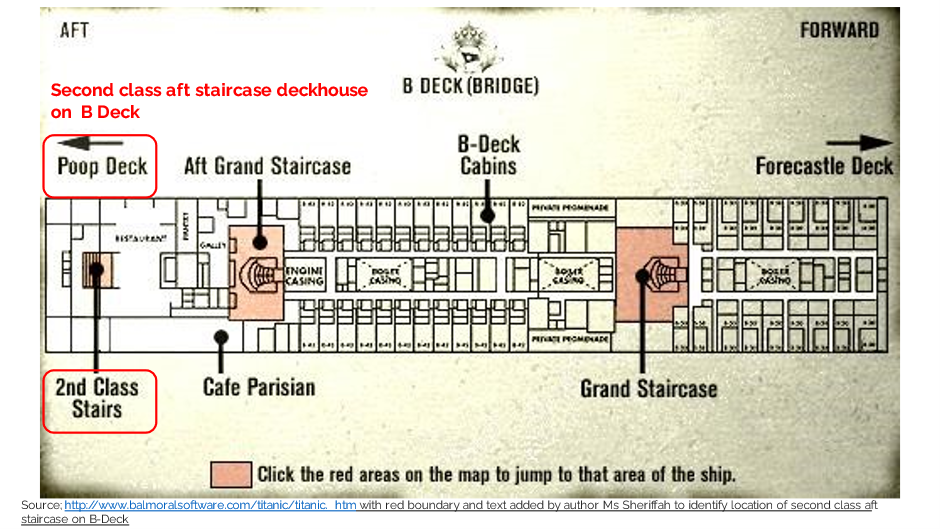
The Second-Class Staircase is the main access staircase for Second-Class passengers aboard the RMS Titanic. (Fig6 and Fig7) Located at the aft of the ship, behind the First Class Aft Grand Staircase, there were 2 stairwell
The second-class forward grand entrances and staircase are handsomely panelled in oak extends through seven decks and has an electric elevator incorporated in the centre which serves six decks.
The forward staircase spiraled down from the Boat Deck to F-Deck, but it had no exit on A-Deck, (Fig 6- Fig 8) as that was an exclusively First-Class deck. It was equipped with a lift operated by Reginald Ivan Pacey.
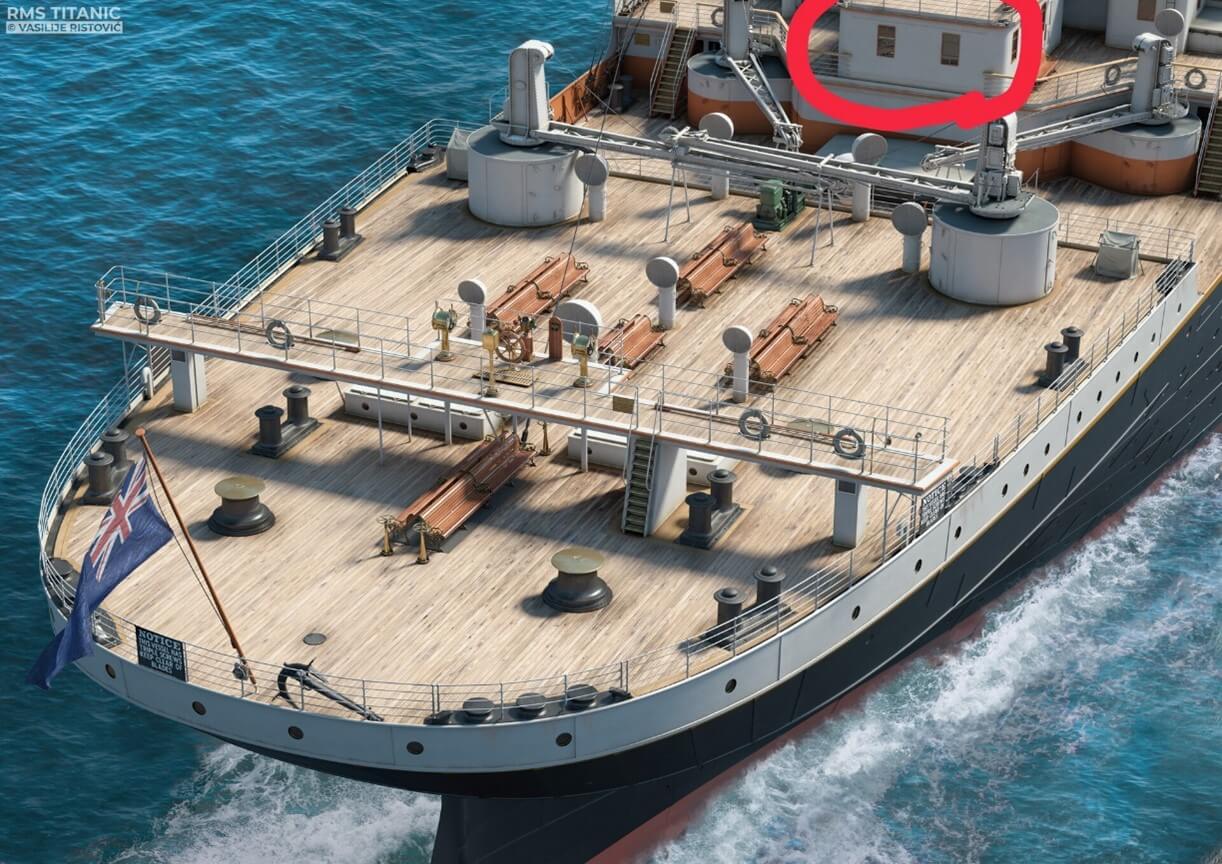
There were three separate outdoor promenade areas for second-class. The main one was a 145 ft long unsheltered stretch at the aft end of the boat deck that encompassed the raised roof of the first-class smoking room. A small deckhouse was installed acting as the second-class entrance, from where the elevator and main staircase were reached. (Fig 7 and Fig 8) There were wooden-slatted wrought iron benches installed along this deck and teak deck chairs could be rented for three shillings/1 dollar per person for the voyage.
This was the very top of the second class forward staircase, leading onto the 2nd class boat deck promenade. Second class had an advantage with having the only elevator up to the boat deck level.
The staircase wrapped around the elevator in the centre and lead down to F-deck. Here at Boat deck, the next level would open onto B-deck as it had no stops on A-deck with it being exclusive to first-class.
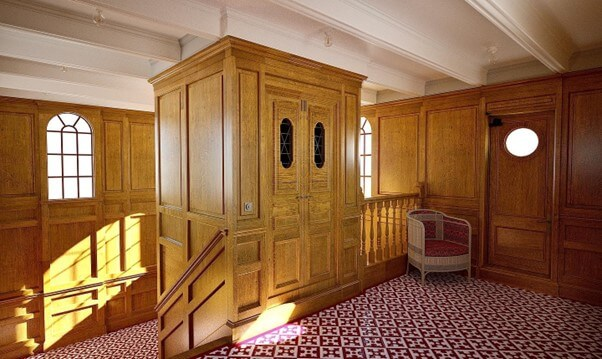
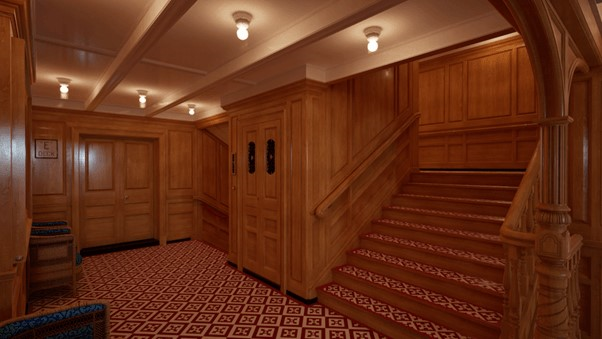

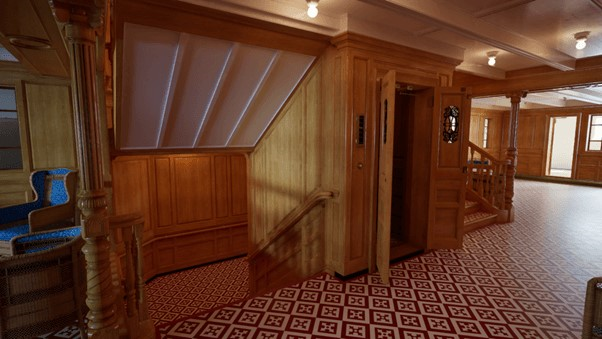

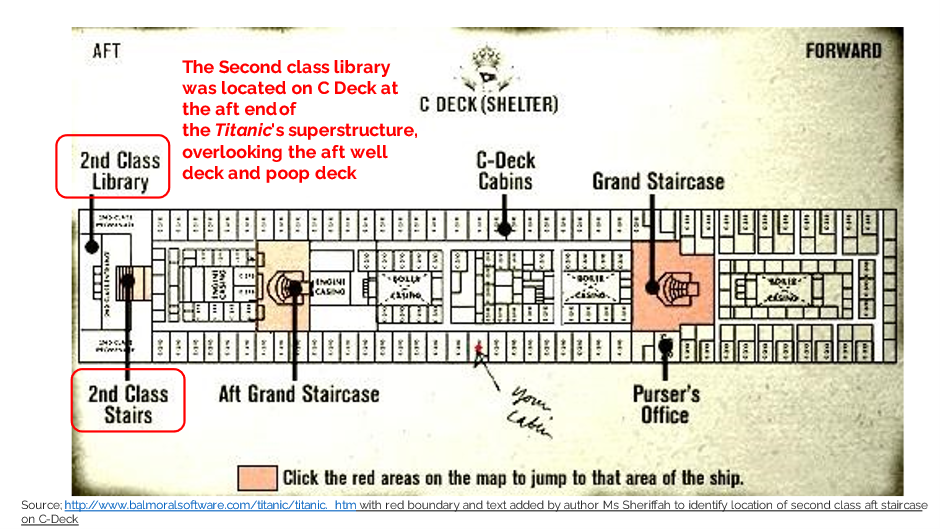
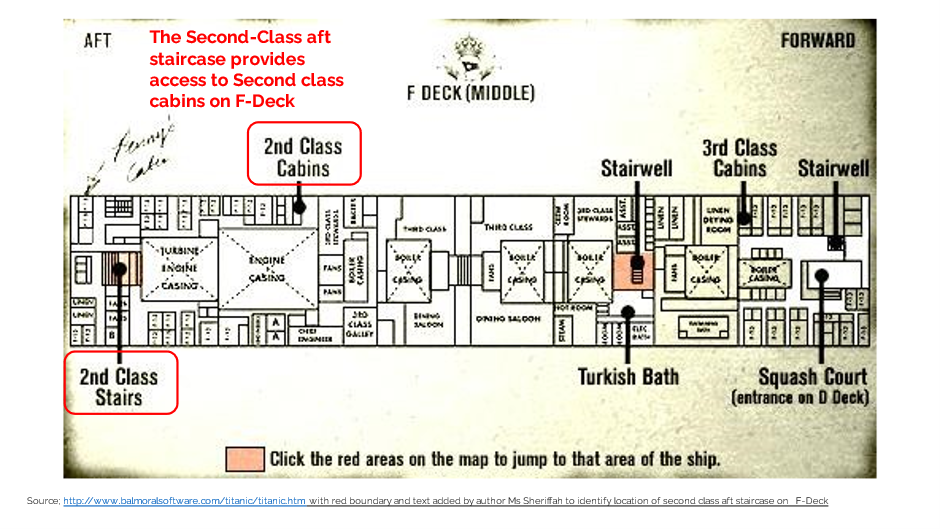
The aft staircase was located below the aft mast. ( Fig6, Fig11-Fig13) Although it had no elevator, it was all paneled in wood, with white and red linoleum tiles on the floor. There were a couple of wicker chairs on each landing. It spanned from B-Deck to F-Deck and gave access to various locations like the Second Class Promenade on B-Deck , the Second Class Library on C-Deck, the Second Class Dining Room on D-Deck, and the Second-Class cabins on F-Deck.
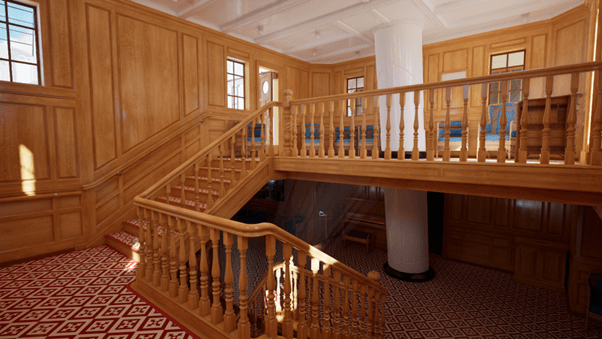

The Second class library was located on C-Deck at the aft end of the Titanic's superstructure, overlooking the aft well deck and poop deck (Fig 14 and Fig 15).
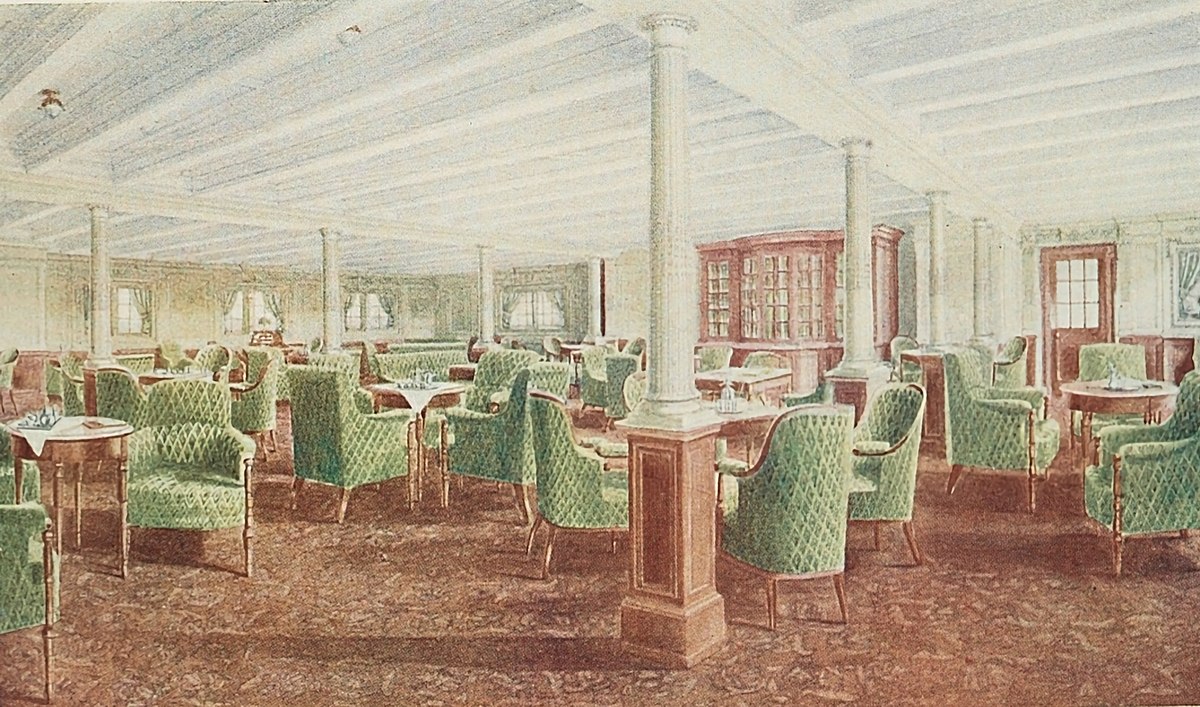

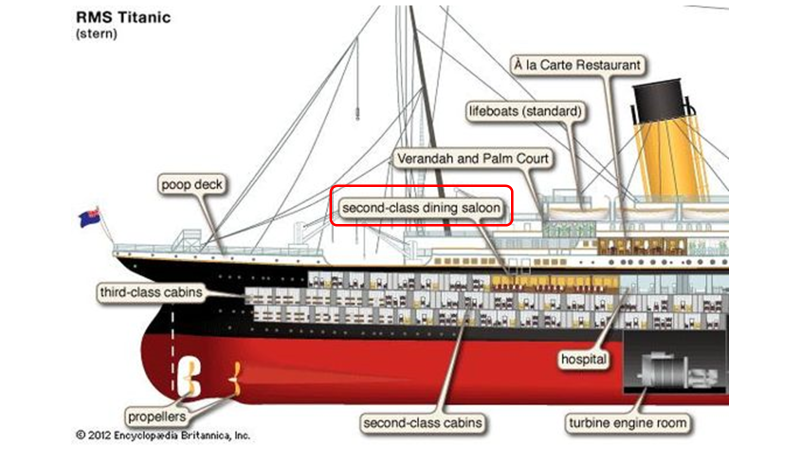
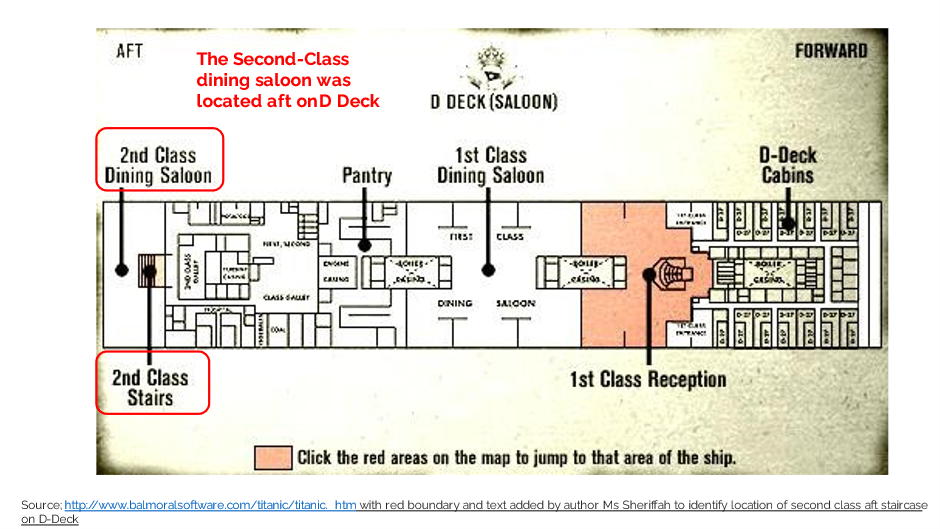
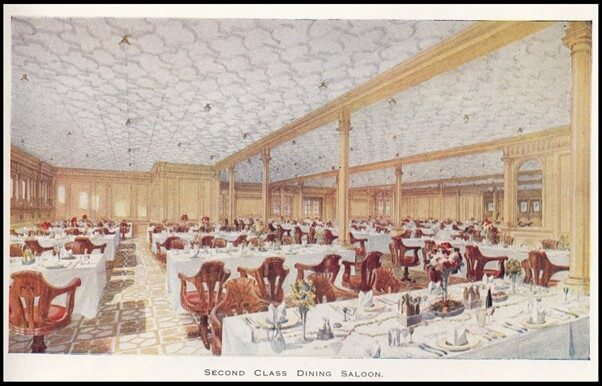
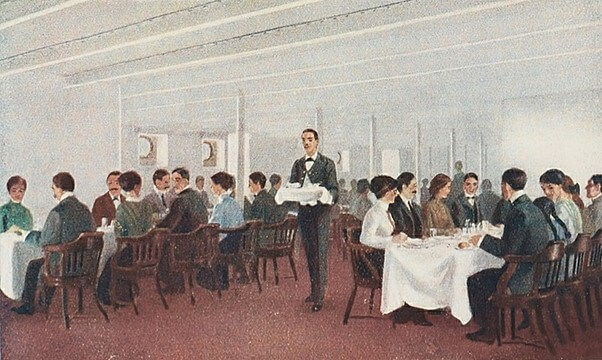
The Second-Class dining saloon was located aft on D Deck and shared the same galley as the First-Class dining saloon further forward. (Fig 16 - Fig 18)
Like first-class passengers, second-class men had a barber shop located on E Deck, accessible via the second-class staircase.
The aft staircase gave access to the Second-Class cabins on F-Deck (Fig 19).
Third Class Entrance and Stairs
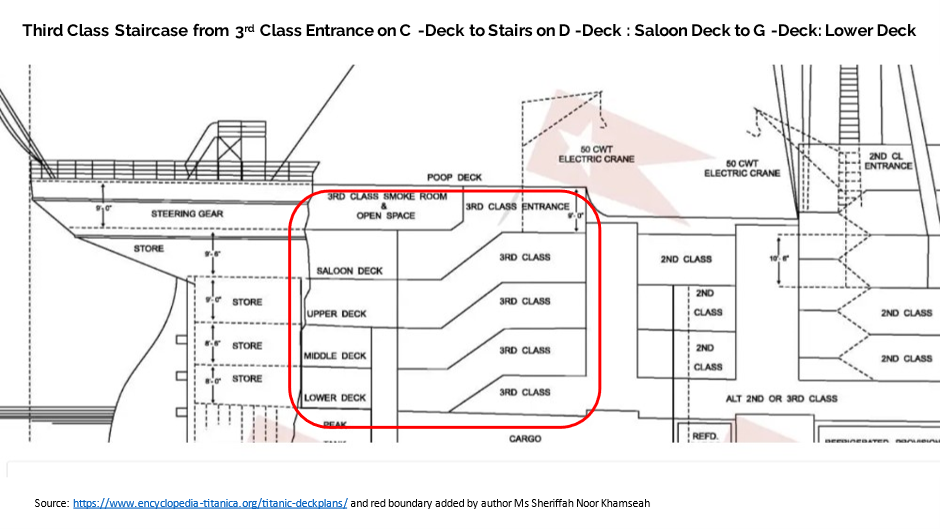
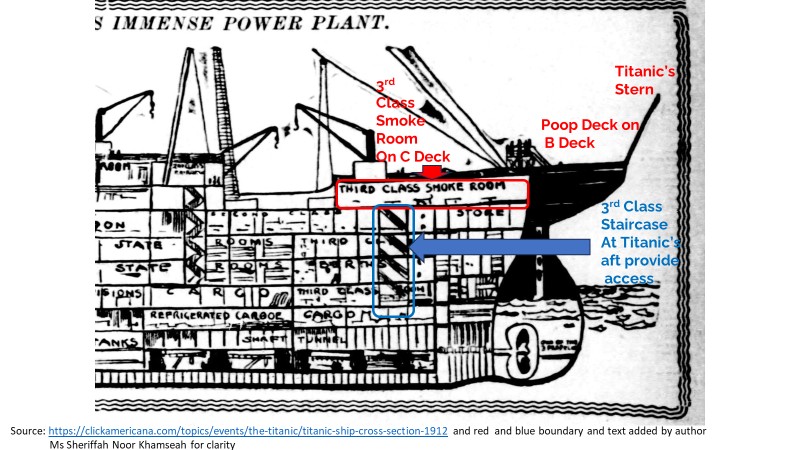
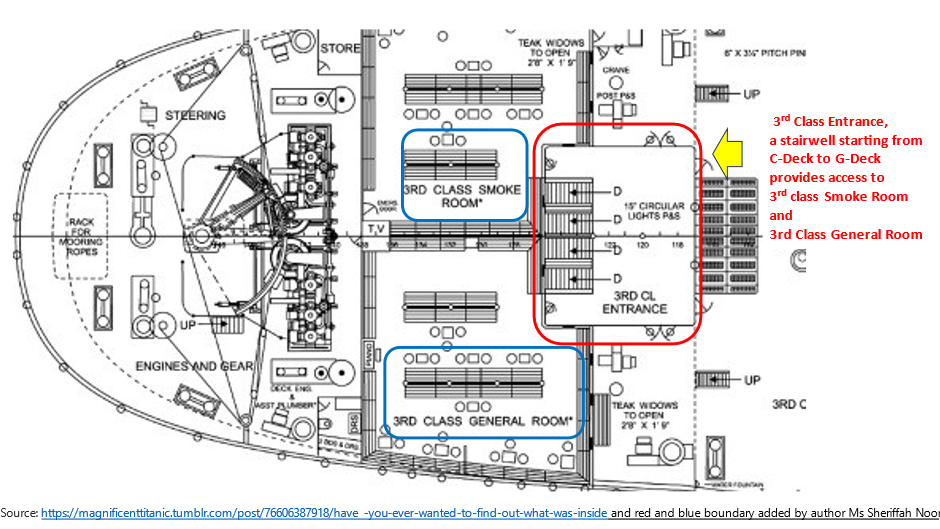
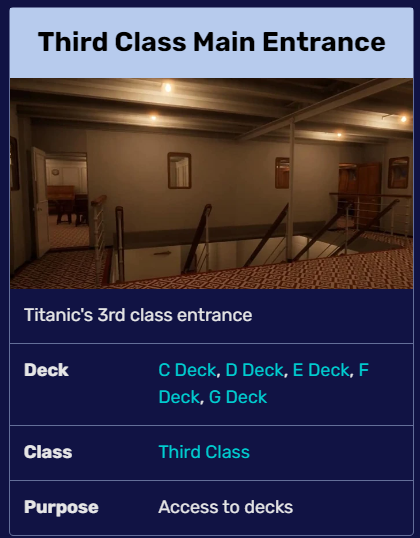
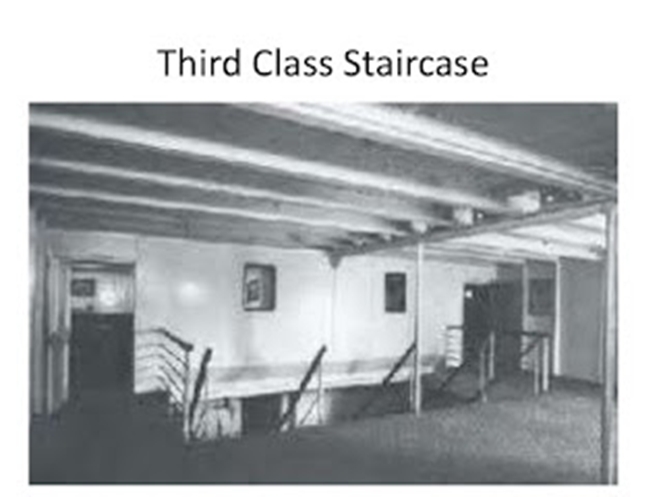
Titanic's Third Class Main Entrance was the place where the most Third Class passengers boarded the ship. It was a stairwell, starting at C Deck going down all the way to G Deck The C Deck landing had easy passages to the General Room and the Smoke Room (Fig 20 - Fig 26). It could be accessed from the Aft Well Deck and served as the 'main stairwell' for Third Class passengers.
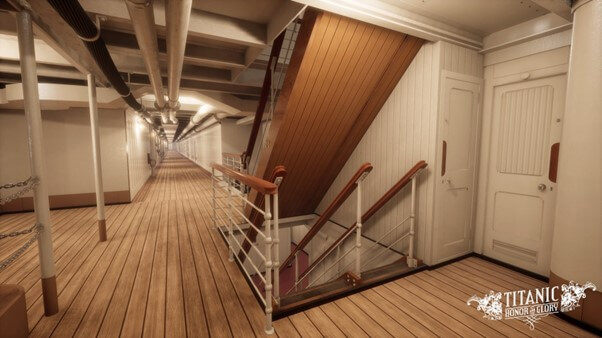
3rd Class Staircase was a very plain and simple stairwell extended from C-Deck down to G-Deck, and was the only means through which 3rd Class Passengers could reach the Aft Well Deck and 3rd Class Promenade (Open spaces) - Stern section.
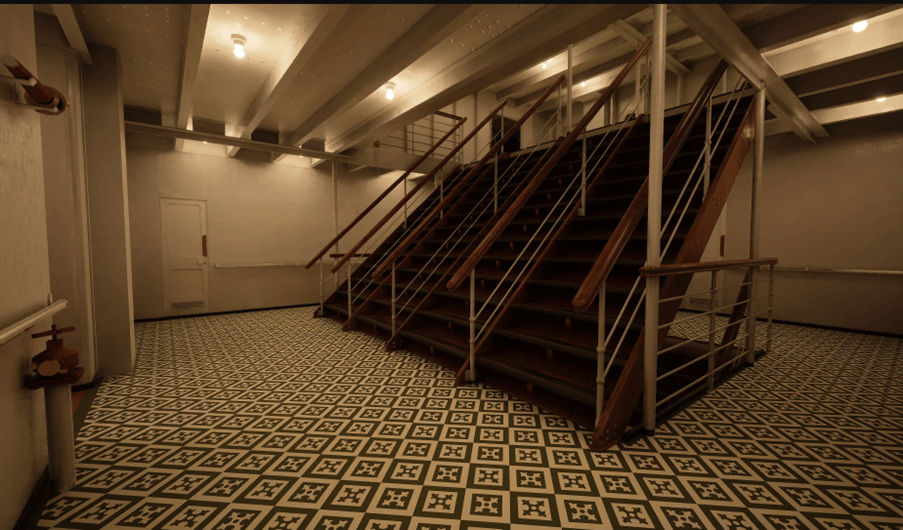
Scotland Road on E-Deck
There was another Third Class entrance for the men at Scotland Road. This one went all the way down to G-Deck
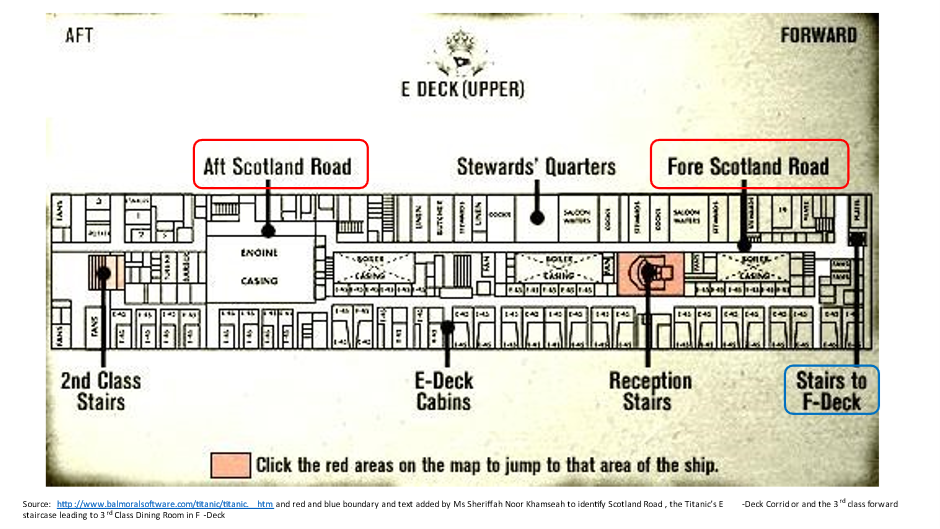
Scotland Road was a long corridor on E-Deck that gave crew members and third class passengers easy access between the bow and the stern of the ship. The name "Scotland Road" was given as a nickname by the crew because many were from Liverpool, and they named it after the thoroughfare in the city (Fig 26 - Fig 31).
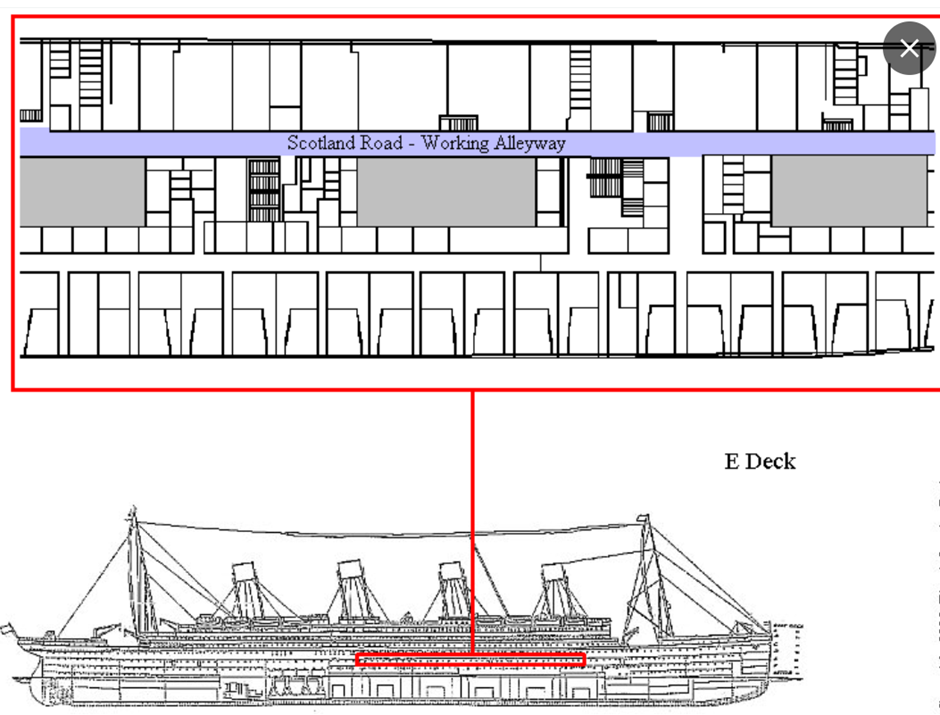
'Scotland Road' sometimes called 'Park Lane' was a companionway which ran nearly 2/3rds the length of Titanics E-Deck level. It was a place of high activity onboard Titanic. It connected the 3rd class separated areas with their dining saloon located below and aft on F-deck, likewise, it provided an open service corridor for Titanic's crew, stewards, and stewardesses. The Portside corridor was a mass of laundry services, dormitories for the ship's stewards, as well as accompanying washrooms for the crew. The starboard side of the corridor beheld the access ladders and fiddley exits to the boiler rooms, as well as a crew only access into the 1st class Grand Staircase on E-deck.
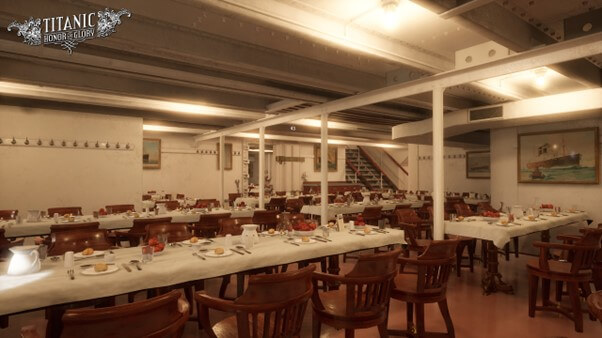
The Third class dining saloon was located midship on F Deck and was actually two rooms separated by a bulkhead (Fig 28). It was 100 ft long in total and could accommodate 473 at a time.
Third Class single men and Third Class families and single women were kept separated, the former in the bow and the latter in the stern. Due to the odd arrangement of the stairs, the aft half of the saloon was for the men, and the fore half was for families and women.
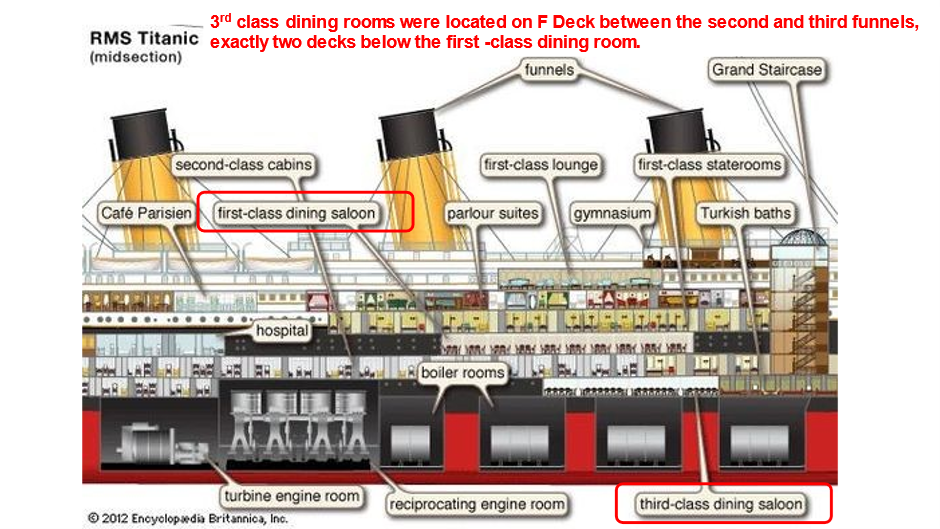
Third-class passengers did not get individual tables; they ate on rows of tables lined up next to each other. Combined, the two third-class dining saloons could hold only around 475 people, so diners were served in two seatings.

Sheriffah Dato Syed is a content creator under the Newswav Creator programme, where you get to express yourself, be a citizen journalist, and at the same time monetize your content & reach millions of users on Newswav. Log in to creator.newswav.com and become a Newswav Creator now!
The User Content (as defined on Newswav Terms of Use) above including the views expressed and media (pictures, videos, citations etc) were submitted & posted by the author. Newswav is solely an aggregation platform that hosts the User Content. If you have any questions about the content, copyright or other issues of the work, please contact Newswav.