.jpg)
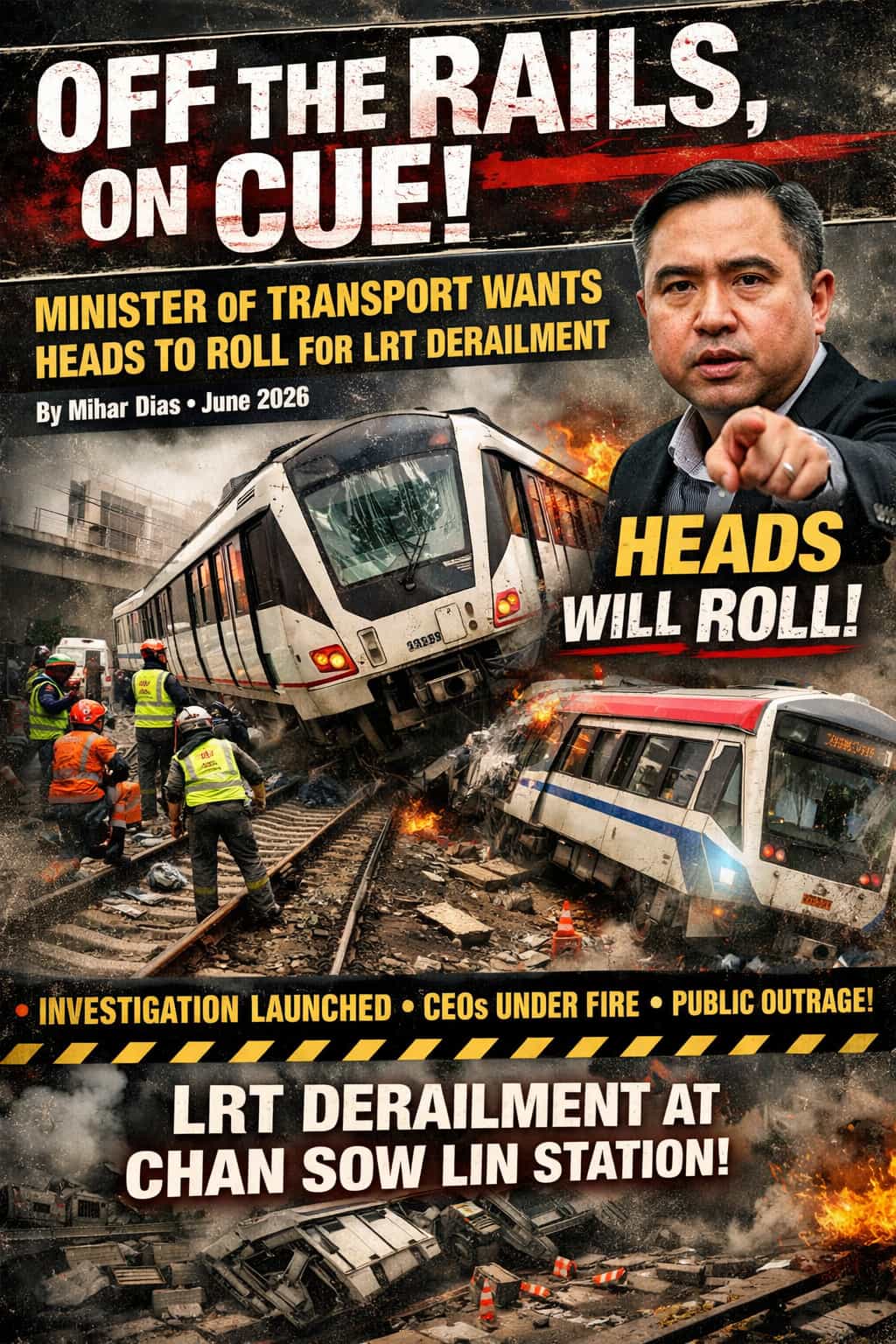
Off the Rails, On Cue: Minister of Transport Wants Heads to Roll for LRT Derailment
By Mihar Dias June 2026
Every government eventually discovers the usefulness of a derailment.
Not merely the physical kind involving steel wheels, faulty track switches and bewildered commuters hanging onto handrails while WhatsApp explodes with blurry videos and angry emojis. No, the political kind is far more useful. It allows ministers to thunder, boards to tremble, CEOs to rehearse solemn expressions and the public to enjoy the national ritual of “heads must roll” before everything quietly returns to normal three news cycles later.
The latest LRT derailment near Chan Sow Lin Station has now become exactly that kind of moment.
Transport Minister Anthony Loke emerged swiftly, sternly and predictably, declaring that the “business-as-usual” attitude at Prasarana Malaysia Berhad could no longer continue. https://newswav.com/A2605_iJhoEy?s=A_2wGHqCe&language=en
A special task force will investigate. Reports will be submitted. Maximum punitive action will be considered. Dismissals may happen. Accountability must prevail.
One could almost hear the soundtrack from a Korean corporate drama swelling in the background.
In Malaysian governance, however, the phrase “special task force” has become a sort of ceremonial incense. We burn it after every public mishap in the hope that the smoke itself resembles reform.
To be fair, a derailment is serious business. Rail systems are supposed to be the dependable alternative to our automotive jungle. When trains jump tracks in the middle of Kuala Lumpur, public confidence does not merely dip — it limps away carrying a damaged wheel assembly.
Fortunately, nobody was injured this time. Twenty-five passengers escaped unharmed. Had this happened during a packed rush hour, the minister would not merely be demanding resignations. The government would be facing a national trauma and endless parliamentary theatre.
But what makes this episode interesting is not the accident itself. Mechanical systems fail everywhere in the world. Switches malfunction. Sensors fail. Human beings forget maintenance schedules while filling PowerPoint slides about “transformative mobility ecosystems.”
What makes this uniquely Malaysian is the sudden rediscovery of outrage.
For years commuters have tolerated delays, signalling problems, overcrowding, escalator breakdowns and the familiar excuse that “technical issues” are being addressed. Malaysians have become so conditioned to transport disruptions that when trains actually arrive on time, some passengers suspect supernatural intervention.
Yet now we are told this incident is unacceptable.
Which means the earlier incidents were acceptable?
The minister’s unusually sharp tone suggests more than concern for commuter safety. It sounds like frustration accumulated over years of bureaucratic complacency. One suspects Anthony Loke knows very well that public patience with infrastructure theatrics is wearing thin.
After all, transport ministers occupy one of the most thankless portfolios in government. Nobody notices you when trains work. But when an LRT carriage sneezes, your face becomes the evening headline.
So now comes the ancient Malaysian administrative tradition: sacrifice.
Someone, somewhere inside the labyrinth of managers, deputy managers, acting deputy managers, consultants, compliance officers and strategic communications executives will likely become the designated offering to public anger. Perhaps a suspension. Perhaps a resignation “to take responsibility.” Perhaps an internal restructuring exercise with a fresh acronym and a new mission statement printed on glossy paper.
And then?
The public already knows the answer.
Another committee.
Another audit.
Another “comprehensive review.”
Another assurance that safety is the utmost priority.
Until the next breakdown.
What nobody dares discuss openly is the deeper culture infecting many government-linked entities. Maintenance is rarely glamorous. Preventive engineering does not generate ribbon-cutting ceremonies. Replacing aging switches lacks the political excitement of launching new stations with drone footage and inspirational music.
Infrastructure in Malaysia often suffers from a national obsession with beginnings rather than upkeep. We adore inaugurations but neglect maintenance. We celebrate launch dates while quietly postponing servicing schedules. We unveil trains like luxury products but treat maintenance budgets like optional subscriptions.
Eventually physics intervenes.
Steel does not care about political slogans. Track switches are immune to press conferences. Mechanical fatigue does not respect ministerial statements.
The danger for Anthony Loke is that once you publicly demand accountability, you also inherit ownership of the system’s future failures. The louder the promise, the greater the political debt.
If he truly wants change, this cannot end with ceremonial firings and a dramatic Cabinet presentation. It requires dismantling the comfortable ecosystem where public transport agencies operate as though commuter inconvenience were merely background noise.
Because Malaysians are increasingly tired of hearing that safety is a priority only after something goes wrong.
The real derailment was never the train.
It was the culture that allowed everybody to believe the tracks would somehow fix themselves.
Mihar Dias (mihardias@gmail.com) is a content creator under the Newswav Creator programme, where you get to express yourself, be a citizen journalist, and at the same time monetize your content & reach millions of users on Newswav. Log in to creator.newswav.com and become a Newswav Creator now!
The User Content (as defined on Newswav Terms of Use) above including the views expressed and media (pictures, videos, citations etc) were submitted & posted by the author. Newswav is solely an aggregation platform that hosts the User Content. If you have any questions about the content, copyright or other issues of the work, please contact creator@newswav.com.