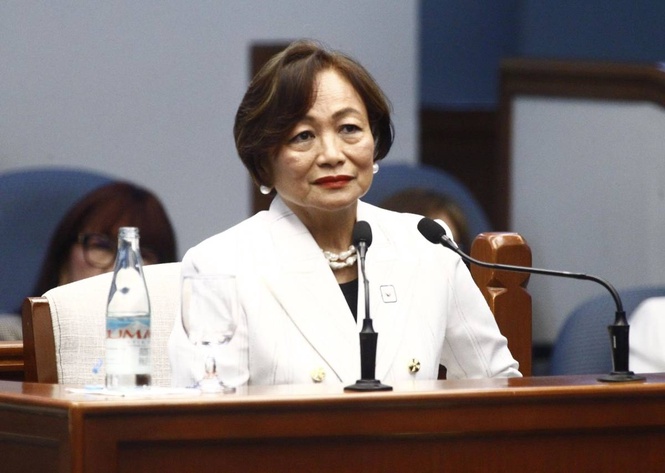
A PUBLIC official cannot hide behind a spouse’s private income or separate bank accounts to deflect allegations of unexplained or ill-gotten wealth, a retired Sandiganbayan justice told the Senate impeachment court, directly countering Vice President Sara Duterte’s defense that investigators cannot look into her husband’s assets.
Testifying on the 24th day of the impeachment trial as a witness called by the House prosecution panel, retired Sandiganbayan justice Amparo Cabotaje-Tang said authorities can investigate assets of a government official’s spouse and children, invoking Section 8 of Republic Act (RA) 3019 or the Anti-Graft and Corrupt Practices Act.
“The properties in the name of other persons and even the spouse and the children may be considered in determining whether the official has unlawfully [acquired wealth],” Cabotaje-Tang told the court under examination by Rep. Chel Diokno of the prosecution panel.
She cited the Supreme Court case of Republic vs. Rabusa, emphasizing that the law scrutinizes spousal assets precisely “to prevent concealment.” Addressing questions from Senate President Sherwin Gatchalian on how unexplained wealth is disguised, Cabotaje-Tang cautioned that officials frequently deploy “dummies or nominees or even proxies, or the assets are registered in the name of or names of other people.” She cited Heirs of Ligot v. Sandiganbayan, stating that investigators determine whether the relative or spouse possessed genuine independent purchasing power.
“The determinant here, according to the Supreme Court, is: Were these people — the spouse, children, or other individuals — financially capable of lawfully acquiring those assets?” Cabotaje-Tang said.
“If they did not have the capacity to purchase those assets in their independent capacity, then that acquisition will be traceable to the public official. Then that asset will be attributed as the public official’s asset,” she added.
Her testimony bears directly on one of the core defenses of Duterte in the impeachment trial, as her lawyers argue that the court cannot look into the bank accounts of her husband, Manases Carpio, as he is a private citizen and not an impeachable officer.
The Anti-Money Laundering Council previously reported that P6.77 billion worth of transactions were coursed through the bank accounts of Duterte and Carpio, including P2.99 billion linked to the vice president’s husband.
When Diokno asked whether government officials must declare spousal assets in their statement of assets, liabilities, and net worth (SALN), Cabotaje-Tang confirmed that they must, unless these assets are covered by a prenuptial agreement, which Duterte and Carpio do not have.
“According to the law, the spouse’s assets also need to be included,” she said.
“If the spouses had a complete separation of property or property relations before the marriage, then the property of the spouse of the official need not be included,” she added.
Cabotaje-Tang’s testimony also took direct aim at Duterte’s explanation for declaring “zero cash on hand or in banks” in her SALNs from 2019 to 2024 as she rejected the practice of lumping assets into broad categories in wealth declarations, as admitted by Michael Poa, one of the vice president’s lawyers.
Citing RA 6713 or the Code of Conduct and Ethical Standards for Public Officials and Employees, Cabotaje-Tang said that “cash on hand and cash in bank... must be specifically declared in the SALN.” “They cannot be lumped together with other personal properties,” she told Senator-Judge Joel Villanueva.
Asked whether grouping cash with other assets would merely be unusual, Cabotaje-Tang said it would run against Section 8 of RA 6713, or the Code of Conduct and Ethical Standards for Public Officials and Employees.
“I will not consider it unusual but it is against the provision of Section 8 of RA 6713,” she said.
The impeachment court is discussing the allegation that Duterte amassed unexplained wealth, failed to disclose all her and her spouse’s wealth, and failed to divest all her business interests during her tenure as vice president.
Duterte and her lawyers have maintained that she did not commit any wrongdoing and that accusations against her have no basis and are politically motivated.
No time limit
Cabotaje-Tang also said that there is no time limit to the state’s right to recover unlawfully acquired or ill-gotten wealth.
Senator-Judge Erwin Tulfo raised the issue of prescription while asking about cases involving public officials whose wealth may have been accumulated over many years.
Tulfo cited for instance a mayor who began his political career as a barangay councilor and eventually became barangay captain, municipal councilor, vice mayor and mayor.
He asked whether the government could still question the source of the official’s wealth after 15 years, particularly if the assets were reflected in the official’s SALN.
Cabotaje-Tang said that under the Constitution, there is no time limit to the right of the state to recover unlawfully acquired wealth.
“There is no period of limitation,” she said.
Tulfo then asked what evidence would establish that a public official’s wealth is unexplained.
Cabotaje-Tang cited RA 1379, which provides a standard for determining whether property acquired by a public official may be presumed to be unlawfully acquired.
“Republic Act 1379 provides a standard stating that if a public official acquires during his incumbency properties or a sizable amount of properties that are manifestly disproportionate to his salary, lawful income, or income from legitimately acquired properties, they shall be presumed prima facie as unlawfully acquired wealth,” she said.
The witness earlier defined ill-gotten wealth as wealth that is acquired through illegal means such as bribery, misappropriation, and malversation.
Senator-Judge JV Ejercito asked whether unexplained wealth is automatically considered illegally acquired or whether it could represent assets accumulated by a public official during their tenure.
In response, Cabotaje-Tang cited RA 1379, saying that a public officer must first be given an opportunity to explain any disproportionality in their assets.
She added that for wealth to be legally presumed unexplained, the official must have acquired the assets during their term and failed to provide a valid, legal explanation for them.
In his interjection, Senator-Judge Raffy Tulfo sought clarification on the legal distinction between an honest omission and intentional concealment when a public official fails to declare assets in his or her SALN.
Cabotaje-Tang replied that while public officials are entitled to due process to explain undeclared properties, repeated omissions over multiple years can demonstrate intentional concealment.
If proven continuous and intentional, such non-declarations in a public official’s SALN can constitute legal dishonesty, she said.
Senator-Judge Vicente Sotto III asked Cabotaje-Tang whether public officials are required to declare funds in their bank accounts in their SALNs, even if they claim the money does not belong to them.
Cabotaje-Tang affirmed that any funds remaining in a public official’s custody or account must still be declared upon filing the SALN.
She also confirmed that this rule strictly applies even if the official claims that the money belongs to someone else.
Senator-Judge Panfilo Lacson lauded Cabotaje-Tang for showing her patience, composure and forbearance during the impeachment trial.
Earlier, Lacson asked Tang clarificatory questions regarding the constitutional prohibition on the president and vice president engaging in business.
Tang explained that the stricter prohibition is due to the greater potential for abuse of power by the president and vice president, who are the two highest officials of the land.
“The prohibitions are more stringent on the president and vice president because of the powers that they wield, there is the greater possibility of abusing their office,” she said.
During the trial, Tang also stressed that her testimony before the impeachment trial was “not for sale,” when asked by defense lawyer Mark Vinluan if the prosecution promised her anything in return for her testimony.
Monday’s session marked the beginning of the hearing of Article II of the impeachment case against the vice president.
Aside from Cabotaje-Tang, prosecutors will also call Office of the Ombudsman Records Division Officer-in-Charge Karen Batu, and Securities and Exchange Commission (SEC) Company Registration and Monitoring Department Director Gerardo del Rosario.
Batu will testify on Duterte’s SALNs submitted to the Office of the Ombudsman, while del Rosario is expected to identify and authenticate SEC records involving companies and business interests linked to Duterte and her husband.
Article II accuses Duterte of culpable violation of the Constitution and betrayal of public trust for allegedly amassing wealth manifestly disproportionate to her lawful income and earnings while serving as a public official.