
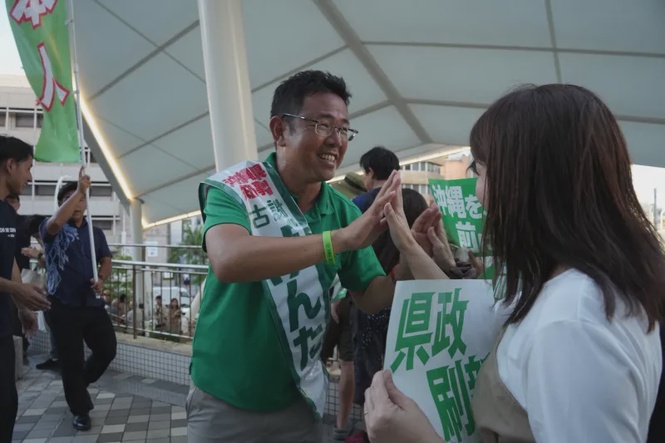
Genta Koja, a 42-year-old conservative-backed independent, swept Okinawa's gubernatorial election on September 13, defeating two-term incumbent Denny Tamaki by more than 147,000 votes and handing Japan's southernmost prefecture its first conservative governor in 12 years.
Six candidates competed for the post, but the race quickly narrowed to a contest between Koja, endorsed by six parties including the ruling Liberal Democratic Party, and Tamaki, who sought a rare third consecutive term. The final count gave Koja 423,124 votes against Tamaki's 276,060 — a margin that reflected a decisive public verdict. Voter turnout reached 61.57%, up 3.65 percentage points from the 2022 election.
The outcome ends Tamaki's eight-year tenure and marks the first time since 2014 that the conservative bloc has controlled Okinawa's prefectural government. Prime Minister Takaichi Sanae, who had characterized the race as a "barometer" for her administration and mobilized support at a level comparable to a national election, welcomed the result. LDP Secretary-General Shunichi Suzuki said at party headquarters in Tokyo: "We have been able to further stabilize our political base."
Economy Rises Above Base Politics in Voter Priorities
Exit polls conducted by NHK revealed a structural shift in what Okinawa's electorate wants from its governor. "Economic and price measures" was cited by 49% of voters as their top policy priority — unseating the U.S. military base question, which has historically dominated Okinawan politics.
Koja's campaign centered on a concrete pledge: doubling average prefectural household income within 10 years, while emphasizing his connections with the national government and the ruling coalition. LDP policy chief Takayuki Kobayashi and Japan Innovation Party leader Hirofumi Yoshimura visited Okinawa to stump for Koja during the campaign. The pitch found traction in a prefecture that consistently ranks among Japan's poorest by per-capita income. Among voters whose top concern was the economy, 70% backed Koja. His support was particularly strong among younger generations — in every age bracket under 50, Koja outpolled Tamaki.
At 42, Koja becomes the first Okinawa governor born after the prefecture's 1972 reversion to Japanese sovereignty, and the youngest in the prefecture's post-reversion history. A former Naha deputy mayor and career central government bureaucrat, he campaigned on rebuilding a cooperative relationship with Tokyo after years of confrontation under Tamaki.
Speaking to reporters in Naha after his victory, Koja framed the result as a mandate for change: "The election was a question of whether to continue the current prefectural administration or to bring about a renewal." While respecting Tamaki's administration, he added: "I want to move Okinawa forward."
Tamaki, who had drawn scrutiny during his tenure for visiting China and clashing with the Takaichi administration over security policy and nuclear principles, notably softened his anti-base stance during the campaign — instead highlighting his two terms' achievements, including robust tourism growth. Speaking to supporters in Naha after the results were announced, he remained defiant on the core issue: "The base cannot be built in Henoko. I was not wrong to argue on behalf of the people of Okinawa." He added: "I accept the will of the people. Though I had many unfinished goals for a third term, I will turn this result into nourishment for the future."
Futenma Relocation and Japan's Southwest Defense Push Gain Ground
Koja's victory carries direct implications for one of the most contentious U.S.-Japan security disputes: the planned relocation of Marine Corps Air Station Futenma — currently sited in the densely populated city of Ginowan — to the Henoko district in the city of Nago in northern Okinawa. Koja takes a position accepting the relocation.
Public opinion on the relocation has shifted markedly. Support for the Henoko move rose to 53%, while opposition fell to 47% — a reversal from four years ago, when 57% opposed the move and only 43% supported it. As construction off the Henoko coast has progressed and the prefectural government lost every legal challenge against the national government, there had been growing speculation that public interest in the base transfer issue had waned. Koja acknowledged the issue while pressing Tokyo for accountability: "The core issue is completely eliminating the danger at Futenma and achieving its early return. Since the central government has not yet provided a specific return date, the new prefecture will firmly demand that the center set a clear timeline."
The election also clears a path for Japan's "Southwest Shift" — a defense strategy deploying missile units and air defense systems across the Nansei Islands chain, including Yonaguni, Ishigaki, and Miyako islands, in response to China's growing military activity and rising tensions in the Taiwan Strait. A Defense Ministry official told the Mainichi Shimbun that with the new governor, "central and local government can finally be on the same page" in an increasingly difficult security environment.
Under Tamaki, Okinawa had conditioned acceptance of any new defense deployments on a substantive reduction in the overall base burden — a stance that created friction with Tokyo's security agenda. Koja's election is expected to remove that obstacle and allow Japan's southwestern defense buildup to accelerate.
The LDP-led coalition successfully consolidated the conservative vote. The progressive "All Okinawa" camp, which had already suffered consecutive defeats in recent local elections, could not rally voters around the base issue as effectively as in past cycles. The Mainichi Shimbun reported that negative social media campaigns targeting Tamaki circulated widely during the race and may have influenced the final outcome.
Social Media Links & Editor Tag - Penny