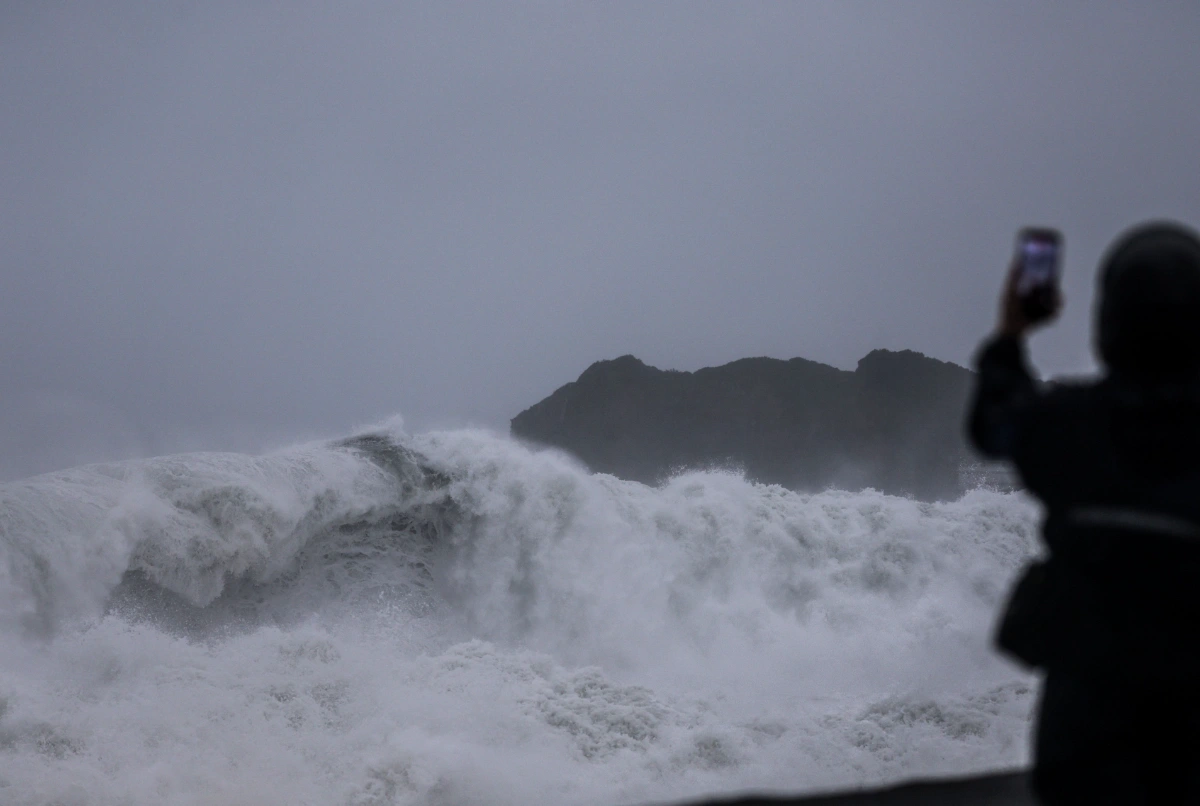
Typhoon Champi has killed one person and injured more than 500 as it swept past Taiwan on Saturday, downing trees, cutting power to hundreds of thousands of homes and forcing hundreds of flights to be cancelled.
At one point, a super typhoon and one of the strongest storms in the Pacific this year, Champi glanced off Taiwan's northeastern coast in Yilan County early on Saturday and is weakening as it heads north towards the Chinese coast.
It is not expected to make landfall there.
Gusts near its centre are still around 126kmph (78mph), and the storm was about 170km (106 miles) north-east of Taiwan, according to the island's Central Weather Administration.
The centre turned south around midnight local time (4pm GMT on Friday), hugged the Yilan coastline, then made a rare loop offshore before moving away to the north.
A man was swept away by waves from the island of Liuqiu, which led to his death, and the fire department said 527 people were injured in the heavy wind and torrential rain.
Close to 1,300 people were evacuated from vulnerable, mountainous areas before the storm arrived, Taiwan's Focus Taiwan news agency reported.
Gusts reached 227kmph (141mph) in some coastal areas, knocking down power lines and sending roof tiles flying. More than 288,000 homes lost electricity, according to the state power company Taipower, though most had been reconnected by Saturday.
The weather administration said the storm could drop up to 900mm (35 inches) of rain between Thursday and Saturday, with the northeast hit hardest.
Transport and offices have been disrupted for a second day. The transport ministry said 259 flights were cancelled on Saturday, down from almost 1,000 on Friday, and governments across northern and central Taiwan, including the capital Taipei, closed offices and schools again. In Taipei, there were downed trees and on-and-off squally rain showers.
"It was most terrifying around midnight," said Lin, a retired teacher, as he inspected downed banana trees in his garden in Yilan, Reuters reported.
"It was a sleepless night. I haven't seen anything like this in many years." Thomas Wang, a 70-year-old Taipei resident running errands on Saturday morning, told Reuters the storm felt like something out of the horror film Poltergeist. "It was quite scary," he said.
Typhoons are more common in summer, but they can strike in autumn too.
China is preparing for the storm's passage up its coast. The emergency management ministry sent a team to the eastern province of Zhejiang, warning of strong winds and heavy rain through Sunday, and said it had readied 400 rescue workers and 600 pieces of equipment, with more than 41,000 firefighters on emergency duty.
In Taizhou, a city on Zhejiang's coast, more than 3,800 fishing boats returned to harbour, offshore fish-farm workers were brought ashore and 2,084 island visitors were evacuated, state media reported. Authorities halted 25 offshore construction projects and suspended 18 passenger ferry routes.
The storm is forecast to track up the Chinese coast and then move into southern Japan. About 8,400 households in Japan's Okinawa islands were without power on Friday afternoon, according to the Okinawa Electric Power Company, and the Japanese government said two people were injured there.
Read MoreThousands of rescuers search for survivors as powerful earthquake in Tibet
China aims to build ‘fertility-friendly society’ as birth rate plummets again
Powerful 7.0-magnitude Tibet earthquake kills at least 16 and collapses homes