
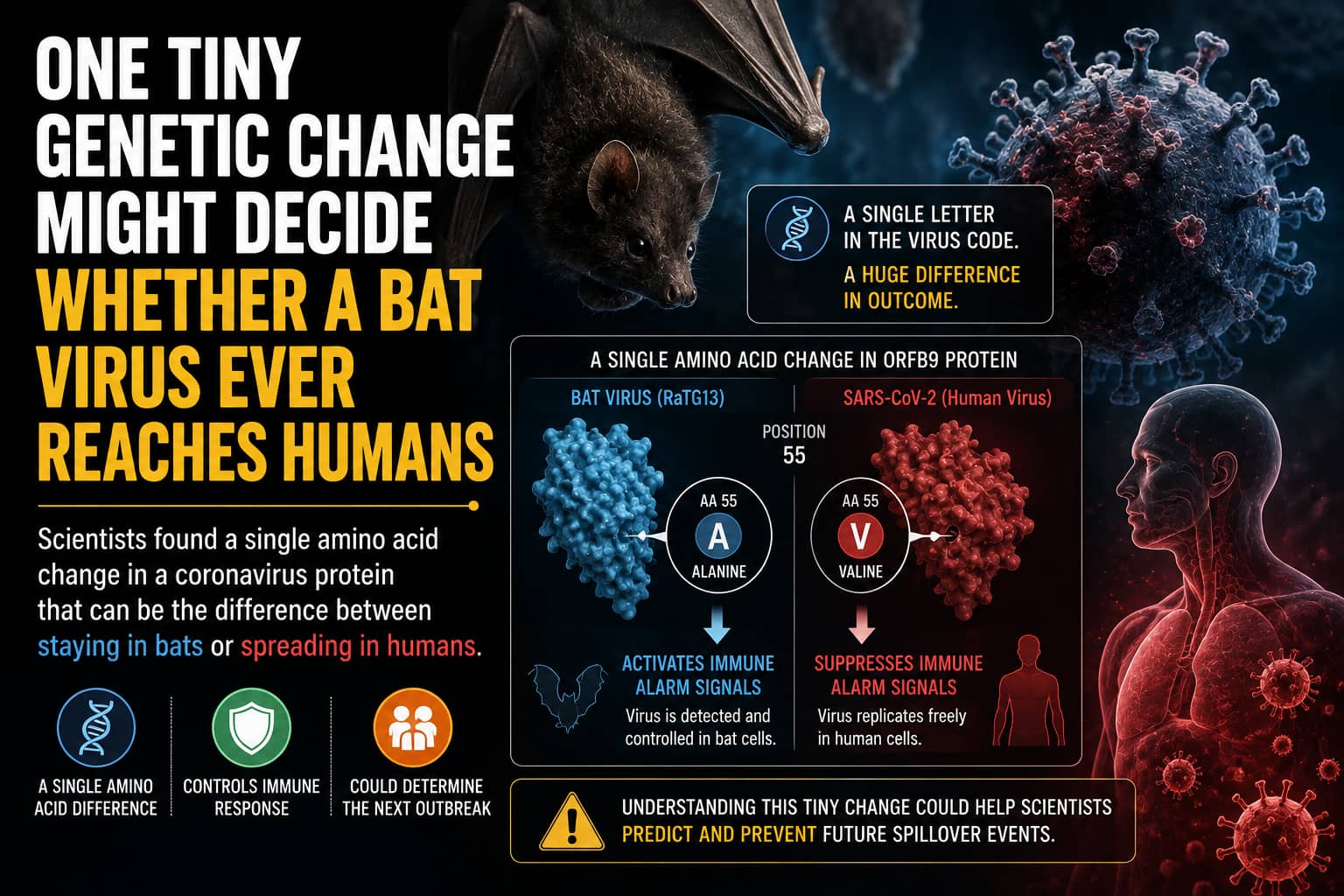
Somewhere in the genetic code of a coronavirus sits a stretch of roughly 100 amino acids that, depending on a single change, can determine whether that virus stays contained in bats or gains the ability to spread in humans. Researchers just mapped exactly how.
The study, published in Cell Host and Microbe and covered by ScienceDaily, compared a protein called OrfB9 in SARS-CoV-2 against the same protein in RaTG13, a closely related bat coronavirus. A single amino acid difference between the two versions changes the protein's behaviour entirely. In human cells, the SARS-CoV-2 version disables immune alarm signals, letting the virus replicate before the body can mount a defence. In bat cells, the RaTG13 version does the opposite, actively triggering protective immune proteins.
Who Ran the Study
The work involved researchers from UCSF's Quantitative Biosciences Institute, the Icahn School of Medicine at Mount Sinai, Institut Pasteur, and the Fred Hutchinson Cancer Center. UCSF's own coverage of the findings quoted senior author Dr Nevan J. Krogan putting the stakes plainly: "The difference between a virus that stays in bats and one that spills over into humans, can come down to remarkably small genetic changes."
Why This Actually Matters for Future Outbreaks
This is not just a historical explanation for how the pandemic started. It gives researchers a specific molecular signature to screen for in circulating bat coronaviruses, potentially flagging viruses that are one small mutation away from being able to jump into humans before that jump actually happens, rather than only being able to study the mechanism retroactively after an outbreak is already underway.
The Uncomfortable Part
If a single amino acid swap is genuinely the difference between a virus staying contained and a virus becoming a global health event, that is a fairly narrow margin sitting between us and the next spillover, one that depends entirely on random mutation rather than anything within human control. The upside is that narrow margin is now something scientists know exactly where to look for.
A Second Team Reached a Similar Conclusion
Separate research out of the University of Cambridge independently zeroed in on genetic changes likely involved in enabling SARS-CoV-2's original jump from bats to humans, adding weight to the idea that spillover events hinge on a small number of identifiable genetic switches rather than being an unpredictable, unknowable roll of the dice each time a new coronavirus circulates in a bat population.
Ronny M (ronny76netstuff@gmail.com) is a content creator under the Newswav Creator programme, where you get to express yourself, be a citizen journalist, and at the same time monetize your content & reach millions of users on Newswav. Log in to creator.newswav.com and become a Newswav Creator now!
The User Content (as defined on Newswav Terms of Use) above including the views expressed and media (pictures, videos, citations etc) were submitted & posted by the author. Newswav is solely an aggregation platform that hosts the User Content. If you have any questions about the content, copyright or other issues of the work, please contact creator@newswav.com.