Author:
Dr. Daniel Chau Jun Wei (MD), Emergency Physician, Pantai Hospital Ipoh; Committee of Malaysia Sepsis Alliance (MySepsis)
Co-authors:
- Dr Khaizurin Tajul Arifin, Department of Biochemistry, Faculty of Medicine, Universiti Kebangsaan Malaysia; Committee of Malaysian Sepsis Alliance (MySepsis);
- Professor Dr Tan Toh Leong, Consultant Emergency Physician, Department of Emergency Medicine, Faculty of Medicine, UKM; Founder and President, Malaysian Sepsis Alliance (MySepsis)
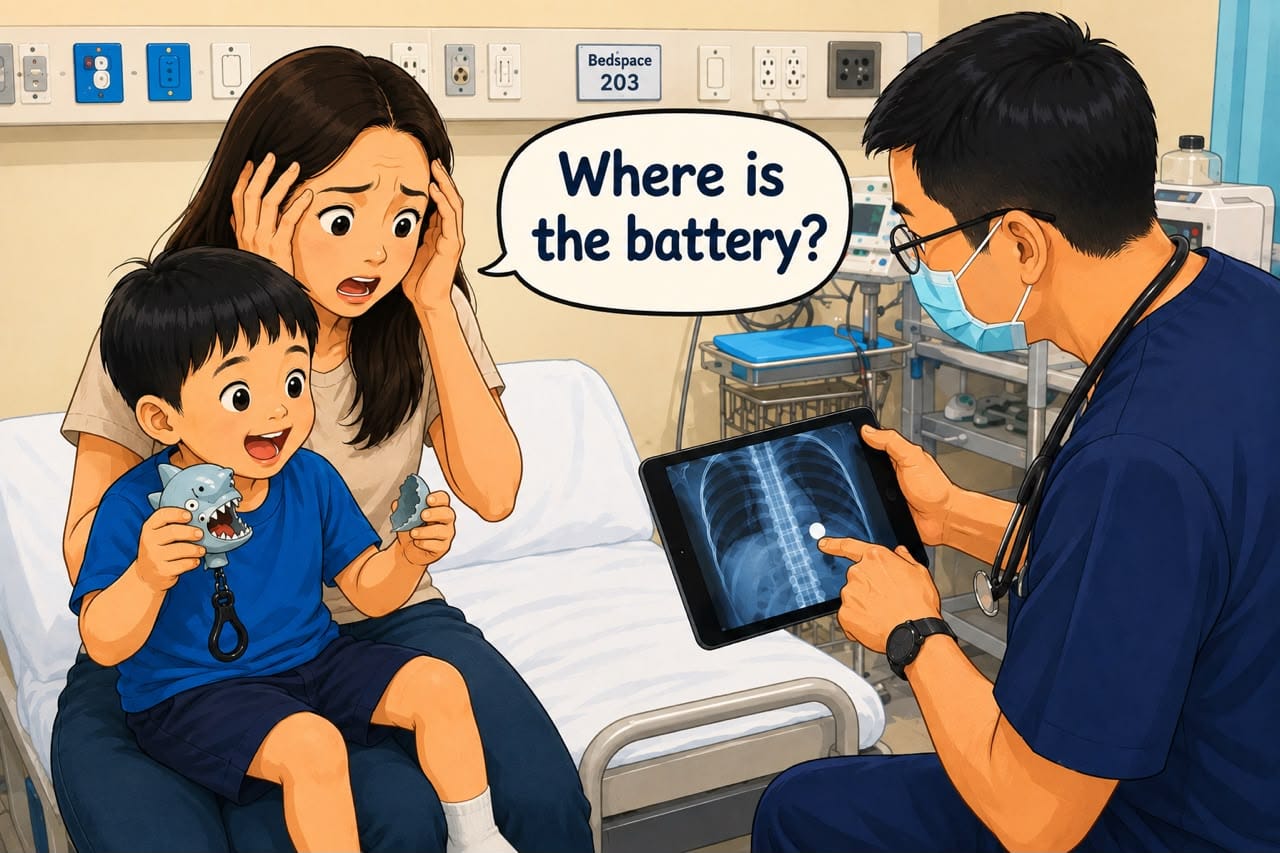
“Did you swallow that?” Your 3-year-old grins and nods. Then you look at the favourite key chain your child broke apart, and the tiny battery goes missing.
You are not alone if you have often wondered why all your toddler wants is to taste everything. US National Poison Data System recorded over 57,000 cases of ingestion of foreign bodies in 5 years or younger, with the peak between 6 months and 3 years (America’s Poison Centers: 39th Annual Report). Mouthing is a developmentally normal behaviour in early childhood. Just like touching things, infants and toddlers mouth objects to learn more about their world. Mouthing behaviour is typical in children under 3 years but varies from child to child and decreases with increasing age (Mouthing Behaviour).
This article will concentrate more on ingestions of non-edible objects in children. Most are harmless, but not all. Fortunately, most foreign bodies that children swallow (80%-90%) pass through their digestive tract uneventfully. About 10%-20% of swallowed foreign bodies need removal via endoscopy, and about 1% need surgery because of complications, including bowel obstruction, perforation, bleeding, abscess, sepsis, or fistula (CPG Foreign Body Ingestion in Children). How do we know which group the child fall under?
Three main things matter:
1. What Did the Child Swallow?
The type of object swallowed by the child largely determines whether the parent needs to be worried or not. The following objects should warrant concerns:
Button batteries: especially lithium button batteries found commonly in toys, watches, and many other household items and rapidly cause serious tissue damage if lodged in the oesophagus
Magnets: ingestion of more than one magnet or a magnet plus a metallic object leads to the attraction of these objects through separate loops of intestines, which could lead to intestinal obstruction, perforation, or other serious complications
Sharp objects: needles, pins, screws, and foreign bodies originating from broken toys or bones, which can injure or perforate the digestive tract
Large objects: > 6 cm long and/or > 2 cm wide, which are too large to pass through the gastrointestinal tract
Expandable objects: superabsorbent toys and water beads expand in size after ingestion
Toxic objects: objects containing lead
Unknown objects: it is safer to get them assessed rather than presume it is harmless
2. Does the Child Have Any Symptoms?
Seek treatment at the nearest emergency department if the child has the following symptoms:
Difficulty in breathing, choking, persistent coughing, or gagging on secretions, noisy breathing
Drooling or difficulty swallowing
Painful swallowing
Foreign body sensation in the throat
Refusing to eat or drink
Persistent vomiting
Chest, throat, or abdominal pain
Abdominal distension
Presence of blood in vomit or stool
Significant distress or altered state of consciousness, especially drowsiness
3. Does the Child Have Any Pre-Existing Illness?
The child also matters. A healthy child who swallowed a small, smooth, low-risk object and does not present with symptoms will be managed very differently from a child with an underlying gastrointestinal problem or previous surgery (CPG Melbourne Hospital). Patients with a higher risk of impaction/obstruction include those with the following:
i. pre-existing gastrointestinal tract abnormalities (eg strictures) or congenital malformations (repaired or unrepaired)
ii. eosinophilic oesophagitis
iii. neuromuscular disease
If a child swallows any potentially high-risk objects or develops any symptoms, the child should be brought to an emergency department for urgent medical review. It is important to note that a child can appear well despite having swallowed a dangerous object, as symptoms may only manifest after serious injury.
In the emergency department, the emergency team will first assess the child’s airway and breathing, followed by vital signs. They will then ask some very important questions: What was swallowed? When did it happen? How many?
If possible, bring the same object, its packaging, or a photograph of it. Even knowing what is missing from a toy or device can provide valuable clues of what should be done next. Depending on the type of object suspected and the child’s clinical state, the medical team may order radiographs to confirm its presence and location. Depending on the object, other imaging modalities may be required, especially if it does not show up on plain radiographs or if complications are suspected.
Following this, management primarily depends on the nature of the swallowed foreign body, its location (in the throat, oesophagus, stomach, small bowel, or beyond), and the patient’s symptoms. While some objects can be managed conservatively and passed through the gastrointestinal tract, others require removal via endoscopy-a procedure whereby a flexible camera passes through the mouth, locates, and removes the swallowed foreign material.
Management of certain foreign bodies is time-sensitive. For instance, an oesophageal button battery must be urgently removed because, otherwise, rapid severe injury may occur. Surgery is required in very few cases and involves complicated situations such as perforation or obstruction or when the object cannot be removed by endoscopy or when endoscopic removal is otherwise unsafe (CPG Foreign Body Ingestion in Children).
However, prevention remains the best step in keeping your child safe. Keep batteries, magnets, small toys or parts, and other hazardous things away from your children and supervise them attentively.
Yet, since "Oops, my child swallowed something..." sometimes will have to be faced, try not to panic. Think about what your child has swallowed, whether he has any symptoms, and his prior health status. When in doubt, it is better to seek medical advice early, as early intervention in certain foreign body ingestion makes a difference.

陈沱良医生DrSeb (drsebchannel@gmail.com) is a content creator under the Newswav Creator programme, where you get to express yourself, be a citizen journalist, and at the same time monetize your content & reach millions of users on Newswav. Log in to creator.newswav.com and become a Newswav Creator now!
The User Content (as defined on Newswav Terms of Use) above including the views expressed and media (pictures, videos, citations etc) were submitted & posted by the author. Newswav is solely an aggregation platform that hosts the User Content. If you have any questions about the content, copyright or other issues of the work, please contact creator@newswav.com.