
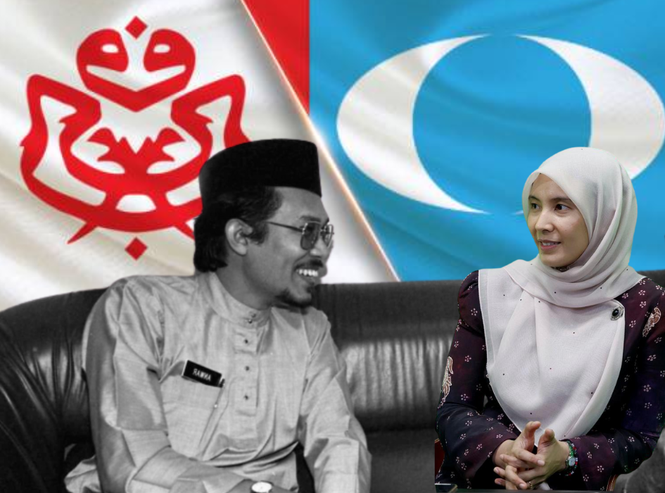
The echoes of 1993 ring loud in 2025 as history loops through bloodlines and ballot boxes. Will Rafizi re-emerge as a last-minute challenger in the 2028 presidential race against Nurul Izzah? He once warned Izzah’s camp never to underestimate him.
On August 23, 2024, I wrote an article exploring the parallels between the Thaksin-Paetongtarn and Anwar-Izzah dynamics — particularly in how Thaksin Shinawatra and Anwar Ibrahim maintained familial dominance at the helm of their respective parties. It posed a pressing question: Was Nurul Izzah inspired by Paetongtarn’s rise to Prime Minister? Coincidentally, exactly nine months later on May 23, 2025, Nurul Izzah Anwar officially assumed the number two position in Parti Keadilan Rakyat (PKR).
What piqued my interest more was how this party election mirrored the 1993 UMNO contest. Then, Anwar Ibrahim challenged Ghafar Baba for the Deputy President role — a young lion shaking the old guard. Like their predecessors, both Anwar and Izzah were first-time challengers to incumbents, and although their victories seemed inevitable to the public domain, the process unfolded with drama and surprise.
First Parallel: At the beginning, neither Anwar nor Izzah declared intentions to contest the deputy presidency, only to later announce their bids under the banner of grassroots pressure. While such a move caught some off guard, Rafizi Ramli appeared to anticipate it, and the earlier branch-level nominations didn’t favor his camp. Ghafar Baba, too, had foreseen a potential challenge from Anwar as early as April 1993.
Second Parallel: Anwar was branded the youthful hope of UMNO, while Izzah was framed as the reformist heiress — a bearer of her father’s torch. Both leaned on the narrative of youthful leadership essential for the party’s future. Their strategies in harnessing mainstream media to craft and sell their image to delegates were strikingly similar. Anwar was hailed “Top 4 Best Finance Minister” by Euromoney in 1993, while in 2025, Izzah was named among 30 in Project Syndicate’s Forward Thinkers list.
Third Parallel: Both campaigns leaned heavily on youth wings. In 1993, Anwar had Zahid Hamidi, Najib Razak, and Muhyiddin Yassin as loyal supporters persuading delegates. Izzah enjoyed the backing of young figures like Adam Adli and Kamil Munim, who saw her as PKR’s torchbearer. Strikingly, both campaigns received full backing from the Information/Communications Ministers of different eras—Mohammed Rahmat then, and Fahmi Fadzil now.
Fourth Parallel: Ghafar was pushed out through a narrative of dwindling support, a pressure tactic echoed in Rafizi’s case, where a national narrative emerged painting him as completely rejected by the grassroots. These narratives served to corner the incumbents into stepping down—pushed Ghafar to withdraw, though it failed with Rafizi. Interestingly, both Rafizi and Ghafar expressed intentions to resign from Cabinet roles if they lost the Deputy President race.
Fifth Parallel: Money politics shadowed both contests. Malaysia’s Political Economy (1997) alleged RM300 million — some from the stock market — funded UMNO’s 1993 election campaign. Rafizi later revealed that a female candidate spent hundreds of thousands on campaign headscarves. These allegations, analysts argue, reflect one of the most extravagant examples of campaign spending in the history of both UMNO and PKR.
Thirty-two years after Anwar ousted Ghafar, a similar campaign pattern ushered in Nurul Izzah’s victory over Rafizi. I see this as a new political equation in PKR. Nurul Izzah is likely being groomed to succeed her father — who will be over 80 by the 2028 party elections — possibly becoming Malaysia’s first female Prime Minister. This narrative may appeal strongly to young voters in the next general election.
Hence, Izzah might not serve in Anwar’s government, except perhaps as a senator. Her role as Deputy President demands her full attention to maintain influence within PKR’s grassroots. If entangled in administration, she risks sharing Rafizi’s fate — losing touch and momentum.
Ironically, Rafizi may emerge more popular post-defeat. He might resign as minister and even leave PKR. Yet he could still retain his Pandan seat as an independent. Talks may also take place to keep him within the cabinet, mending ties between the HIRUK and DAMAI factions ahead of GE16.
Ultimately, the climax could see Nurul Izzah “challenging” Anwar Ibrahim for the presidency in 2028 — a staged democratic drama PKR might celebrate. Publicly, we’ll see a symbolic and smooth transition. But, will Rafizi re-emerge as a last-minute challenger in the 2028 presidential race against Nurul Izzah? He once warned Izzah’s camp never to underestimate him.
Amir Al Fateh is a content creator under the Newswav Creator programme, where you get to express yourself, be a citizen journalist, and at the same time monetize your content & reach millions of users on Newswav. Log in to creator.newswav.com and become a Newswav Creator now!
The User Content (as defined on Newswav Terms of Use) above including the views expressed and media (pictures, videos, citations etc) were submitted & posted by the author. Newswav is solely an aggregation platform that hosts the User Content. If you have any questions about the content, copyright or other issues of the work, please contact creator@newswav.com.