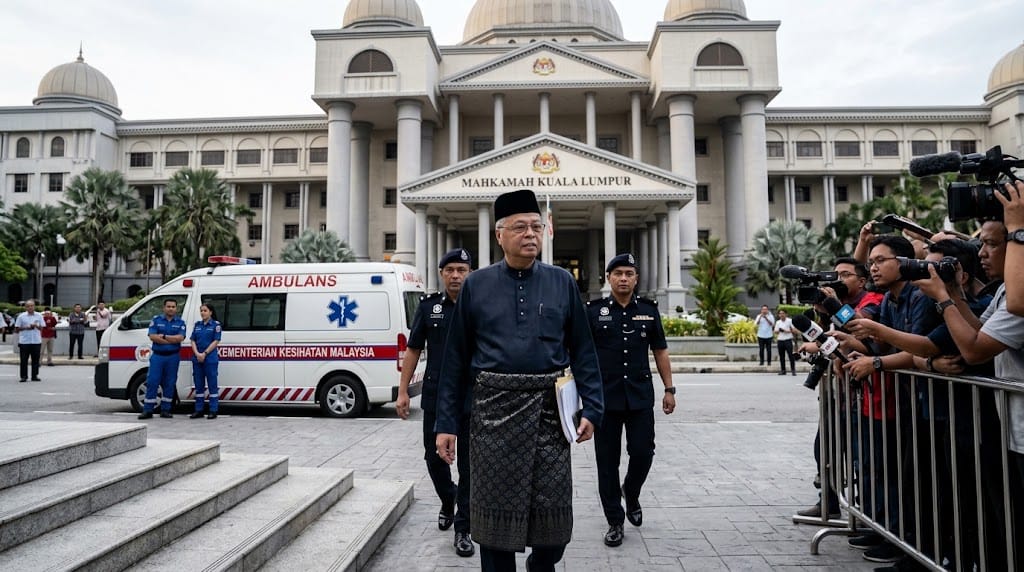
The road to the dock at the Kuala Lumpur Court Complex now comes with a mandatory pit stop at the National Heart Institute (IJN). Exactly two weeks ago, when the former prime minister was first scheduled to face the judge, his heart suddenly decided to take an unscheduled break stopping for two full seconds and landing him in hospital for an emergency leadless pacemaker procedure. Medical science prevailed, his health bounced back just in time, and he was able to make his grand, fully-recovered entrance. Yet, stepping through those courthouse doors, Ismail Sabri Yaakob looked less like a lone defendant and more like a late attendee at an ongoing ex-Prime Ministers' convention. With three former premiers hauled before the courts to face distinct charges of financial mismanagement and graft, premier criminality has ceased to feel like an extraordinary anomaly; it has comfortably settled in as an institutional routine.
The latest chapter unfolded with Ismail Sabri charged under Section 36(2) of the Malaysian Anti-Corruption Commission (MACC) Act for failing to declare his assets. While ordinary Malaysians spent the pandemic era queuing up for EPF targeted withdrawals and micro-grants just to keep their stalls open, Ismail Sabri was busy orchestrating what might be the most breathtaking personal productivity drive in Malaysian history. Over a brief 15-month tenure in the nation’s top office, he stands accused of keeping an undisclosed treasury valued at roughly RM163 million spread across ten foreign currencies including Swiss Francs, Euros, Japanese Yen, and UAE Dirhams, alongside five 1kg Suisse fine gold bars.
Mathematically, that represents a personal asset accumulation rate of over RM10 million for every single month he spent in Putrajaya.
For a leader whose entire political persona was wrapped in the rustic, humble charm of Bera and who cheered us up during lockdowns by debuting a different high-end designer batik shirt on TV every afternoon, the irony is thick enough to cut with a parang. It turns out the paternal slogan of Keluarga Malaysia came with a very exclusive family trust fund. The national family budget was apparently not preserved in modest ASB units or local savings accounts, but in a private, multi-currency bureau de change that could put the money changers at Mid Valley to shame.
Yet, the core issue goes deeper than the jaw-dropping scale of the foreign hoard. The true systemic problem lies in the legal mechanism used to pursue it.
Charging high-profile political figures with the procedural failure to declare assets rather than directly prosecuting the source of illicit enrichment creates a profound legal disconnect. Administrative non-compliance functions as convenient low-hanging fruit. It allows enforcement agencies to score procedural victories and collect fines while leaving the paramount question completely untouched: How does a career politician on a government salary amass a mini central bank of Swiss gold and foreign cash in the first place?
When justice settles for paperwork violations, it risks sanitizing systemic corruption. It treats what ought to be a fundamental investigation into plunder as a mere clerical oversight. This is precisely why Malaysia’s legal framework urgently requires structural evolution, specifically through the introduction of Unexplained Wealth Orders (UWOs). Without laws that legally obligate public officials to prove the legitimate origin of assets disproportionate to their known official income, procedural charges will remain a soft, unsatisfactory compromise.
To rely strictly on procedural notices is to perpetuate the ancient local caution: harap pagar, pagar makan padi. When institutional accountability stops at procedural technicalities, democratic fatigue sets in. The greatest long-term threat to the nation is not merely the missing millions, but the quiet normalization of political greed and the tragic erosion of public trust.
“When wealth accumulated in office can only be challenged on the paperwork left behind, accountability is reduced to a clerical filing fee.” - Annan Vaithegi
Annan Vaithegi (annanvaithegi@icloud.com) is a content creator under the Newswav Creator programme, where you get to express yourself, be a citizen journalist, and at the same time monetize your content & reach millions of users on Newswav. Log in to creator.newswav.com and become a Newswav Creator now!
The User Content (as defined on Newswav Terms of Use) above including the views expressed and media (pictures, videos, citations etc) were submitted & posted by the author. Newswav is solely an aggregation platform that hosts the User Content. If you have any questions about the content, copyright or other issues of the work, please contact creator@newswav.com.