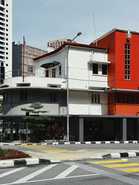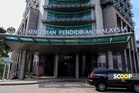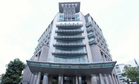
If the Ministry of Education (KPM) can enforce racial equity quotas on the ownership structures of private establishments, what guarantee is there that other ministries and government agencies won't pass similar policies for sectors under their respective purview?
Lately, events in this country have been unfolding at a breakneck pace—with Najib's pardon, the Negeri Sembilan royal dispute, and now this 30% Bumi equity ‘bombshell’ for tuition centres!
In the latest controversy to hit the nation, Petaling Jaya MP Lee Chean Chung has called on KPM to clarify whether existing tuition centres without 30% Bumiputera equity will be denied registration renewal from 2027.
According to Lee, the requirement appears in official KPM registration guidelines covering all four categories of private education centres — tuition centres, language and skills centres, franchise education systems, and branches.
He also noted that the ministry has not explained the legal or policy basis for linking education registration to the racial composition of company shareholding.
Lee went on to stress that education regulation should primarily focus on teaching standards, teacher qualifications, student safety, premises, and compliance with the law, urging KPM to consult affected operators and issue clear guidance before any 2027 implementation.
Meanwhile, reacting to this latest mind-boggling revelation, the Melaka Action Group for Parents in Education (Magpie) and independent scholar Sharifah Munirah Alatas said the move was not only unfair to operators who have built their businesses over years, but also failed to encourage actual Bumiputera entrepreneurship.
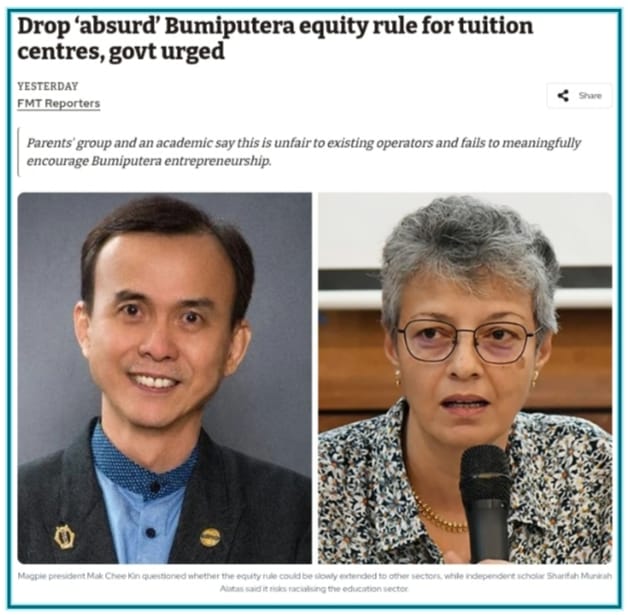
(Screenshot of news headline and image from Free Malaysia Today)
Sharifah alluded to the policy as being absurd, warning that it risks racialising the education sector, while alleging how distracted the education ministry is from more pertinent issues.
She argued in a Facebook post that this directive may yet be another example of how our government gets bogged down in trivial administrative interventions while failing to focus on core obligations — such as teacher training, administrative bloat, teacher workload, and pressing classroom challenges.
She further contended that the 30% equity condition merely redirected earned benefits to passive groups instead of actually nurturing real Bumiputera entrepreneurs in the sector.
Quick bucks for a lucky few, at the expense of the blood, sweat, and tears of others?
Meanwhile, parents' group Magpie's chairman, Mak Chee Kin, expressed a similar concern, asking: “Is it fair to require existing businesses, some of which have operated successfully for decades, to surrender 30% of their ownership simply to continue operating?
According to him, these entrepreneurs invested their own money, took risks, employed teachers, and built their centres from the ground up. Should they be penalised by a policy introduced years after they established their businesses?
Most notably, Mak also questioned whether the Bumiputera equity rule could gradually creep into other sectors.
Frankly, isn't that exactly what many genuine, hardworking business owners will be silently fearing now?
What could be next—gyms, music schools, yoga centres, and heaven knows what else? Will the sky be the limit?
The thing is, won't such a requirement unfairly force owners to surrender 30% equity just to renew a licence, penalising genuine effort while creating unproductive ‘sleeping partners’?
Wouldn't it perpetuate a form of ‘Ali Baba’ culture which the government is already trying its best to eradicate?
For sure, this latest controversy is bound to leave the already confused public scratching their heads and asking: What exactly is in KPM's mind?
Instead of calculating and enforcing ‘shareholding ratios’ for businesses, shouldn't they be collectively racking their brains to come up with holistic measures to fix the much-publicized weaknesses in our public education system?
Not too long ago it was the controversial guidelines for non-Muslim houses of worship in Selangor that sparked a huge uproar — and now, this?
Seriously, have logic and common sense packed their bags and left this land?
Ultimately, what many infuriated members of the public may be left wondering is this: What other absurd 'guidelines' could be turning up unannounced at our doorstep next? And will the PH government review the policy fast and revoke it before the 2027 deadline?
Notes to Ponder: According to a report, the 30% Bumiputra equity requirement for private education centres was passed by the BN government in 2006 under the then Education Minister Hishamuddin Hussein. So where was MCA and Gerakan then?
Main information source: The Rakyat Post and Free Malaysia Today.
JK Joseph (jtkingsworld@gmail.com) is a content creator under the Newswav Creator programme, where you get to express yourself, be a citizen journalist, and at the same time monetize your content & reach millions of users on Newswav. Log in to creator.newswav.com and become a Newswav Creator now!
The User Content (as defined on Newswav Terms of Use) above including the views expressed and media (pictures, videos, citations etc) were submitted & posted by the author. Newswav is solely an aggregation platform that hosts the User Content. If you have any questions about the content, copyright or other issues of the work, please contact creator@newswav.com.