
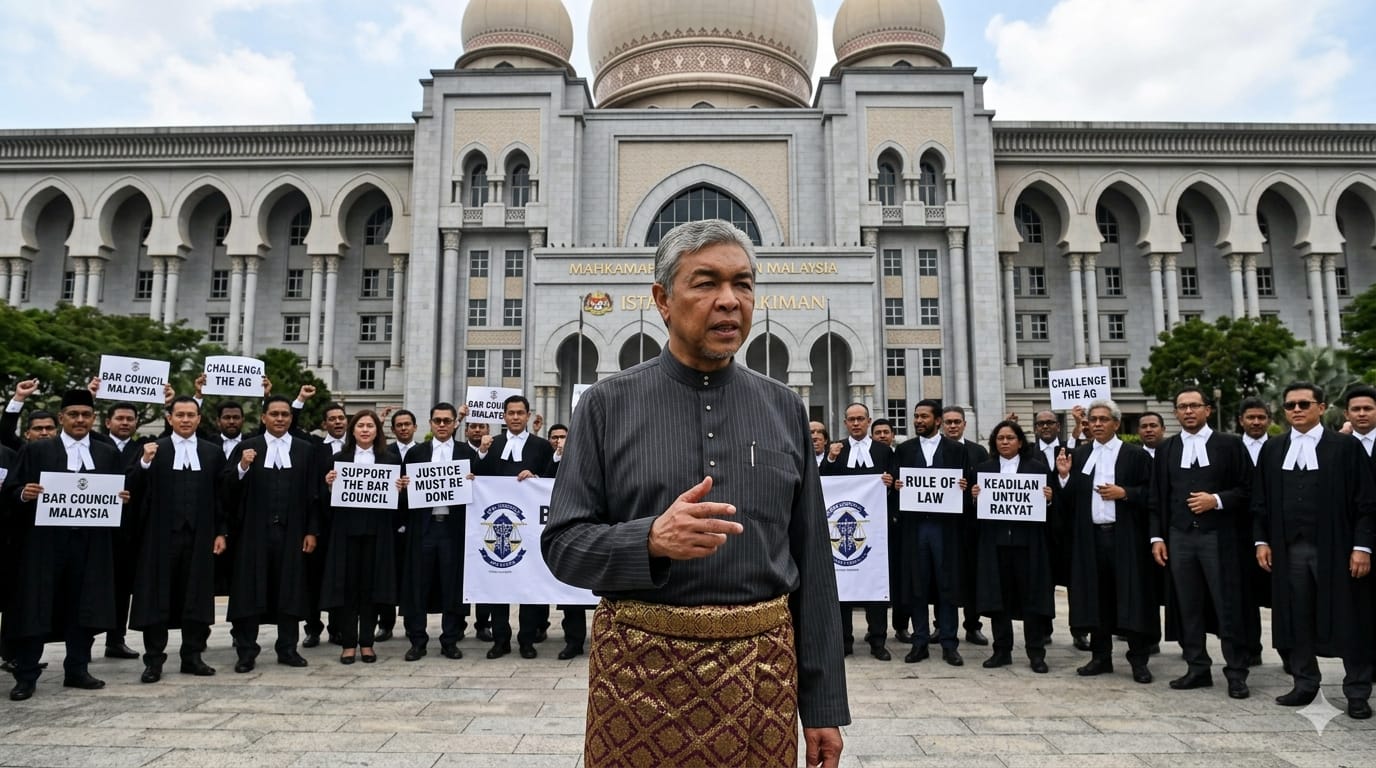
Let us get one thing straight first. The Malaysian Bar is not suing the Judge.
The Bar is not attacking the judiciary.
The Bar is questioning the process used by the Attorney General’s Chambers (AGC) in the decision involving Ahmad Zahid Hamidi’s DNAA on 47 charges.
That distinction matters.
Because right now, many ordinary Malaysians are not angry at the courts. In fact, many are saying “syabas” to the judiciary for allowing the Bar’s judicial review application to move forward. Why? Because for many rakyat watching this whole drama unfold, the courts now look like the last remaining institution willing to let difficult questions be asked openly.
And honestly, can you blame the public for feeling uneasy?
Forty-seven charges.
Not four.
Not seven.
Forty-seven.
The prosecution had already called more than ninety-nine witnesses. The defence had started calling witnesses too. The trial was already deep inside the process. Then suddenly boom the charges were withdrawn halfway through the journey.
Of course people started saying it smelled fishy.
This is Malaysia lah. People may not know constitutional law or Article 145(3), but they know when something feels odd. They know when things look like they are being swept under the carpet.
And this is the problem the AGC still does not seem to understand.
Justice must not only be done but must be seen to be done.
That sentence is not just legal decoration for textbooks. It is the foundation of public confidence. Once people stop believing the system treats everyone equally, the entire structure starts shaking.
Today, many Malaysians feel the system bends differently when VVIPs are involved. If an ordinary makcik, lorry driver, or small businessman faced 47 charges, would the process suddenly stop halfway? That is the uncomfortable question hanging over this case.
Nobody is saying the AG broke the law.
Even many legal experts admit the Attorney General has broad powers under the Constitution. Fine. Legally, maybe everything is proper.
But rakyat are asking something deeper.
If the law allows something that feels unfair to the public, then maybe the problem is no longer just about law it is about trust.
This is why the Malaysian Bar’s move matters.
For many frustrated Malaysians, the Bar now looks like the last bastion against a system they feel has been gamed for crooked elites while ordinary people are told to trust the process quietly.
And the irony?
The judiciary now appears more willing to let scrutiny happen than the institutions supposedly defending public confidence.
That is why this issue refuses to die.
Because the rakyat are no longer debating technicalities.
They are debating belief.
And once belief collapses, no amount of press statements or legal explanations can easily rebuild it.
The Political Analyst
Again, let us begin with the most important point often lost in the political shouting.
The Malaysian Bar is not challenging the Judge.
It is challenging the Attorney General’s process.
That distinction is politically explosive.
Why?
Because the Court of Appeal’s decision to allow the Bar’s judicial review application has unintentionally created a dangerous contrast inside the Madani government itself: the judiciary increasingly appears institutionally confident, while the Attorney General’s Chambers appears politically vulnerable.
For Prime Minister Anwar Ibrahim and the Madani administration, this is not merely a legal headache. It is political quicksand.
The deeper the government tries to defend the Zahid DNAA issue procedurally, the more the public conversation shifts toward legitimacy, perception, and political compromise.
And perception, in politics, is often more powerful than legal technicalities.
The symbolism is devastating.
Forty-seven charges.
A prima facie case already established.
More than ninety-nine prosecution witnesses already heard.
Then a DNAA arrives before final judgment.
Legally defensible? Perhaps.
Politically survivable? That question is becoming harder.
The real danger here is not immediate collapse. The danger is slow erosion.
The Madani government was built heavily on moral language reform, institutional integrity, governance, accountability. But when a politically sensitive prosecution involving the deputy prime minister is halted midway, the government’s reform narrative begins colliding with its coalition realities.
This is where the political quicksand begins.
UMNO needs Zahid.
Anwar needs UMNO.
DAP needs coalition stability.
And every party inside the coalition understands that destabilising the arrangement risks reopening old political chaos.
But the more the coalition appears dependent on preserving political survival at all costs, the more public confidence shifts away from the executive branch and toward the judiciary.
Ironically, the courts may now emerge from this controversy with stronger institutional credibility than the AG’s office itself.
That is a remarkable reversal.
For years, reformists demanded judicial independence. Today, many Malaysians are quietly saying “syabas” to the courts simply for allowing scrutiny to continue.
At the same time, the AG’s office increasingly faces a perception problem it cannot solve merely through legal arguments.
This matters because governments rarely fall from one scandal alone. They weaken when small controversies accumulate into a broader narrative.
And the broader narrative now forming around the Madani government is uncomfortable: reform rhetoric at the top, but political accommodation underneath.
The coalition may survive this legally.
But politically, the damage is cumulative.
There is also a growing “Negeri Sembilan style” anxiety inside the coalition itself a fear of slow internal instability rather than dramatic collapse. Quiet dissatisfaction. Grassroots frustration. Supporters who remain publicly loyal but privately exhausted.
That kind of instability is often more dangerous than open rebellion because it weakens morale silently.
The Madani government now faces a defining dilemma.
Can it continue defending coalition survival while simultaneously preserving its reform credibility?
Because eventually, every reform government reaches the same brutal crossroads:
political survival versus the rule of law.
And once the public begins believing survival matters more than principle, trust does not collapse overnight.
It drains away slowly.
One controversy at a time.
The Reformist
Dear Malaysians,
Before anything else, remember this carefully.
The Bar is not suing the Judge.
The Bar is asking whether the Attorney General’s process in stopping Zahid Hamidi’s 47-charge corruption trial should itself be questioned.
That is not rebellion against the judiciary.
That is accountability.
And honestly, the rakyat deserve answers.
Because here is the million-dollar question:
If a prima facie case had already been established, why stop halfway?
The prosecution had already called nearly one hundred witnesses.
The defence had started its case.
The trial was moving toward a conclusion.
So why not let the Judge decide?
Simple question.
No need for complicated legal gymnastics.
If Zahid was innocent, then let the court acquit him.
If Zahid was guilty, then let the court convict him.
That is literally how justice is supposed to work.
Instead, the process stopped in the middle, and now ordinary Malaysians are expected to simply move on quietly.
Sorry lah.
People are not stupid.
This is why so many voters especially those who once shouted loudest about reform now look emotionally exhausted. Some have gone politically “hibernating.” Not because they suddenly support corruption, but because disappointment has slowly replaced belief.
That is the real danger.
Not anger.
Apathy.
A nation can survive noisy protests.
What it cannot survive is citizens who quietly stop believing integrity matters.
And integrity matters because integrity leads and lasts.
Without integrity, reform becomes branding.
Without integrity, Madani becomes slogan management.
Without integrity, the law starts looking like two separate systems one for ordinary Malaysians and another for VVIPs.
That is why this case matters beyond Zahid himself.
Because once powerful people appear able to walk away from 47 charges through procedural discretion, the ordinary citizen begins asking a very dangerous question:
What exactly is the law protecting anymore?
The rakyat are not demanding mob justice.
They are demanding transparency.
They are demanding consistency.
They are demanding the same legal energy applied equally regardless of title, rank, or political importance.
And if the institutions cannot explain convincingly why this process happened the way it did, then public suspicion will continue growing.
Not because people hate the law.
But because they fear the law is becoming a joke when power enters the room.
Malaysia does not need louder slogans.
Malaysia needs institutions brave enough to withstand scrutiny.
Because in the end, justice must not only be done.
It must be seen to be done.
And right now, far too many Malaysians are still waiting to see it.
Annan Vaithegi writing on power, governance and society
Annan Vaithegi (annanvaithegi@icloud.com) is a content creator under the Newswav Creator programme, where you get to express yourself, be a citizen journalist, and at the same time monetize your content & reach millions of users on Newswav. Log in to creator.newswav.com and become a Newswav Creator now!
The User Content (as defined on Newswav Terms of Use) above including the views expressed and media (pictures, videos, citations etc) were submitted & posted by the author. Newswav is solely an aggregation platform that hosts the User Content. If you have any questions about the content, copyright or other issues of the work, please contact creator@newswav.com.