
When the viral video of a child running after her mother’s car began circulating online, the public’s reaction was swift and judgmental. Comment sections filled with accusations: “How could a mother be so cruel?” and “She must have wanted to traumatise her child.”
But such comments misunderstand human reality. The mother did not set out to abandon her child. What we saw was not malice, but Murphy’s Law in action: if something can go wrong, it will go wrong.
Human beings are creatures of habit. We rely on routine and muscle memory to get through our days. Most of us do not consciously think through every action while driving, cooking, or getting ready for work. We perform these tasks almost robotically, trusting the patterns we’ve repeated countless times.
Now imagine a mother who is used to hearing two car doors shut before driving off, because both her children usually get in quickly. One day, one child shuts the car door twice while the other lags behind. The sound of two “thunks” convinces the mother that everyone is inside. Distracted, rushing, or thinking about her next errand, she drives off. She makes a mistake — a dangerous one, yes, but also a very human one.
If she was running late, if her mind was occupied with other stresses, or if something as simple as an urgent need to use the bathroom intruded, the chances of making that mistake only multiplied. That is Murphy’s Law: the inevitability of error when routines and reality collide.
The lesson here is simple but important: not every unfortunate incident is born out of intent. Sometimes, it is just the fallibility of human beings doing their best in a busy, chaotic world.
From the Car Door to the Flagpole
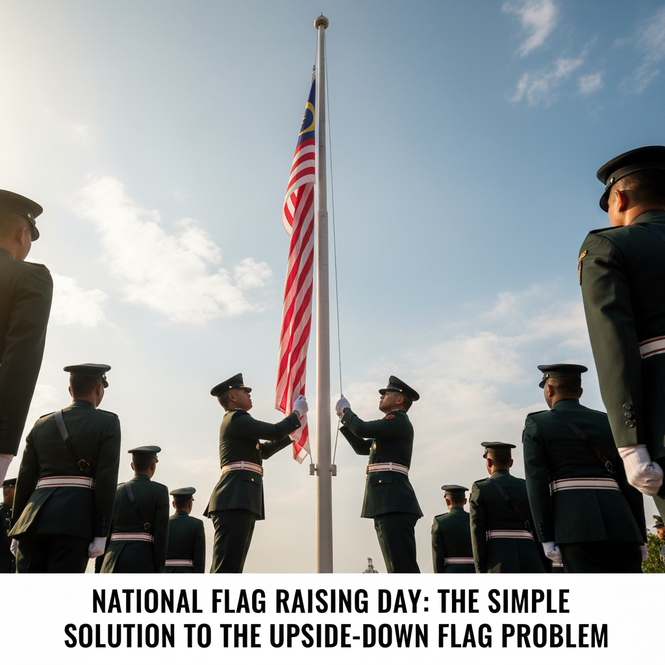
The same principle helps explain the wave of flags being flown upside down across the country in the lead-up to Merdeka.
Many Malaysians find it hard to believe that so many mistakes could happen “by accident,” especially after repeated warnings from authorities and the publicity around recent cases. Some insist it must be deliberate sabotage, a silent protest, or even an act of disloyalty.
But I beg to differ.
Most people are not glued to the news. They are not obsessively following every political controversy or government statement. Instead, they are preoccupied with the ordinary but exhausting business of life.
If you show the faces of Ahmad Zahid Hamidi or Fadillah Yusof — the country’s two deputy prime ministers — to a hundred Malaysians working long shifts or running small businesses, I would not be surprised if half of them could not name who they are. That is not because ordinary Malaysians are careless or apathetic, but because their attention is consumed by more immediate concerns: keeping their jobs, paying their bills, raising their families.
The same holds true for raising the national flag.
A Chore, Not a Ceremony
For many, the act of putting up the Jalur Gemilang during Merdeka season is not treated as a sacred ritual but as one more task in a long list of daily chores.
Imagine a parent squeezing in the job of flag-raising in the short window between picking up the kids from school and starting dinner, or after finishing the laundry but before visiting a sick relative in hospital. In those ten or fifteen minutes, the flag is dug out, dusted off, fixed to a pole, and hoisted up in the usual spot. Then life moves on to the next urgent demand.
This does not mean people do not respect the flag. On the contrary, they are making the effort to put it up despite their limited time. But because it is one task among many, it is subject to the same human inattentiveness that leads us to forget groceries at the supermarket or misplace our car keys.
And just as a mother can forget her child for one terrifying moment, so too can a person, in haste or distraction, hang a flag upside down.
The Numbers Don’t Lie
Consider this: suppose one million flags are flown during the Merdeka season. If even 0.1 percent are raised incorrectly, that would still amount to 1,000 upside-down flags.
In statistical terms, this is entirely normal. In fact, it would be surprising if every single one of a million flags were perfectly displayed, given the fallibility of human beings.
What has changed is not necessarily the number of mistakes, but our sensitivity to them. In previous years, an upside-down flag might have been ignored, corrected quietly, or dismissed as a trivial slip. Today, in the age of smartphones and social media, every mistake becomes a viral photo, amplified as evidence of disrespect or rebellion.
We may not be seeing more mistakes. We may simply be seeing them more clearly.
Two Paths Forward
If this is the reality, then there are really only two ways to respond.
The first is the traditional way: accept that errors are inevitable. Out of a million flags, a thousand mistakes are not a sign of widespread disloyalty. They are simply statistical noise — the inevitable cost of being human. To interpret every upside-down flag as an insult is to misunderstand both people and probability.
The second is to redesign the ritual. If flag errors are truly intolerable, then perhaps Malaysia should dedicate a fixed day and time for raising the Jalur Gemilang — say, on 1 August at 10am — and even declare it a public holiday. If everyone were free from other duties and treated flag-raising as a national ceremony, then mistakes would indeed be less forgivable.
Until such a system exists, however, we must grapple with the truth that errors will always slip through. That is the nature of life, the nature of routine, the nature of Murphy’s Law.
Choosing Our Interpretation
In the end, the question is not whether mistakes will happen. They will. The question is how we choose to interpret them.
We can see the mother driving off without her child as cruel, or we can see her as human. We can see an upside-down flag as treason, or we can see it as a mistake made by a tired shopkeeper rushing between errands.
One interpretation breeds outrage. The other breeds understanding.
As we celebrate Merdeka, perhaps we should remember that patriotism is not measured by flawless execution of ritual, but by the countless ordinary acts of Malaysians who, despite the chaos of daily life, still find a few spare minutes to raise their flag at all.
TheRealNehruism (nehru.sathiamoorthy@gmail.com) is a content creator under the Newswav Creator programme, where you get to express yourself, be a citizen journalist, and at the same time monetize your content & reach millions of users on Newswav. Log in to creator.newswav.com and become a Newswav Creator now!
The User Content (as defined on Newswav Terms of Use) above including the views expressed and media (pictures, videos, citations etc) were submitted & posted by the author. Newswav is solely an aggregation platform that hosts the User Content. If you have any questions about the content, copyright or other issues of the work, please contact creator@newswav.com.
