
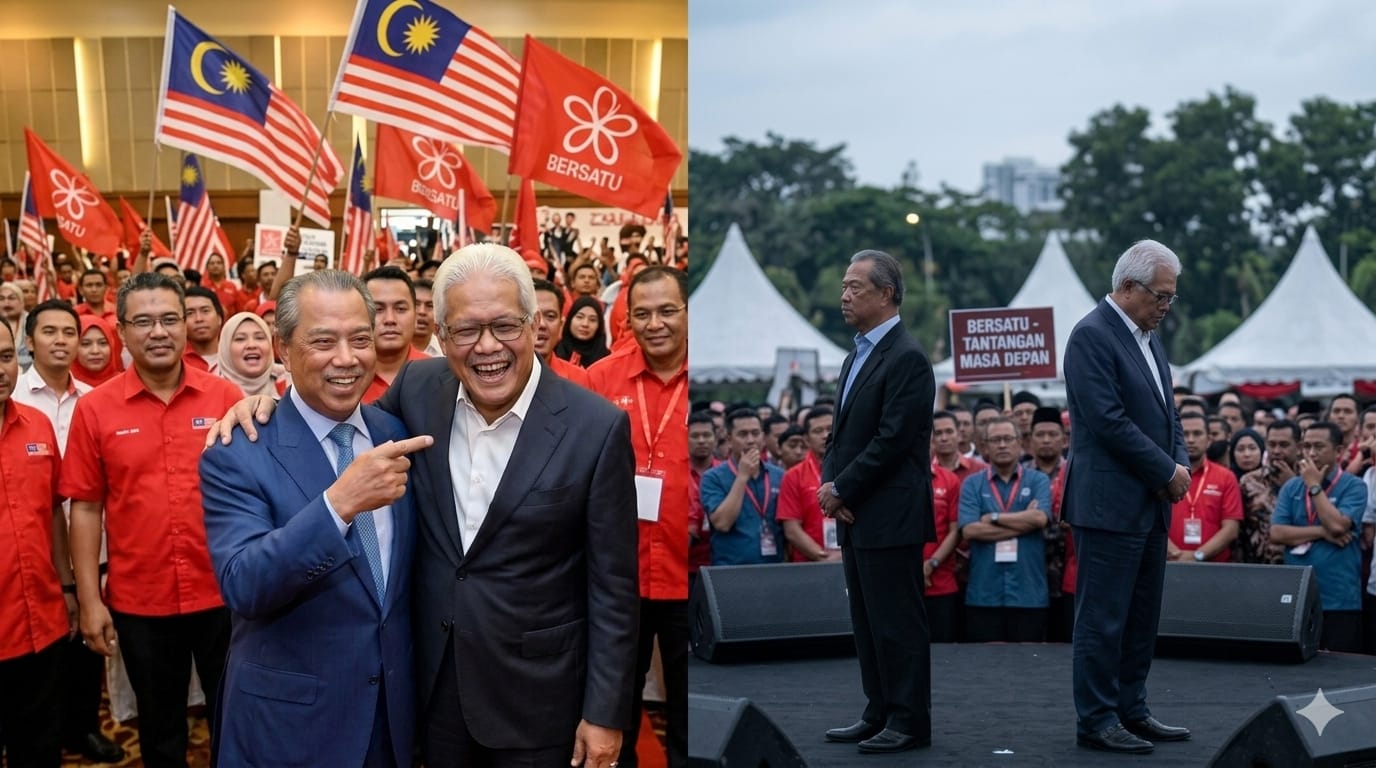
Malaysian politics has always been fond of relationships that defy ordinary definitions. There are marriages of convenience, arranged marriages, shotgun marriages, and then there are those uniquely Malaysian arrangements where both sides insist everything is fine in public while privately occupying entirely different political bedrooms. And occasionally, there is the most Malaysian of all political traditions: a divorce announced today, followed by a coalition meeting tomorrow, as if nothing emotional or structural had ever happened.
It is within this familiar ecosystem of shifting loyalties and carefully maintained smiles that the relationship between Tan Sri Muhyiddin Yassin and Datuk Seri Hamzah Zainudin must now be understood. Once upon a time, they were not merely colleagues in the same party; they were part of the same political machinery, moving in synchrony during the height of Perikatan Nasional’s rise to federal power. Hamzah was not a peripheral figure standing quietly behind Muhyiddin during press conferences. He was one of the key operators within Bersatu, eventually rising to become deputy president, and during the so-called “Abah” era, when Muhyiddin occupied Putrajaya, Hamzah was firmly embedded in the party’s internal engine room, helping to keep the coalition together during one of the most unstable periods in modern Malaysian politics.
Today, however, the photographs of that era feel like they belong to a different political family album altogether. The warmth of that earlier alignment has been replaced by distance, suspicion, and increasingly public accusations. Hamzah was expelled from Bersatu in February, a move that immediately transformed him from deputy president into political adversary. In the aftermath, he declared that he had gone from being Muhyiddin’s “number one supporter” to his “number one enemy”, while also questioning what he described as a “ghost” haunting the party. Not long after, he resurfaced with a new political vehicle, Parti Wawasan Negara, which itself was later admitted into the Perikatan Nasional coalition.
As if that were not already enough political drama for a single cycle, Muhyiddin then escalated the narrative further by publicly alleging that his former deputy had been involved in a “grand design” to depose him and take control of Bersatu. In ordinary conversational Malay, this is no longer the realm of marah tapi sayang. This is the point where the relationship has clearly moved beyond reconciliation, and into the territory where even the most optimistic family mediator would quietly suggest separate legal representation.
The Grand Design and the Hantu
The phrase “grand design” is one of those wonderfully dramatic expressions that Malaysian politics seems to reserve for moments of internal crisis. Nobody in Malaysian political life ever admits to having a small or modest plan. No one ever says, “There was a slightly ambitious discussion over teh tarik about leadership transition.” Instead, everything becomes a grand design, a master plan, or a carefully orchestrated manoeuvre, as if political disagreement cannot exist without cinematic scale.
Muhyiddin’s allegation frames the internal Bersatu conflict not as a routine leadership disagreement, but as something more structured: an organised attempt to displace him and take control of the party apparatus. It is important, however, to treat this as precisely that an allegation from one side of a fractured political relationship. Hamzah and his supporters have offered a different interpretation, portraying themselves as victims of internal purges and arguing that Bersatu had drifted away from its original direction.
What makes this episode striking is the context. This is Bersatu, a party born from rebellion within the Malay establishment, strengthened through defections, and elevated into federal power through one of the most consequential realignments in modern Malaysian politics. A party that once benefited from disruption is now experiencing disruption from within, and the irony is difficult to ignore.
For many observers, the situation triggers déjà vu. Malaysian political memory is not short when it comes to dramatic realignments. The Sheraton Move and other episodes have conditioned the public to expect that alliances are never truly stable, only temporarily aligned. At this point, it almost feels as though Malaysian political manoeuvres require their own travel brochure, complete with guided tours of coalition collapses and leadership transitions.
Hamzah himself added a theatrical layer when, after his expulsion, he questioned what “ghost” had taken over Bersatu. The remark quickly became part of the narrative, as if unseen forces were now needed to explain internal politics. In reality, there is no need for supernatural explanations when political relationships break down. More often than not, the “ghost” is simply accumulated ambition, mistrust, and competing visions of leadership.
The Apprentice and the Sifu
There is also a deeper irony resembling a mentor–student narrative. Muhyiddin has previously indicated that he supported Hamzah’s rise and envisaged a succession pathway for him. This transforms the dispute into something like a political martial arts story: the sifu trains the apprentice, the apprentice grows in strength, and eventually the question arises of who holds authority over the legacy of power.
Hamzah’s supporters reject this framing. For them, succession is not about personal promises but shifting support within the party. If MPs, grassroots members, and internal structures align behind a different figure, that is political reality, not betrayal. The tension lies between loyalty based on past relationships and legitimacy based on current support.
Political parties rarely resolve this cleanly because leaders almost never agree on when their own relevance begins to fade. Every politician supports renewal in principle, but prefers it after they have left the stage.
The Messy Divorce and New Alignment
The situation deepened when Hamzah launched Parti Wawasan Negara after his expulsion. The move was significant, but more striking was its rapid integration into Perikatan Nasional. A figure expelled from one founding party of PN returned through a new platform.
The symbolism is hard to miss. Bersatu helped form PN. Muhyiddin became closely associated with PN’s identity. Hamzah was expelled. He created a new party. That party was then welcomed into PN. In any other context, this would seem implausible, but in Malaysian politics, it is another chapter in fluid alliances.
This also reflects a broader shift. PAS, once a partner within PN, has strengthened its position, altering internal balance. As PAS grows, coalition negotiations become more complex, and no single figure dominates opposition coordination.
PAS and Changing Power
The Muhyiddin - Hamzah conflict cannot be separated from PAS’s evolving role. Alliances endure through overlapping interests, not sentiment. When interests diverge, partnerships become transactional.
Hamzah’s new platform adds flexibility for PAS, even if it does not elevate Wawasan to equal status with Bersatu. Muhyiddin is no longer the sole reference point in opposition politics, and that shift matters. Authority is often eroded long before it is formally removed; it begins when others realise they can operate without it.
Sheraton’s Long Shadow
The Sheraton Move continues to shape expectations. It taught that governments can change without elections and that numbers can redefine leadership overnight. Once that logic becomes normalised, similar behaviour inevitably appears within parties.
This does not validate conspiracy claims, but it explains why they are easily believed.
Opposition Fragmentation
Beyond personalities, the deeper issue is fragmentation. Energy that could be used for policy alternatives and governance critique is instead absorbed by internal disputes and coalition restructuring.
For voters, this creates fatigue. Politics begins to resemble a reality show of alliances and betrayals, all justified as being “for the rakyat”, while public concerns remain cost of living, wages, and stability.
Who Won?
There is no clear winner. Muhyiddin retains stature. Hamzah retains relevance. PAS retains strength. But outcomes will be judged over time.
The real questions are structural: can Bersatu survive fractures, can Wawasan establish identity, can PAS maintain consistency, and can opposition politics move beyond personality conflict?
The Real Grand Design
“Grand design” may ultimately be less about conspiracy and more about perception. Malaysian politics is defined by constant movement alliances, splits, and recombinations. Yet beneath it lies a deeper question: whether any of this produces long-term direction.
Today’s ally becomes tomorrow’s rival. Today’s rival becomes next month’s partner. Voters are left tracking shifting loyalties without stable ideological anchors.
Perhaps the real task is not to uncover hidden designs, but to build political systems that can survive ambition and succession without perpetual fragmentation.
Until then, the ghosts remain not because politics is haunted, but because it keeps repeating itself.
“In Malaysian politics, today’s trusted deputy can become tomorrow’s Grand Designer. The tragedy is that while politicians keep redesigning their alliances, the rakyat are still waiting for someone to redesign the country.” - Annan Vaithegi
Annan Vaithegi (annanvaithegi@icloud.com) is a content creator under the Newswav Creator programme, where you get to express yourself, be a citizen journalist, and at the same time monetize your content & reach millions of users on Newswav. Log in to creator.newswav.com and become a Newswav Creator now!
The User Content (as defined on Newswav Terms of Use) above including the views expressed and media (pictures, videos, citations etc) were submitted & posted by the author. Newswav is solely an aggregation platform that hosts the User Content. If you have any questions about the content, copyright or other issues of the work, please contact creator@newswav.com.