
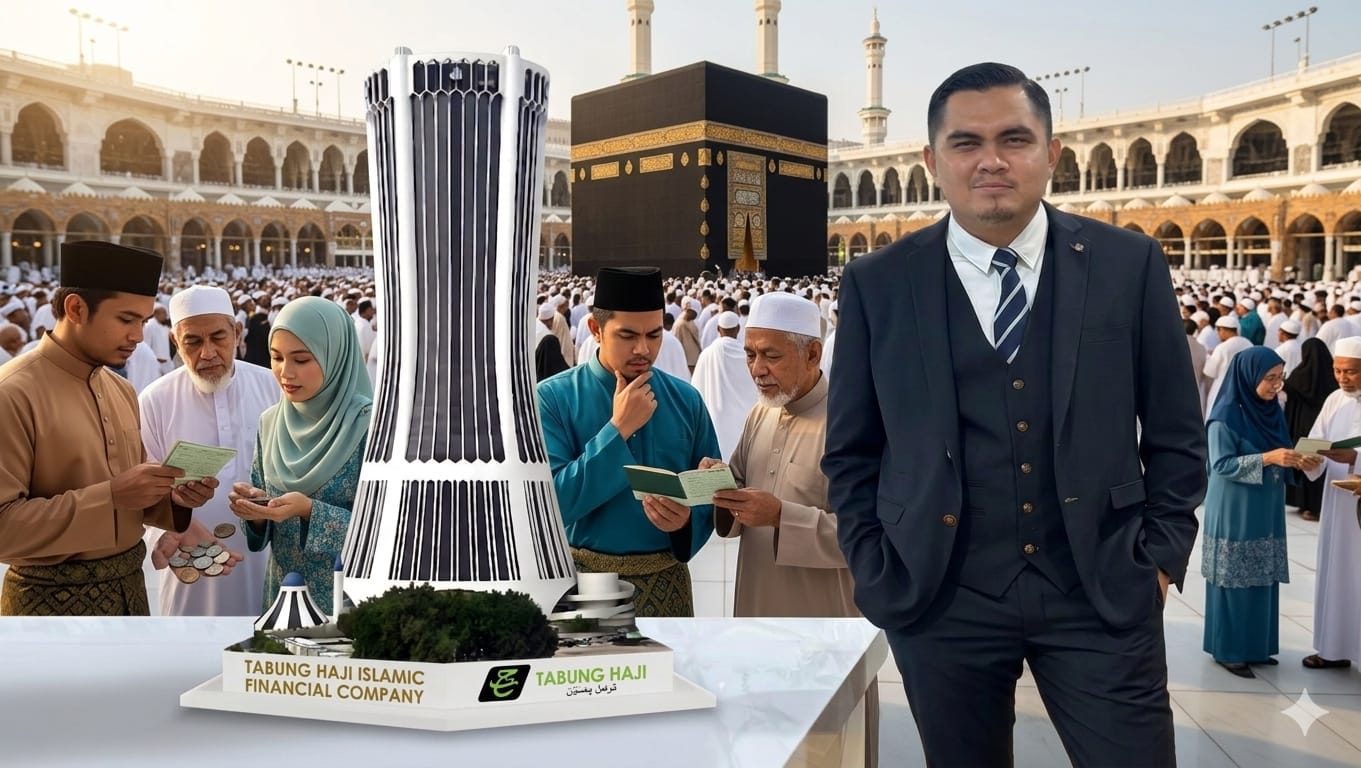
Imagine a pakcik in Jasin putting aside RM50 whenever he can.
Not for an iPhone. Not for a holiday in London. Not even for a new motorbike.
He saves because, perhaps once in his lifetime, he hopes to stand before the Kaabah.
For him, the money deposited in Lembaga Tabung Haji is not merely a balance on an app. It represents years of work, sacrifice, faith and hope.
It is AMANAH.
That is why the newly released Royal Commission of Inquiry report into Tabung Haji deserves something better than another round of Malaysian political ping-pong.
And that is why UMNO Youth chief Dr Akmal Saleh’s reaction deserves scrutiny.
Akmal has challenged those accusing UMNO politicians of “sakau” stealing Tabung Haji funds to produce proof and identify the politicians involved. Former Tabung Haji chairperson Abdul Azeez Abdul Rahim has meanwhile maintained that he was cleared, referring to statements by MACC chief Azam Baki.
Fair enough.
If someone alleges that a specific person stole money, prove it. Criminal culpability cannot be manufactured through hashtags, political speeches or comment sections. An RCI is not a criminal court, and an adverse institutional finding is not automatically proof that a particular individual committed theft.
But here is where Akmal’s question becomes far too convenient.
Because “who sakau?” is not the only question raised by the RCI.
The inquiry examined Tabung Haji’s management and operations over the 2014-2020 period after the institution came under intense scrutiny. A 2018 financial review had revealed an RM11 billion asset-liability gap. The government itself subsequently considered the institution sufficiently troubled to undertake restructuring, while the RCI was established to investigate what had happened.
So perhaps the better question is not merely:
Who stole?
It is:
Who decided?
Who approved?
Who supervised?
Who knew?
What financial controls failed?
What governance mechanisms failed?
What information was presented to decision-makers and depositors?
What warnings were ignored?
And if the RCI identifies conduct warranting further investigation, who will now investigate it and what consequences will follow?
That is accountability.
“Sakau or no sakau?” is a political slogan.
There is an important distinction here that should not be blurred for partisan convenience. Mismanagement is not automatically theft. Weak governance is not automatically corruption. Questionable accounting is not automatically a criminal offence by a named politician.
Each allegation requires evidence and, where criminal liability is alleged, proper investigation and due process.
But the reverse is equally true.
The absence of a sentence saying “Politician X stole RMX” does not magically convert institutional failure into competent management.
If your kampung surau’s accounts are in serious disorder, you do not close the AGM simply because nobody found cash stuffed inside the chairman’s songkok.
You open the ledger.
That should be obvious.
It should be especially obvious to a medical doctor.
Akmal is not an uneducated political novice struggling to understand a technical document. He is a trained physician and an elected assemblyperson. Medicine demands an ability to distinguish symptoms from causes, correlation from diagnosis, and suspicion from proof.
A doctor examining a patient with serious internal bleeding does not declare the patient healthy merely because he cannot immediately identify which blood vessel ruptured.
First, establish that something is wrong.
Then diagnose what happened.
Then determine the cause.
Then decide responsibility and treatment.
Why should our standard for a major national institution entrusted with Muslim savings be intellectually lower?
The RCI exists precisely because “everything okay, boss” was no longer an adequate diagnosis.
Prime Minister Anwar Ibrahim said before the report's release that he would not characterise the issues simply as corruption, but acknowledged major challenges requiring changes in Tabung Haji’s management. The government also said the institution is now on stronger footing following restructuring.
That nuance matters.
Unfortunately, nuance is rarely invited to Malaysian political rallies. It doesn't shout well through a microphone.
And this is where Akmal’s political identity makes his response particularly interesting.
He has built a significant part of his public persona around defending Malays and Islam. When he believes Malay dignity, Islamic sensitivities or communal interests have been challenged, Malaysians rarely need to send a search party looking for Akmal.
He will find the microphone.
Sometimes the microphone probably finds him.
But Tabung Haji presents a considerably harder test of what “defending Malays” actually means.
Defending Malays cannot mean defending only Malay feelings.
It must include defending Malay institutions.
Malay savings.
Malay economic security.
Good governance in institutions created principally to serve Muslims.
And above all, AMANAH.
Tabung Haji is not merely another investment company with shareholders studying quarterly earnings over cappuccino.
Its depositors include ordinary Muslims saving patiently to fulfil one of Islam’s fundamental obligations. That is precisely why public discussion around its governance carries an ethical dimension beyond ordinary corporate performance.
The government itself has described transparency over the RCI as important because depositors deserve to understand what happened, while experts have stressed that disclosure should identify governance weaknesses without prejudging criminal guilt before legal processes are completed.
That is the balance Akmal should be demanding.
Not immunity for UMNO.
Not guilt by association against UMNO.
Truth.
If UMNO politicians committed no wrongdoing, a rigorous investigation should establish that.
If executives acted improperly, establish it.
If political interference occurred, document it.
If regulators failed, identify how.
If accounting practices crossed legal lines, investigate them.
If nobody committed a crime but governance was catastrophically poor, say that too and identify who was institutionally responsible.
This is not anti-UMNO.
It is pro-amanah.
In fact, somebody genuinely interested in rehabilitating UMNO should want precisely this process.
The worst possible defence of a political party is to reduce accountability to the narrowest criminal threshold imaginable: unless you can show me the thief holding the money, stop asking questions.
Corporate governance does not work that way.
Neither does political responsibility.
A chairman can be responsible for governance failures without stealing RM1.
A minister can bear political responsibility without personally receiving RM1.
A board can fail its fiduciary duties without its members secretly meeting behind an Anneh coffee shop to divide cash-filled envelopes.
And an institution can suffer enormous damage through incompetence, bad incentives, weak controls, political interference or irresponsible decision-making without every failure satisfying the ingredients of criminal theft.
That is why an RCI matters.
It examines systems.
And systems are where Malaysia repeatedly fails because our politics prefers villains and heroes.
Villains are easy.
Systems require reading.
There is another uncomfortable question for the government itself.
Why did Malaysians have to wait years to read this report?
Anwar has said publication was delayed because releasing it earlier could have damaged confidence in Tabung Haji and triggered withdrawals while restructuring was underway. The government now argues that the institution is sufficiently stable for disclosure.
That explanation deserves scrutiny too.
Transparency should not become something governments dispense only when politically or institutionally convenient.
If the report identifies matters requiring enforcement action, Malaysians deserve to know why follow-up took the time it did, what investigations occurred previously, and what will happen now.
Accountability cannot wear a party jersey.
Not UMNO red.
Not PKR blue.
Not DAP rocket red.
Not PAS green.
Especially not when the money belongs to ordinary people.
And perhaps that is the larger lesson Akmal should take from this episode.
Malay politics has spent decades producing champions willing to defend Malays against somebody.
The Chinese.
DAP.
Liberals.
Foreign influences.
Occasionally a convenience-store chain.
But the Malay community does not merely need warriors against perceived external enemies.
It needs guardians of institutions.
Politicians willing to ask uncomfortable questions when the answers might embarrass their own side.
Leaders prepared to defend Malay wealth as fiercely as Malay symbolism.
Representatives who understand that protecting the community means ensuring its institutions are professionally governed, independently scrutinised and relentlessly accountable.
That requires considerably more courage than shouting “sakau siapa?”
So yes, Dr Akmal.
Ask for proof.
You should.
Demand that accusations against individuals be substantiated.
You should do that too.
But don't stop there.
Ask who made the decisions.
Ask who approved them.
Ask what the RCI found about governance.
Ask why weaknesses were allowed to persist.
Ask which recommendations have been implemented.
Ask what remains unresolved.
Ask whether further forensic investigation is required.
Ask MACC, the police, regulators and the Attorney-General’s Chambers what happens next.
And if the evidence ultimately clears every UMNO politician, say so loudly.
But if evidence establishes responsibility anywhere political, administrative, civil or criminal be equally loud then.
Because that is the difference between defending a political party and defending the Malays.
The first requires loyalty.
The second requires AMANAH.
And if Dr Akmal truly wants to be remembered as a champion of the Malays, Tabung Haji offers him a far more meaningful battlefield than another racial controversy ever could.
No boycott required.
No rally required.
No enemy required.
Just open the report, follow the evidence, and defend the pakcik's RM50 with the same ferocity normally reserved for defending Malay pride.
That would be a Malay champion worth listening to.
Annan Vaithegi, if you claim to defend a community, defend not only its dignity, but its money, institutions and amanah.
Annan Vaithegi (annanvaithegi@icloud.com) is a content creator under the Newswav Creator programme, where you get to express yourself, be a citizen journalist, and at the same time monetize your content & reach millions of users on Newswav. Log in to creator.newswav.com and become a Newswav Creator now!
The User Content (as defined on Newswav Terms of Use) above including the views expressed and media (pictures, videos, citations etc) were submitted & posted by the author. Newswav is solely an aggregation platform that hosts the User Content. If you have any questions about the content, copyright or other issues of the work, please contact creator@newswav.com.