
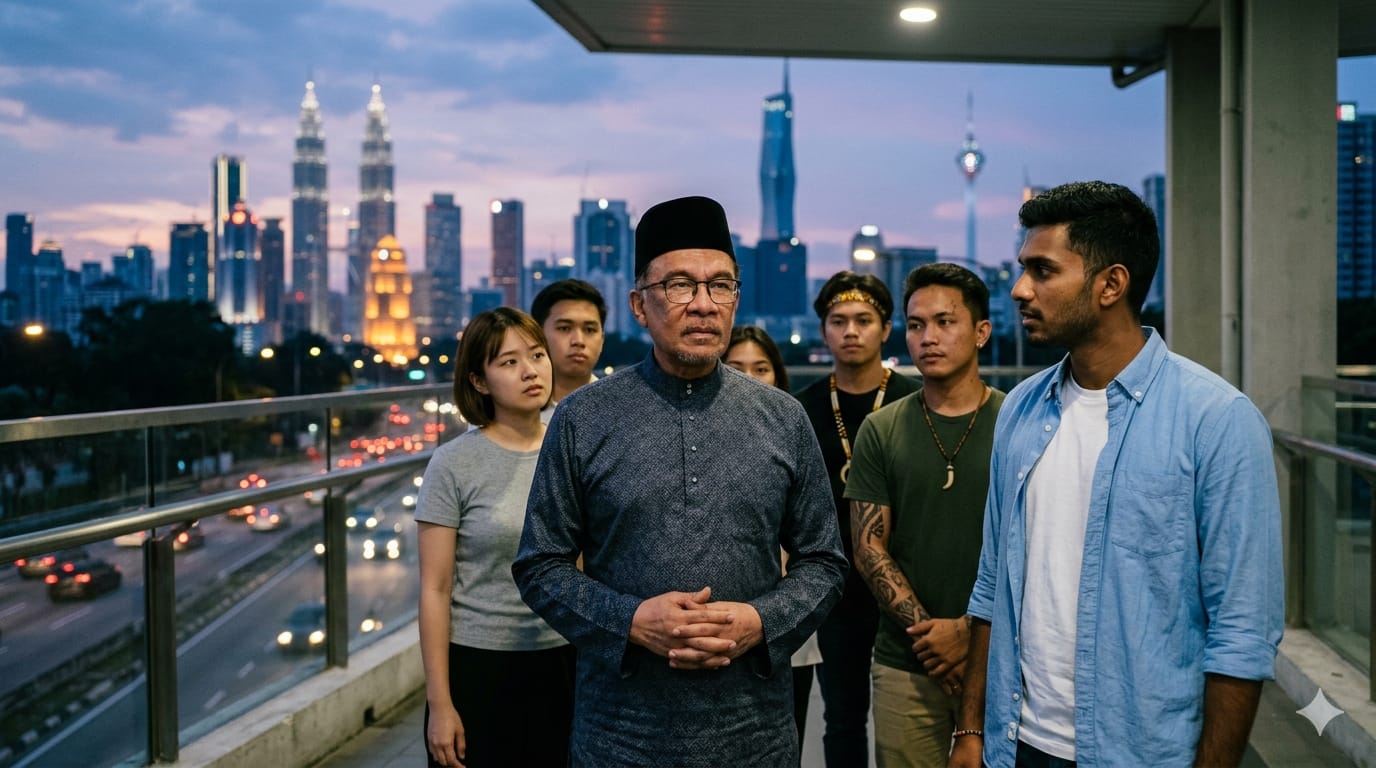
There was once a speech that made many Malaysians believe again.
A speech delivered with emotion, conviction, and the language of unity.
For many rakyat, especially minorities who had spent years feeling politically sidelined, those words were more than campaign rhetoric.
They sounded like reassurance.
Like a promise that finally, Malaysia could move beyond endless racial suspicion and selective empathy.
That was the spirit of Reformasi.
But today, as criticism now emerges not from the opposition but from within Anwar Ibrahim’s own coalition Malaysians are beginning to ask a painful question:
What happened to that promise?
When Your Own Coalition Starts Warning You
The recent warning by DAP MP V. Ganabatirau that anti-hate rhetoric means little without firmer government action is politically significant.
Not because disagreement inside a coalition is unusual.
But because it reflects something deeper:
A growing perception that the government’s language on unity has become stronger than its enforcement.
For months, Malaysians have watched repeated controversies involving racial and religious tensions.
Selective outrage.
Thousands of inflammatory comments circulating openly online.
And through all this, many ordinary citizens especially minorities increasingly feel the state reacts inconsistently.
That perception, fair or unfair, is politically dangerous.
Because trust once broken repeatedly becomes very difficult to rebuild.
The Silent Majority vs The Power To Act
Prime Minister Anwar Ibrahim recently called on the “silent majority” to speak up against extremism and hatred.
The sentiment sounds noble.
But Ganabatirau’s response reflects the frustration many Malaysians already feel:
The rakyat can condemn hate.
But only the government has the machinery to enforce laws consistently.
This is the heart of the growing DAP-PKR tension.
One side speaks about harmony.
The other increasingly asks:
Where is the firm action?
Because in a functioning democracy, national unity cannot depend entirely on citizens policing each other while institutions hesitate.
“Cakap Tak Serupa Bikin” Politics
This is where public disappointment becomes emotionally charged.
Anwar Ibrahim’s political brand was built on justice, fairness, reform, and courage against abuse of power.
For years, many Malaysians defended him passionately.
Some marched during Reformasi.
Some voted believing Malaysia would finally become more equal and less racially weaponised.
But increasingly, public reaction online reflects a painful phrase Malaysians understand immediately:
“Cakap tak serupa bikin.”
Say one thing.
Do another.
The frustration is not simply about speeches.
It is about perceived inconsistency.
When ordinary people are investigated quickly over certain issues, but influential political actors appear untouched despite repeated provocations, the rakyat naturally begin asking whether enforcement truly applies equally.
That is how trust deficits grow.
Not overnight.
But slowly.
Relentlessly.
DAP’s Growing Problem
The criticism aimed at DAP in recent months reveals another uncomfortable reality.
Many non-Malay supporters no longer ask whether DAP is inside government.
They ask whether DAP still has influence inside government.
For years, DAP positioned itself as a firm voice against extremism and selective treatment.
But now, parts of its support base accuse the party of becoming too cautious, too silent, or too absorbed in coalition survival.
Comments online increasingly describe the party as having “sold out,” “gone quiet,” or “woken up too late.”
Some openly threaten to abandon Pakatan Harapan entirely.
Whether fair or emotional, this sentiment matters politically.
Because coalition governments survive not only through parliamentary numbers.
They survive through belief.
And belief is beginning to erode.
The Tyranny Debate
One of the most controversial reactions surrounding Anwar’s recent remarks involved the phrase “tyranny of the minority.”
For many Malaysians, especially minorities already feeling politically vulnerable, the phrase landed badly.
Some immediately argued the opposite:
That Malaysia’s deeper historical tension has often been the fear of majority dominance rather than minority aggression.
This is why rhetoric matters.
In a multi-racial society already on edge, leaders cannot afford ambiguity when addressing racial and religious tensions.
Words shape confidence.
But actions determine whether confidence survives.
The Bodek Culture Problem
Another growing frustration among the rakyat is what many describe as “bodek politics.”
Whenever controversial issues emerge, parts of the political ecosystem seem more interested in defending leaders than demanding accountability.
Everything becomes spin.
Everything becomes explanation.
Everything becomes damage control.
And slowly, Reformasi risks looking less like transformation and more like elite preservation with newer branding.
That perception is devastating for a movement built on moral credibility.
Beyond Wesak Day Speeches
Malaysia does not lack speeches about unity.
What it lacks is confidence that unity will be defended equally.
Celebrating festivals together is important.
Taking photographs at temples, mosques, churches, and gurdwaras is important.
But genuine harmony requires more than symbolic appearances.
It requires moral courage.
Firm enforcement against hate speech.
Consistent protection for all communities.
Faster resolution of disputes involving minority places of worship.
And the political will to confront extremists even when they are politically inconvenient.
Otherwise, “unity” risks becoming another election slogan rather than national reality.
The Bigger Political Risk
What makes this moment especially dangerous for Anwar Ibrahim is that criticism is no longer coming only from opposition figures.
It is emerging from within his own coalition ecosystem.
That signals frustration is spreading beyond partisan attacks.
And with GE16 slowly approaching, many voters who once tolerated compromise for the sake of stability are becoming less patient.
The Sabah election warning signs already triggered nervous conversations inside Pakatan circles.
Now many quietly wonder:
Can the coalition still hold its traditional support base together if minorities increasingly feel unheard while conservatives still remain unconvinced?
That is the political trap now forming around the MADANI government.
Final Thought
Anwar Ibrahim once inspired Malaysians by speaking like a leader for all communities.
That is why expectations became so high.
But in politics, the higher the promise, the harsher the disappointment when reality feels different.
The rakyat are not asking for perfection.
They are asking for consistency.
If every Malaysian child truly belongs equally under the same national roof, then the government cannot appear hesitant or selective when some communities feel threatened.
Because in the end, unity is not proven by speeches during festivals.
It is proven by whether every citizen believes the law, the government, and the nation will protect them equally when tensions rise.
And right now, that belief is under serious strain.
Annan Vaithegi writes Malaysian political opinion columns blending governance, public sentiment, and grassroots realities because in a multi-racial nation, trust is not built through slogans alone, but through equal courage in moments of tension.
Annan Vaithegi (annanvaithegi@icloud.com) is a content creator under the Newswav Creator programme, where you get to express yourself, be a citizen journalist, and at the same time monetize your content & reach millions of users on Newswav. Log in to creator.newswav.com and become a Newswav Creator now!
The User Content (as defined on Newswav Terms of Use) above including the views expressed and media (pictures, videos, citations etc) were submitted & posted by the author. Newswav is solely an aggregation platform that hosts the User Content. If you have any questions about the content, copyright or other issues of the work, please contact creator@newswav.com.