
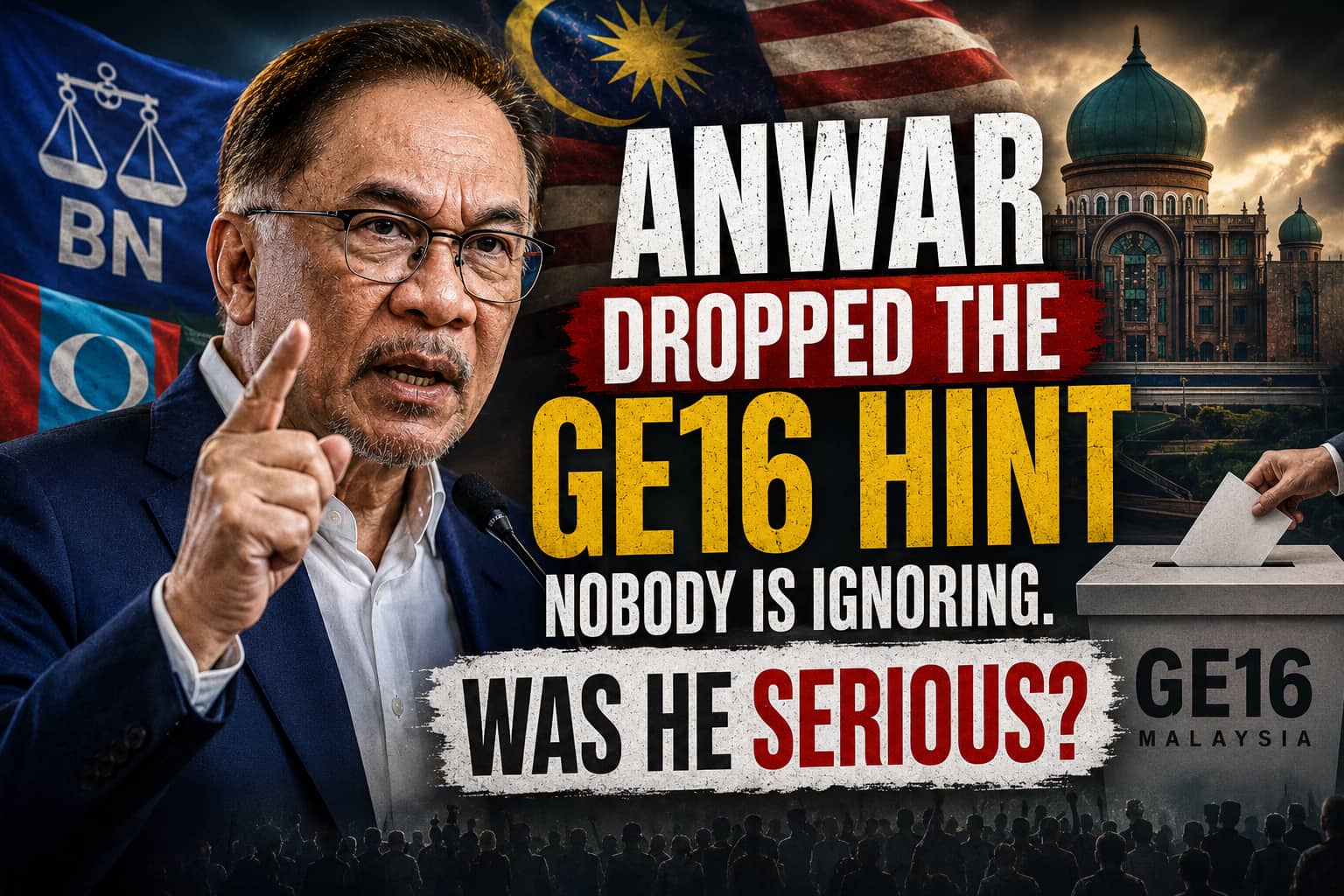
It was May 17, 2026, and PM Anwar Ibrahim was speaking at a PKR Johor convention when he said something that stopped the political room. Not a policy announcement. Not a reform pledge. A warning.
Anwar said that after BN announced its intention to contest all 56 Johor seats independently, without cooperating with PH, he would be calling PH leaders together to discuss whether the coalition should consider a nationwide general election. "If they choose confrontation in Johor, then our answer must also be firm," he said. "If they choose war, then we will fight seriously."
Let that sit for a moment. A sitting prime minister, whose governing coalition includes the party he is responding to, publicly floating the idea of calling an early general election in response to that party's state-level strategy. In Malaysian politics, that is not a minor statement.
GE15 produced a hung parliament that required Anwar to stitch together the Unity Government from components that don't naturally belong together. BN, under Zahid Hamidi, joined PH in government as a coalition partner despite being PH's historic opponent. The arrangement has produced stability and some economic progress, but it has also produced the tension now on full display in Johor, where BN's independent posture signals that the federal partnership has a ceiling.
TRP described Johor 2026 as a crucial testing ground likely to serve as a precursor to new national political alignment, with BN and PH expected to contest all 56 Johor seats independently of each other while nominally remaining federal partners. What happens when two governing partners compete aggressively in the same state will test the rhetorical commitment to unity in ways that press conferences cannot paper over.
Fair Observer's analysis of the Anwar administration's trajectory noted that coalition politics have repeatedly slowed or blunted the reform agenda Malaysians were promised, and that the balance between governing survival and genuine reform delivery is increasingly fragile ahead of the 2028 election deadline. An early election, if Anwar chose to call one, would be a high-risk gamble. PH is not in a dominant enough position to win a majority alone. BN's independent energy is unpredictable. And PN, while disorganised, is not irrelevant.
What is more likely is that the Johor election serves as the political temperature reading that Anwar then uses to calibrate his GE16 timing. If BN underperforms, the unity government narrative holds and Anwar can continue. If BN sweeps Johor convincingly, the pressure to reassert PH's independent relevance before GE16 grows urgent.
(The above is my personal reading of the political signals. Not a prediction.)
My Opinion
Malaysian politicians dropping GE16 hints at Johor conventions is not unusual. What is slightly different here is the context: the man hinting is the prime minister, and the party he's hinting against is technically in his own government. That's a level of political tension that doesn't resolve quietly. It resolves at an election.
Ronny M (ronny76netstuff@gmail.com) is a content creator under the Newswav Creator programme, where you get to express yourself, be a citizen journalist, and at the same time monetize your content & reach millions of users on Newswav. Log in to creator.newswav.com and become a Newswav Creator now!
The User Content (as defined on Newswav Terms of Use) above including the views expressed and media (pictures, videos, citations etc) were submitted & posted by the author. Newswav is solely an aggregation platform that hosts the User Content. If you have any questions about the content, copyright or other issues of the work, please contact creator@newswav.com.

