
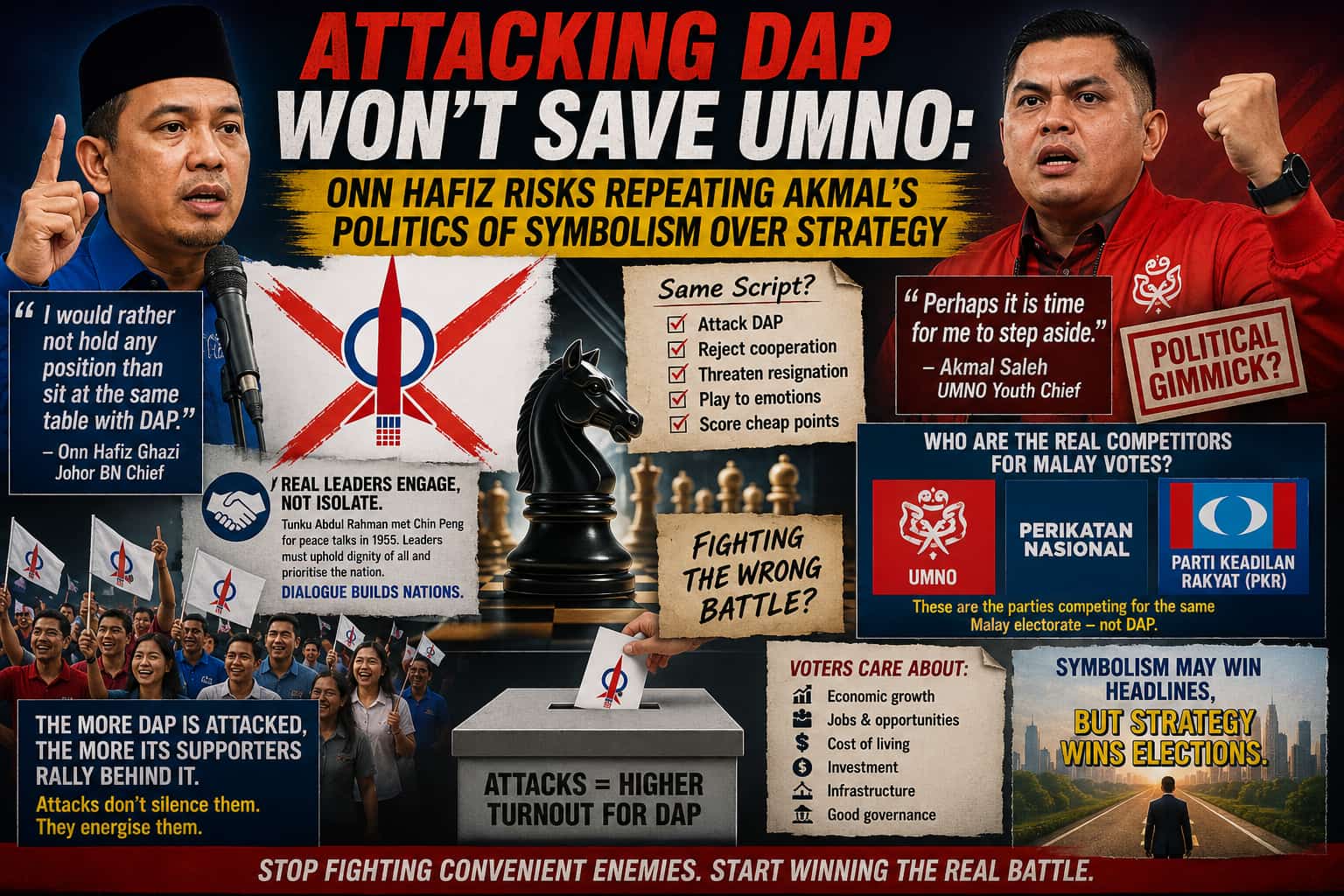
As Johor heads towards another state election, Johor Barisan Nasional chief Datuk Onn Hafiz Ghazi has chosen a familiar political script: attack DAP, reject cooperation, and portray himself as willing to sacrifice power for principle.
His declaration that he would rather forgo the Menteri Besar position than "sit at the same table" with DAP immediately grabbed headlines. Yet beyond the dramatic rhetoric lies a crucial political question: Is DAP really UMNO's biggest threat in Johor, or is this merely another attempt to consolidate Malay support by creating a convenient political enemy?
The strategy bears a striking resemblance to the political style adopted by UMNO Youth chief Datuk Dr Akmal Saleh. Time and again, Akmal has positioned himself as a defender of Malay interests by taking confrontational stances against DAP. Most recently, his suggestion that he might resign after party president Dato' Seri Ahmad Zahid Hamidi rejected calls for UMNO to leave the Unity Government was widely dismissed by analysts as a political gimmick rather than a genuine threat.
Now, Onn Hafiz appears to be adopting a similar approach.
The problem is that such politics may generate applause within certain segments of the party base, but it does little to address UMNO's actual electoral challenges.
In reality, DAP is not competing with UMNO for Malay votes.
The parties fighting directly for the Malay electorate are UMNO, Perikatan Nasional, and Parti Keadilan Rakyat. These are the parties contesting the same political space, appealing to similar voter demographics, and seeking to dominate the Malay political narrative.
By focusing attacks on DAP, UMNO risks fighting the wrong battle.
More importantly, the strategy could produce the exact opposite effect of what its proponents intend.
Many non-Malay voters have become increasingly frustrated with the performance of the Unity Government. Some have expressed disappointment over reforms that have progressed slower than expected, while others feel that coalition compromises have diluted Pakatan Harapan's original agenda.
Under normal circumstances, such dissatisfaction might result in lower voter turnout among DAP supporters.
However, when DAP becomes the primary target of political attacks, many of these voters are likely to return to the ballot box not because they are fully satisfied with DAP's performance, but because they perceive the attacks as an attempt to marginalise their political representation.
In other words, the more aggressively DAP is attacked, the more likely its supporters are to rally behind the party.
Rather than discouraging turnout, such rhetoric can energise DAP's voter base and strengthen solidarity among non-Malay communities who feel politically targeted.
This dynamic has been observed repeatedly in Malaysian politics. Political attacks intended to weaken DAP often end up reinforcing the perception that the party remains the principal defender of non-Malay interests, thereby consolidating its support rather than diminishing it.
Political commentator Tajuddin Rasdi recently criticised Onn Hafiz's stance, arguing that leaders should be willing to engage with those who hold different political views. He pointed out that Malaysia's founding leaders understood the importance of dialogue and compromise in governing a diverse nation. For example, Tunku Abdul Rahman met Communist Party of Malaya (CPM) leader Chin Peng during the Baling peace talks in 1955. He upheld the dignity of all parties involved and prioritised the interests of the nation above political differences.
The irony is particularly striking because DAP and UMNO leaders already sit together within the federal Unity Government framework. Cabinet ministers from both parties work collectively on national policies and administration. To claim that cooperation is impossible while simultaneously benefiting from a government built upon that cooperation creates an obvious contradiction.
Ultimately, voters are increasingly concerned about issues such as economic growth, job opportunities, cost of living pressures, investment attraction, infrastructure development, and governance. Endless political posturing against coalition partners may generate headlines, but it does not necessarily convince voters that a party has solutions to their daily concerns.
If UMNO hopes to regain lost ground among Malay voters, its focus should be on presenting a stronger vision than Perikatan Nasional and offering better policies than Parti Keadilan Rakyat. Those are its genuine competitors for political influence within the Malay electorate.
Attacking DAP may produce temporary political excitement, but it risks becoming a distraction from the real contest ahead. In the long run, symbolic confrontations and resignation threats may energise party loyalists, yet they are unlikely to solve UMNO's deeper electoral challenges.
The lesson from Akmal's political theatrics should be clear: symbolism may win headlines, but strategy wins elections.
By: Kpost
Information Source:
Kpost (ckhorsk@gmail.com) is a content creator under the Newswav Creator programme, where you get to express yourself, be a citizen journalist, and at the same time monetize your content & reach millions of users on Newswav. Log in to creator.newswav.com and become a Newswav Creator now!
The User Content (as defined on Newswav Terms of Use) above including the views expressed and media (pictures, videos, citations etc) were submitted & posted by the author. Newswav is solely an aggregation platform that hosts the User Content. If you have any questions about the content, copyright or other issues of the work, please contact creator@newswav.com.
