
The tectonic plates of Malaysian politics did not just shift this week; they completely shattered, treating the public to yet another masterclass in elite soap-operatics. In a swift, late-night execution of political divorce papers, PAS officially ended its six-year marriage of convenience with Bersatu. PAS Youth Chief Ahmad Fadhli Shaari had already set the stage by publicly lamenting a trail of “broken trust” a phrase delightfully rich in irony for an alliance initially forged in the murky, backroom hotel corridors of the Sheraton Move. It seems the shelf life on marriages built purely on shared ambition remains brutally short.
But while Bersatu leaders process their eviction notice, they aren't exactly mourning. Instead, Hamzah Zainudin and his band of high-profile castaways are packing their bags for a massive "Reset" conference on June 13. The grand agenda? To gather thousands of disgruntled loyalists in Kelantan and, with breathtaking predictability, launch yet another splinter party. Because if there is one thing Malaysia’s bloated political ecosystem desperately needs, it is a new vehicle fueled entirely by the spite of men who lost an internal boardroom coup.
Even the establishment itself is looking structurally brittle. Just days ago, BERSAMA founder Rafizi Ramli fired an explosive parting shot at his former home, predicting that PKR risks "dying out" after the Anwar Ibrahim era because of its rigid bureaucracy and terminal failure to reinvent itself. Naturally, the party machinery instantly closed ranks. PKR figures like Loh Ker Chean and Zaihasri Jaafar scrambled to pour cold water on the remarks, defensively arguing that Anwar is merely a "symbol" and that PKR has no shortage of capable leaders. Yet, their very insistence highlights the exact anxiety plaguing the nation: traditional parties have become so obsessed with preserving their empires and securing supreme leadership terms that they’ve forgotten how to actually grow.
Yet, amidst this burning circus of elite infighting, a quiet, almost radical experiment is happening on the opposite end of the spectrum.
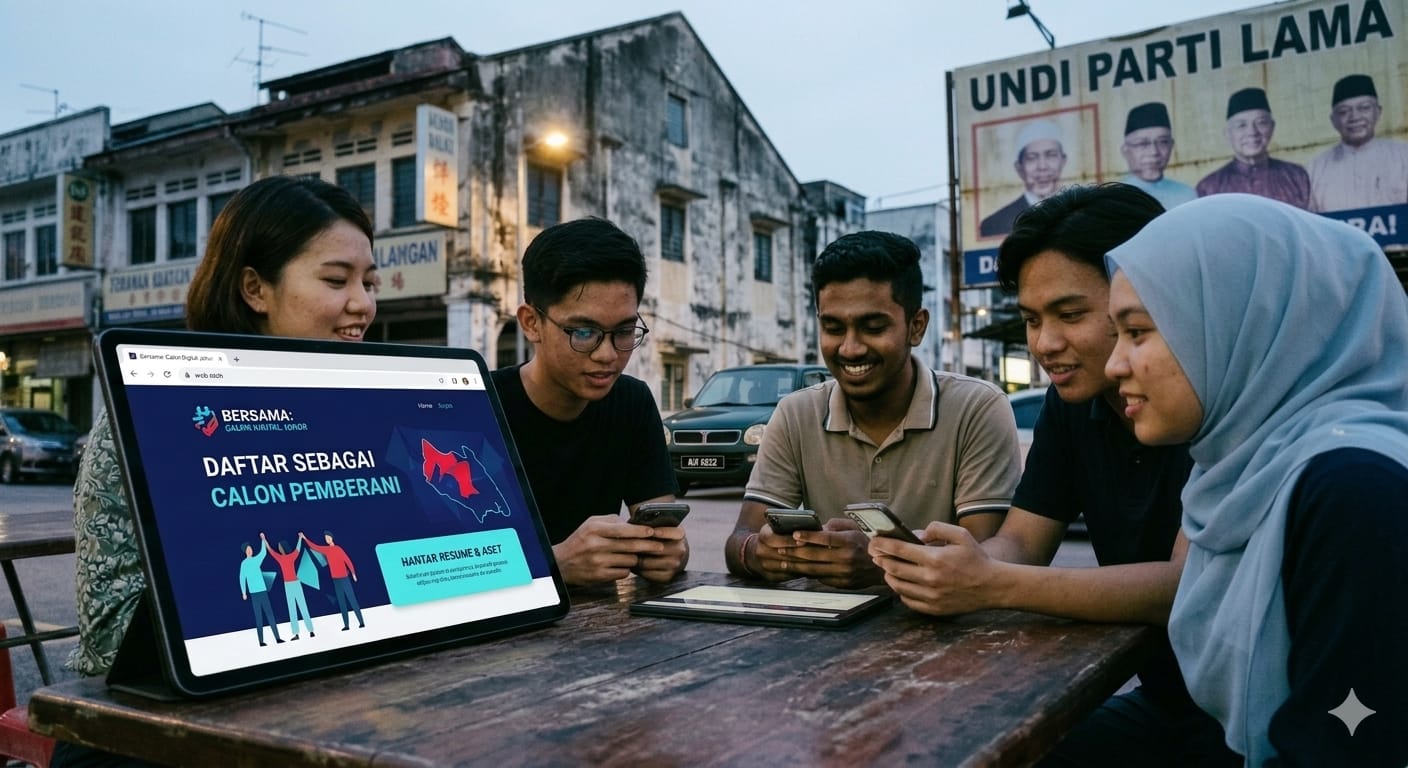
While the old guard scrambles to carve up the carcass of Perikatan Nasional, Parti Bersama Malaysia (BERSAMA) announced it is opening an online portal for ordinary citizens to apply as election candidates. Let that sink in. Instead of surviving a decades-long gauntlet of carrying bags, apple-polishing warlords, and surviving factional purges, doctors, engineers, and everyday professionals can simply upload their resumes, declare their assets, and apply to run for Parliament.
From a purely analytical standpoint, dropping a digital-first meritocracy into the upcoming 16th Johor state election is a monumental gamble. The state’s electorate has expanded dramatically to roughly 2.7 million voters. This isn't just a monolith of tech-savvy urbanites. It is a highly complex, fiercely contested battleground where identity and geography dictate survival.
If BERSAMA follows through on its ambitious goal to contest all 56 state seats, its algorithms will crash head-first into cold reality. In highly urbanized, ethnically diverse southern hubs like Iskandar Puteri, where Chinese voters make up over 47% of the demographic alongside a sizeable Malay and Indian mix, voters have traditionally clung to established brand names.
Meanwhile, in Johor's sprawling semi-rural heartlands where the Malay voter base routinely exceeds 60% elections are won not by slick user interfaces, but by deeply entrenched grassroots machinery, face-to-face community patronage, and massive structural funding. History is littered with third-party idealists who lost their financial deposits to political dinosaurs simply because they brought policy whitepapers to a knife fight.
But herein lies the twist of hope.
Voter fatigue in Malaysia has graduated from mild cynicism to profound, systemic exhaustion. The PAS-Bersatu divorce proves that the old guard is entirely consumed by its own survival, leaving millions of swing voters completely, hopelessly politically homeless. Crucially, voters aged 40 and below now command a massive 48% block of Johor’s total electoral roll. These under-30 and Undi18 cohorts do not carry the rigid, lifetime party loyalties of their parents. They are a floating, unpredictable digital electorate that consumes its reality through algorithms, not branch meetings.
By demanding total financial transparency and bypassing traditional political gatekeepers, BERSAMA is banking on a brand new currency. They are testing a beautiful, desperate thesis: that Malaysians are finally tired of voting for the "least worst option" engineered behind closed doors.
Will an open-source political application portal win a majority in Johor tomorrow? Logistically, no. But in a week where our traditional leaders proved once again that their only true loyalty is to their own survival, the mere existence of BERSAMA’s portal offers a rare, flickering glimmer of light. It reminds us that politics can be something more than a revolving door of elite musical chairs. For the first time in a long time, the door has been left unlatched for the rest of us.
Annan Vaithegi writes sharp and thoughtful columns on Malaysian politics, power struggles, reform, and the voice of the rakyat.
Annan Vaithegi (annanvaithegi@icloud.com) is a content creator under the Newswav Creator programme, where you get to express yourself, be a citizen journalist, and at the same time monetize your content & reach millions of users on Newswav. Log in to creator.newswav.com and become a Newswav Creator now!
The User Content (as defined on Newswav Terms of Use) above including the views expressed and media (pictures, videos, citations etc) were submitted & posted by the author. Newswav is solely an aggregation platform that hosts the User Content. If you have any questions about the content, copyright or other issues of the work, please contact creator@newswav.com.