
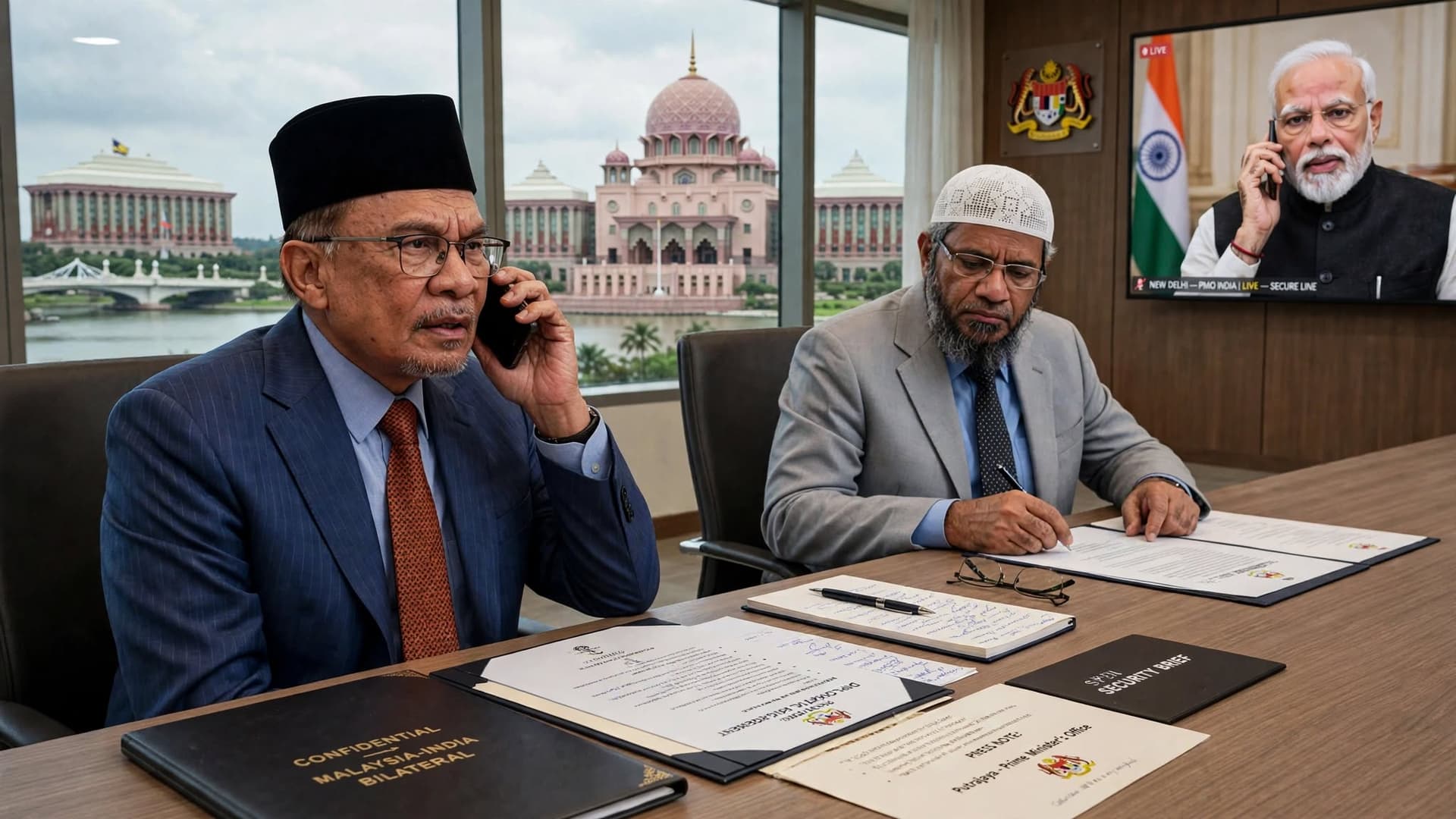
In the administrative heart of Putrajaya, statecraft relies on structure: diplomatic immunity, formal extradition requests, mutual legal assistance treaties, and international law. Yet when an Indian news crew quietly runs an undercover sting operation targeting Dr. Zakir Naik inside a high-security residence just a short distance from federal police headquarters and the Prime Minister’s Office the issue ceases to be a routine extradition request. It becomes an unmistakable audit of national sovereignty.
For years, Putrajaya’s posture has been framed around due process and diplomatic protection. Yet behind these formal legal explanations lies a troubling reality: maintaining a status quo of convenient ambiguity creates a dangerous web of interconnected vulnerabilities for Malaysia.
On the diplomatic front, selective legal standards erode Putrajaya's international standing and spark recurring trade friction with major regional powers. Domestically, harboring a foreign preacher whose provocative rhetoric strains delicate ethnic and religious fault lines directly risks social cohesion in a plural society. Compounding both is a severe sovereignty risk, as foreign media outlets exploit Malaysia’s capital as an arena for covert operations and foreign political warfare.
1. Diplomatic Protection vs. Foreign Media Exposure
Under international legal norms, non-citizens granted permanent residency place their safety under the host nation's care. The core argument against extraditing Zakir Naik has long rested on Putrajaya’s duty to ensure personal safety specifically, the assertion that he would face persecution, extrajudicial harm, or unsafe custody if returned without binding guarantees. In a jurisdiction where custodial safety remains a sensitive, highly scrutinized concern, a sovereign government cannot simply surrender a resident if doing so risks trial by media rather than a court of law.
However, providing legal sanctuary does not insulate Putrajaya from foreign political interference. The spectacle of foreign journalists operating covertly in Malaysia’s administrative capital demonstrates how easily sanctuary can turn into exposure. When a resident under state protection uses that platform to weigh in on foreign electoral politics, the host nation is dragged directly into external conflicts. Sanctuary, under these conditions, does not project strength; it signals that Putrajaya can be weaponized as an arena for foreign news cycles.
The Custodial Double Standard
Furthermore, Putrajaya’s primary justification rests on the duty to protect non-citizens from potential custodial abuse or unsafe detention conditions abroad. Yet this rationale exposes a glaring domestic paradox. Human rights advocates routinely highlight Malaysia’s own unresolved record of deaths in police lockups and detention centres cases where ordinary citizens frequently fail to receive basic safety guarantees or institutional accountability.
When ordinary individuals face real risks within the domestic justice system while a high-profile foreign preacher receives state-backed protection and luxury residence in Putrajaya, the state's legal duty looks less like an unyielding human rights principle and more like a political privilege. A nation that struggles to ensure custodial safety for its own citizens cannot convincingly invoke custodial safety as a selective shield for a foreign firebrand.
2. The Demographic Reality: Silence from 200 Million
A central narrative used domestically to justify ongoing protection claims that returning Naik exposes him to systemic religious hostility under India's political climate. Yet this argument collapses when measured against demographic realities. India is home to over 200 million Muslims a population larger than Malaysia’s entire citizenry and nearly matching Pakistan.
Within India itself, there are no mass mobilizations, no nationwide rallies, and no sustained petitions from major Indian Muslim civic bodies demanding international asylum on his behalf. Long before foreign authorities issued legal notices, prominent Indian Muslim institutions representing traditional Deobandi, Barelvi, and Shia bodies voiced opposition to his methodology, viewing his polemics as divisive rather than protective of Indian Islam.
If the vast majority of India's own Muslim population treats his legal troubles as an individual judicial matter rather than a communal crisis, Putrajaya’s insistence on framing his presence as an existential matter of religious protection looks less like diplomatic solidarity and more like domestic political theater.
3. The Reciprocity Paradox and the Extradition Dilemma
The legal argument regarding Naik frequently stalls when measured against formal international standards: Interpol previously withdrew Red Notices citing insufficient evidentiary thresholds, and UN terror designations do not exist. Without unassailable judicial proof, surrendering an individual to foreign political pressure would set a dangerous precedent.
Yet, a nation’s commitment to international law is judged by consistency. Malaysia routinely relies on mutual legal assistance treaties and extradition agreements to pursue its own fugitives abroad. This creates a glaring contradiction in statecraft:
| International Principle | Malaysia's Stated Posture | Practical Reality |
|---|---|---|
| Extradition Treaties | Respect for international judicial norms | Selective deferral for politically sensitive figures |
| Domestic Order | Zero-tolerance for communal incitement | State-level preaching bans alongside federal protection |
| Sovereignty | Immunity from foreign political interference | Putrajaya utilized as a venue for foreign media stings |
When Putrajaya shields a figure barred by multiple nations including the UK, Canada, Bangladesh, and Sri Lanka it risks compromising its reputation as a consistent international actor. Demanding compliance from foreign partners while deflecting standard processes at home erodes sovereign credibility.
4. Domestic Harmony Is Not an Abstract Commodity
Beyond international trade friction and media spectacles lies the most immediate stake: social cohesion. A plural society cannot afford to harbor foreign figures whose public record includes questioning the loyalty or heritage of minority communities.
While federal authorities rely on procedural due process, several state governments previously imposed local bans on Naik’s public lectures to safeguard public peace. This divide underscores a vital distinction: what is technically legal is not inherently safe for social order. When religious rhetoric spills beyond its original source and touches sensitive domestic lines, the resulting friction is borne entirely by ordinary citizens. National unity requires strict boundaries against communal provocation, not perpetual tolerance for divisive speech.
The Imperative for Coherence
When formal legal channels stall, media spectacle takes over. But ambiguity cannot serve as a permanent policy. Harboring a foreign firebrand yields no strategic dividend for Malaysia it generates economic friction with crucial trade partners, invites foreign undercover operations into the nation's seat of power, and strains domestic harmony.
Courts demand evidence, diplomatic partners demand consistency, and a multiracial society deserves peace. Putrajaya must recognize that protecting a single individual at the expense of national credibility and sovereign clarity is a trade-off Malaysia cannot afford to keep making.
Annan Vaithegi commentator on diplomacy, statecraft, and public order in multiracial societies.
Annan Vaithegi (annanvaithegi@icloud.com) is a content creator under the Newswav Creator programme, where you get to express yourself, be a citizen journalist, and at the same time monetize your content & reach millions of users on Newswav. Log in to creator.newswav.com and become a Newswav Creator now!
The User Content (as defined on Newswav Terms of Use) above including the views expressed and media (pictures, videos, citations etc) were submitted & posted by the author. Newswav is solely an aggregation platform that hosts the User Content. If you have any questions about the content, copyright or other issues of the work, please contact creator@newswav.com.