
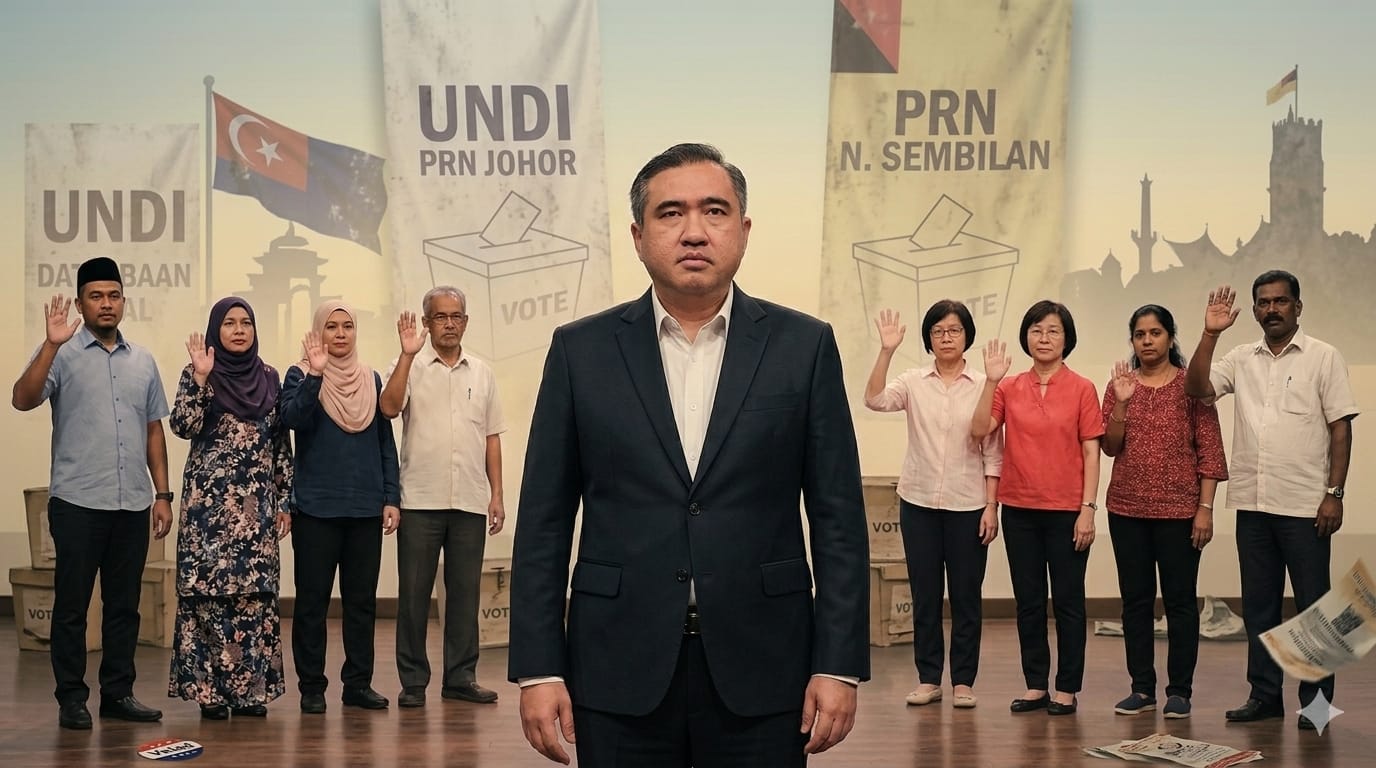
After decades of being one of Malaysia’s most disciplined political machines, DAP is now facing a blunt reality: it is highly efficient at organisation, but increasingly less effective at expanding its appeal beyond its established base. The gap between party structure and voter sentiment is widening, and the recent state election results in Johor and Negeri Sembilan made that difficult to ignore. It was against this backdrop that Anthony Loke announced he would step down as Negeri Sembilan DAP chairman after more than two decades leading the state chapter, a move many immediately interpreted as taking responsibility for the party’s disappointing performance.
That interpretation is understandable, but it is also too simplistic.
Leaders come and go. Chairmen retire. New faces emerge. That is the natural rhythm of political organisations.
The more important question is not why Anthony Loke is stepping aside.
It is why DAP, despite remaining one of Malaysia’s most organised and disciplined political parties, is finding it increasingly difficult to expand beyond its traditional political boundaries.
Johor and Negeri Sembilan are not merely two election results.
Together, they represent a warning that DAP’s greatest challenge today is no longer survival.
It is growth.
Winning Is One Thing. Growing Is Another.
For decades, DAP measured success differently from most political parties.
Simply surviving in a hostile political environment was itself an achievement.
Building branches.
Recruiting members.
Winning urban constituencies.
Establishing itself as the principal opposition voice.
That journey produced leaders like Lim Kit Siang, Karpal Singh, Lim Guan Eng and Anthony Loke. Their politics was forged in opposition, where every speech and campaign reinforced DAP’s identity as a party willing to challenge the establishment.
But opposition politics and governing politics are fundamentally different.
The former rewards conviction.
The latter demands compromise, delivery, and coalition management.
This shift has changed how Malaysians evaluate DAP.
Voters are no longer asking whether DAP can fight corruption or criticise government failures.
They are asking something harder.
Can DAP deliver meaningful reforms while sharing power with parties that often hold different political instincts?
That is the question every reform movement eventually faces.
The Government Tax Every Reform Party Must Pay
There is an old saying in politics: governments do not lose elections overnight. They lose them one unmet expectation at a time.
DAP is now paying what political scientists call the “government tax.”
In opposition, supporters judged the party by its courage.
In government, they judge it by its results.
That is a far harsher standard.
Reactions after the Johor and Negeri Sembilan elections reflected this tension. Some accused DAP of becoming too accommodating. Others said it had traded credibility for power. Others still argued it remains the cleanest component in government but lacks influence over national direction.
These views contradict one another.
Yet they point to the same conclusion.
The debate is no longer about whether DAP is relevant.
It is about what DAP now represents.
That question is more important than any single electoral loss.
Anthony Loke Is Probably Not the Problem
It is always tempting to personalise political setbacks.
Anthony Loke is an easy target because he holds multiple roles: party secretary-general, federal minister, and until now, Negeri Sembilan chairman.
But reducing DAP’s challenges to one individual misses the larger picture.
Among current leaders, Loke is widely seen as one of the party’s strongest assets.
He is pragmatic, multilingual, and comfortable working across institutions. He has avoided the confrontational style of earlier opposition politics and built working relationships within government structures.
If even a leader like Loke struggles to significantly expand DAP’s appeal beyond its base, the issue is unlikely to be personal.
It is structural.
Perhaps DAP has reached a political ceiling that cannot be broken simply by changing leadership.
That possibility deserves serious reflection.
Johor and Negeri Sembilan Tell the Same Story
Although the two elections unfolded in different contexts, they delivered a similar message.
DAP largely defended its existing strongholds but struggled to expand.
That distinction is crucial.
Holding ground shows loyalty, but expansion shows relevance. Parties that stop growing eventually find that defending territory becomes harder each cycle.
Johor and Negeri Sembilan therefore raise a difficult question: has DAP reached the limits of its current political language?
For years, its message centred on clean governance, reform, accountability and competence. These remain important, but elections are not decided by principles alone. They are shaped by identity, emotion and belonging.
Progressive politics often assumes good governance will naturally defeat identity politics. Malaysia suggests otherwise.
Performance matters, but identity still matters. Ignoring that reality would be politically dangerous.
The Three Electoral Realities
DAP’s current challenge can be understood through three broad voter dynamics.
First, its Chinese support base remains its most reliable foundation, but it is no longer significantly expanding. In many areas, it is stable but saturated, with younger voters becoming more issue-based and less historically loyal.
Second, its support among Indian voters is more uneven than before. While DAP remains influential in urban Indian communities, expectations have risen faster than visible outcomes, especially on socio-economic mobility and long-term structural issues. Coalition constraints explain limitations, but voters ultimately judge results, not constraints.
Third, the Malay electorate remains the party’s most persistent structural barrier. Despite years in coalition government and efforts to project a more inclusive image, DAP still struggles to significantly expand its appeal in rural and semi-rural Malay-majority areas. Historical perceptions continue to shape political trust, and incremental outreach has not yet shifted the overall ceiling.
Taken together, these three realities show that DAP is not facing a single problem.
It is facing three different political ceilings at once.
A Plateau, Not a Collapse
This is why Johor and Negeri Sembilan should not be read as isolated setbacks.
They are signs of a broader plateau.
DAP is no longer in a phase where incremental improvements guarantee expansion. It is in a phase where every additional gain requires a fundamentally different approach to communication, engagement and policy delivery.
The question is no longer whether DAP is strong.
It is whether its strengths are still sufficient for the political environment it now operates in.
The Identity Crisis of a Reform Party
Perhaps the greatest irony facing DAP is that its success in entering government now risks eroding the identity that brought it there.
For decades, DAP knew exactly what it was: the watchdog, the opposition voice, the critic of abuse and corruption.
Now it is part of the government it once opposed, and expectations have shifted. Supporters no longer ask what it has blocked, but what it has achieved.
A reform party built on resistance must now prove it can govern without losing moral clarity. That is far harder than winning opposition seats.
The Coalition Dilemma
DAP’s future cannot be separated from coalition politics.
Some argue it has compromised too much to sustain the Unity Government.
Others argue staying in government is necessary for stability.
Both views contain truth.
But they may be asking the wrong question.
The issue is not simply whether DAP should stay in or leave government.
The issue is whether Malaysians still understand what DAP stands for while it is in government.
Political identity cannot survive indefinitely on opposition memory.
It must be renewed through governance.
That is the challenge now facing reform parties everywhere.
Beyond Anthony Loke
Anthony Loke stepping down as Negeri Sembilan chairman may open space for new leadership. That is a good thing.
But Johor and Negeri Sembilan show the issue is not just about new leaders. It is about renewing politics itself.
DAP needs a new way of speaking and connecting. One that reaches beyond its loyal supporters to voters it has never won before. One that shows rural voters that good governance matters as much as identity. One that proves reform in government can still make a difference.
It is easy to blame individuals. But the harder task is to understand what voters are really saying.
These elections were not only about losing seats. They show that old political strategies are no longer enough.
For years, DAP worked to enter government. The next challenge is harder. Not just to be in power, but to grow beyond its current limits.
Annan Vaithegi writes that political parties rarely decline because they run out of leaders. They decline because they run out of ideas that can reach people they have never persuaded before.
Annan Vaithegi (annanvaithegi@icloud.com) is a content creator under the Newswav Creator programme, where you get to express yourself, be a citizen journalist, and at the same time monetize your content & reach millions of users on Newswav. Log in to creator.newswav.com and become a Newswav Creator now!
The User Content (as defined on Newswav Terms of Use) above including the views expressed and media (pictures, videos, citations etc) were submitted & posted by the author. Newswav is solely an aggregation platform that hosts the User Content. If you have any questions about the content, copyright or other issues of the work, please contact creator@newswav.com.