
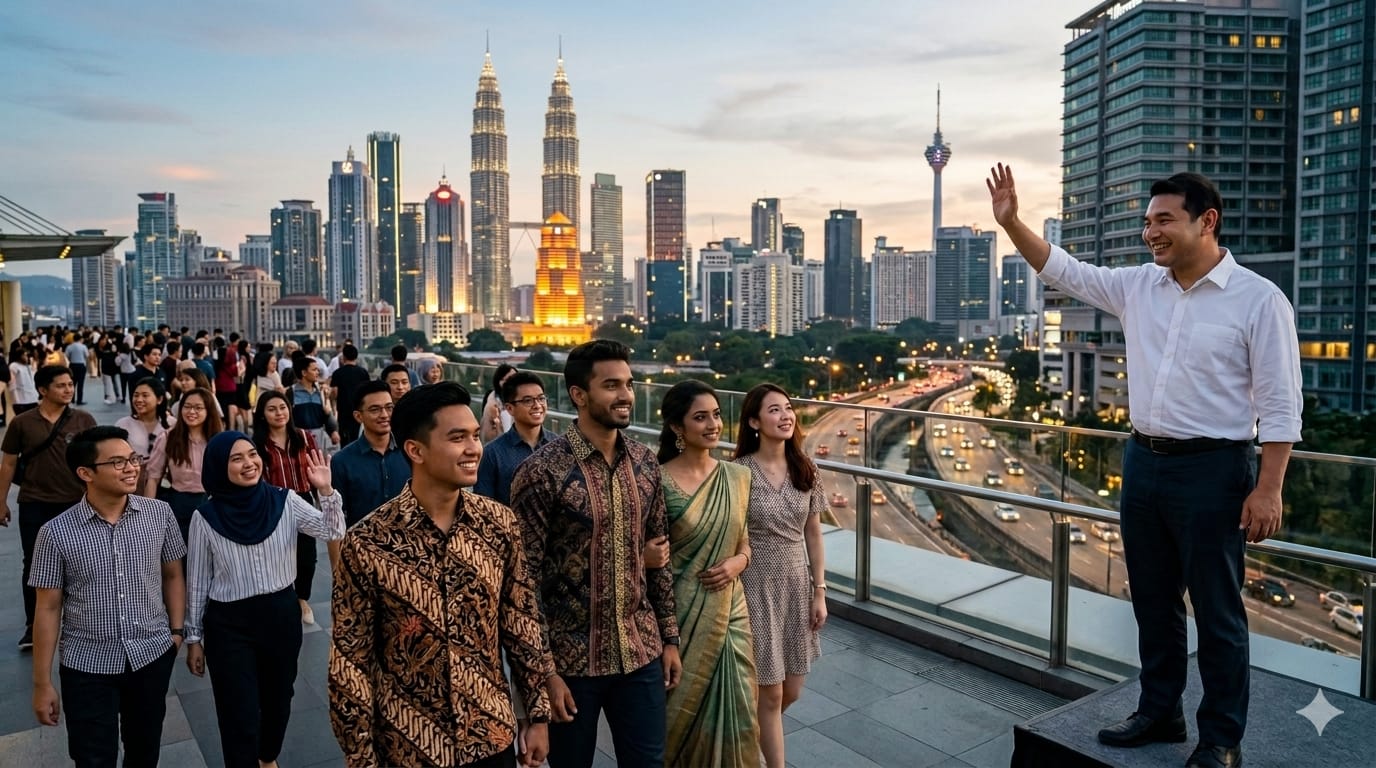
- Moving forward together, beyond the old divisions. Visual created Gemini prompt by Annan Vaithegi
Long before politicians argued over race and religion on television, Indian estate workers were clearing rubber fields under the burning sun, Chinese miners were digging wealth from dangerous tin mines, and Malay farmers were feeding villages across the peninsula.
They did not build separate countries.
They built one Malaysia.
Yet decades later, their descendants are still trapped inside political systems that continue measuring belonging, opportunity, and loyalty through racial lenses.
That is the uncomfortable truth beneath the latest political clash involving Rafizi Ramli, Parti Bersama Malaysia, and the growing debate over racial tensions in the country.
The headlines may focus on personalities. Rafizi blames the government. Professors blame Rafizi. Supporters blame Anwar. Critics blame everyone.
But beneath all the shouting lies a deeper national question:
Can Malaysia ever truly escape race politics?
This is why the recent criticism from National Unity Advisory Council member Tajuddin Rasdi matters politically. He argued that Rafizi spoke loudly about rising racial tensions only after leaving government, despite remaining relatively quiet while serving as Economy Minister.
And honestly, that criticism carries some truth.
But it also exposes a larger hypocrisy inside Malaysian politics itself.
Because many leaders only discover the courage to speak freely after leaving power.
Inside Cabinet: collective responsibility. Outside Cabinet: sudden moral clarity.
That contradiction is not unique to Rafizi. It is part of Malaysia’s broader political culture.
For decades, politicians across all coalitions have campaigned using the language of unity, moderation, and togetherness. But once in power, many quietly return to the old formula:
manage ethnic fears, protect communal voting blocs, avoid upsetting racial sensitivities, and maintain political survival.
That formula has shaped Malaysia since independence.
The original Perikatan model itself was built around ethnic bargaining Indian representation through MIC. Chinese representation through MCA, Malay representation through Umno
At the time, perhaps it reflected political realities. Malaysia was young. Communities were economically segregated. Trust was fragile.
But over time, something dangerous happened.
Race-based politics stopped becoming a temporary balancing mechanism. It became the operating system itself.
And once politicians realised fear mobilises voters faster than unity, racial politics evolved from protection into political dependency.
That dependency still shapes modern Malaysia.
Every election cycle, Malaysians are reminded to fear someone:
Fear losing Malay rights. Fear losing Chinese economic power. Fear religious extremism. Fear liberalism. Fear Islamisation. Fear secularism. Fear becoming outsiders in our own country.
The result? A nation permanently negotiating with itself.
This is why conversations about unity in Malaysia often feel exhausting.
Everyone talks about harmony. Few are willing to restructure the system producing division.
And this is where Rafizi’s new political venture, Parti Bersama Malaysia, becomes an important test.
Not because Bersama is guaranteed to succeed. It may fail spectacularly.
But because it is attempting something Malaysian politics rarely does honestly: challenging whether race-based political architecture itself is still sustainable.
That is a dangerous conversation.
Not only because conservative forces will resist it. But because even supposedly progressive parties still rely heavily on racial calculations behind closed doors.
This is the paradox many Malaysians increasingly notice.
Politicians publicly speak about “Malaysian First.” But candidate placements, policy negotiations, coalition arrangements, and even public statements are still filtered through racial arithmetic.
Unity becomes branding. Division remains machinery.
And ordinary Malaysians are becoming tired.
Younger voters especially are increasingly disconnected from the emotional language that dominated older political generations.
Many young Malaysians are not asking: “Which race protects me?”
They are asking: “Can I afford rent?” “Will salaries rise?” “Can I buy a home?” “Will my degree matter?” “Is there a future here?”
That generational shift matters enormously.
Because younger Malaysians are growing up inside a globalised digital economy where identity feels more fluid, but they still enter political systems organised through ethnic categories designed generations ago.
The mismatch creates frustration.
And perhaps that frustration explains why many Malaysians now respond emotionally to leaders like Rafizi.
Not necessarily because they fully trust him. But because they are desperate for somebody willing to openly question the system itself.
Still, Bersama faces a brutal reality.
Talking about a “one-race Malaysian identity” is easier than governing one.
Malaysia’s social contract, affirmative action structures, education systems, economic networks, and political institutions have all evolved around communal balancing for decades.
Untangling that structure requires more than slogans. It requires courage. Institutional reform. Transparent policies. Means-based assistance. Educational transformation. And most importantly: leaders willing to lose votes for principle.
That last part is where Malaysian politics usually collapses.
Because the harsh reality is this: Race remains the easiest political weapon in the country.
It creates fear quickly. It simplifies complex economic frustrations. It unites supporters emotionally. And it distracts from governance failures.
Politicians know this. Which is why race and religion continue returning every election season like an endless recycled script.
The tragedy is that Malaysia already possesses the ingredients to become something extraordinary.
A multicultural society. Multiple languages. Religious diversity. Deep historical roots. Strong regional cultures. Economic potential.
Many countries spend decades trying to build diversity. Malaysia inherited it naturally.
Yet instead of treating diversity as strategic strength, politics often treats it like permanent instability requiring endless management.
That mindset damages everyone.
Being “Malaysian” should never require someone to erase being Indian, Chinese, Malay, Kadazan, Iban, Sikh, Orang Asli, or Eurasian.
The real goal is simpler: that no child’s opportunities, dignity, or belonging should depend on race.
That does not mean ignoring historical inequalities. It means ensuring historical protection does not become permanent political segregation.
And perhaps this is where the current government struggles most.
The Madani administration came into power carrying reformist expectations. But many Malaysians now feel the government spends more time managing coalition sensitivities than confronting the deeper systems generating racial distrust.
Supporters argue this caution is necessary for stability. Critics call it fear.
Both may be correct.
Because Malaysia’s political system punishes leaders who move too slowly. But it also punishes leaders who move too boldly.
That is the trap.
Still, avoiding the conversation entirely only deepens public frustration.
The country cannot endlessly survive by treating race relations like a political fire that only needs temporary containment.
Eventually, Malaysians must decide whether race politics remains the foundation of national stability or the main obstacle preventing a stronger national identity from emerging.
And if parties like Bersama truly want to become more than another political rebellion, they must prove that “Malaysian First” is not merely a slogan shouted after leaving power.
It must become a serious institutional vision capable of protecting the vulnerable without trapping citizens inside racial boxes forever.
Otherwise, Malaysia will continue doing what it has mastered best:
recycling division while calling it stability.
Annan Vaithegi writes sharp and thoughtful columns on Malaysian politics, power struggles, reform, and the voice of the rakyat.
Annan Vaithegi (annanvaithegi@icloud.com) is a content creator under the Newswav Creator programme, where you get to express yourself, be a citizen journalist, and at the same time monetize your content & reach millions of users on Newswav. Log in to creator.newswav.com and become a Newswav Creator now!
The User Content (as defined on Newswav Terms of Use) above including the views expressed and media (pictures, videos, citations etc) were submitted & posted by the author. Newswav is solely an aggregation platform that hosts the User Content. If you have any questions about the content, copyright or other issues of the work, please contact creator@newswav.com.