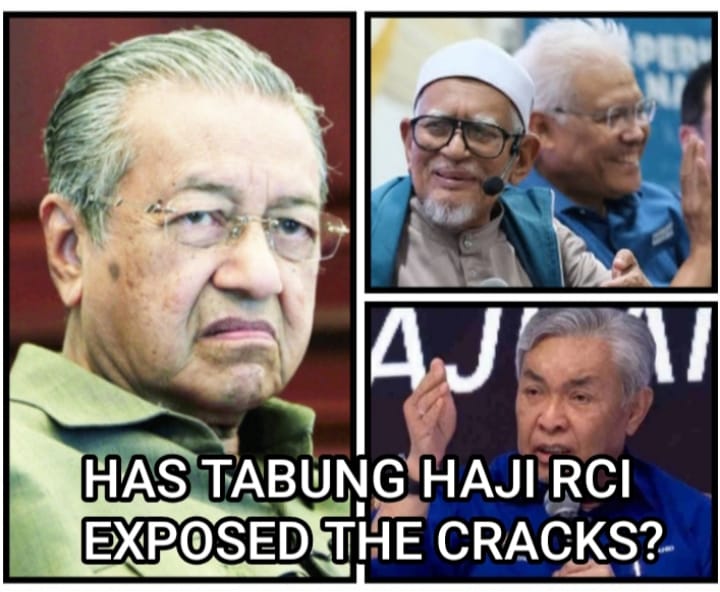
Will intense jealousy and internal rivalries ensure that the much-hyped ‘Malay unity’ movement is destined to have a short, troubled life?
In the beginning, politicians hailed it as a grand platform for Malay-Muslims to unite—under a single, so-called “big umbrella.” The impression given was that it was primarily to bring them all together rather than act as an outright political cartel.
Dr Mahathir was among the earliest to raise this subject on his highly popular Facebook page, while PAS leaders kept stressing that perpaduan ummah (Malay-Muslim unity) was necessary to protect Islam and ensure the country is governed by Malay-Muslims.
But some serious questions remain: Was it driven by a genuine desire to unite fellow Malay-Muslims in order to preserve their interests, rights, and special privileges, or was it mainly driven by a hunger for total control over them for political hegemony?
Well, it looks like that question has since been answered, not once, but twice: first in the Johor state election, followed by more recently in Negeri Sembilan.
In both episodes, not only did the gloves come off, but the masks were removed too—unabashedly!
Surprisingly, their target demographic appeared to have swallowed the “political bait” hook, line, and sinker. Perhaps, the emotional pull of race and religion was just too strong.
True enough, the Malay unity narrative turned out to be the “magic formula” that enabled BN and PAS to bulldoze the minority non-Malay electorate with sheer numbers, forcing the latter to concede defeat virtually hands down.
To hardcore critics, though, this move would have resembled two different teams on a football pitch “ganging up” against a side with only eleven men. Would the outcome ever be in doubt?
For sure it would have also made Dr Mahathir and Hadi ecstatic—maybe even injecting fresh life into them.
So, here's the uncomfortable question: were all those passionate calls for ummah unity actually a well-choreographed political drama then?"
After all, in politics, no matter how hard one tries to disguise it, isn't power the be-all and end-all?
Then, amid the euphoria and the victory celebrations, reality came knocking.
Earlier this month, after the NS election results were announced, a senior PN politician reportedly questioned the appointment of the new Menteri Besar, insinuating that the state UMNO chief was overlooked and someone else got the job instead. There were also allegations that UMNO's top leadership had interfered in the appointment process.
Were those the earliest signs yet of cracks appearing in the nascent Malay unity electoral pact?
Of course, basic common sense would dictate that all “marriages of convenience” come with a built-in expiry date. But then, has common sense ever been synonymous with most politicians?
Then came Melaka. While the combined “Blue and Green Wave” was expected to sweep through easily in the upcoming state election, no-nonsense state leader Ab Rauf Yusoh hinted that, Malay unity or not, there would be no “free pass” for PAS or anyone else, for that matter. Everything had to be negotiated, and nothing was assured. Clearly, the chief minister was not prepared to compromise. Did the opposition take things for granted then?
And while that was brewing, soon another controversy grabbed the nation's attention. This time it was something bigger: nearly four years after its completion, the Royal Commission of Inquiry (RCI) report on the Tabung Haji debacle was finally released.
Initially, there was a huge uproar, with politicians pointing fingers everywhere except at themselves.
Now if ever there was a compelling justification for ummah unity, was this not the perfect occasion for them to stand up and be counted? After all, it was to future-proof Malay-Muslim interests in a matter supposedly of paramount importance to them.
But where were the Malay unity warriors—especially those from the opposition—when it came to debating the RCI findings in Parliament? Instead of speaking up, they chose to walk out. Their excuse: PM Anwar—just discharged from hospital after a hernia operation—was absent.
Ironically, even UMNO-BN MPs swallowed their pride and stayed back, even though the alleged “scandal” had happened under their watch.
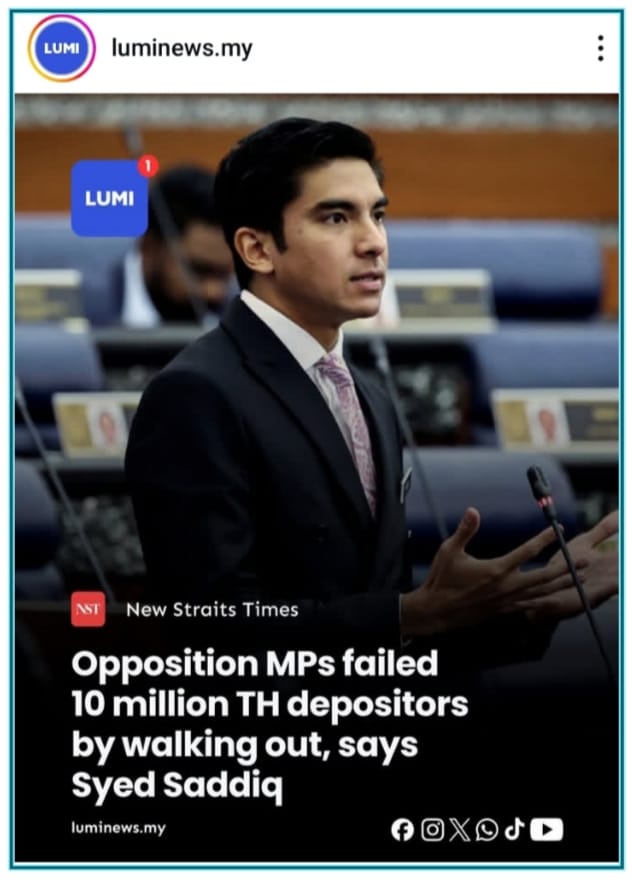
Screenshot from Luminews.my Instagram (Source: NST)
It was left to Muar MP Syed Saddiq to angrily call out the PN lawmakers for their action. He must have also hit the bullseye when he remarked that those who boast loudest about championing Malay and Islamic interests decided to boycott the debate instead of facing the facts.
So much for Malay unity!
The thing is, history has already demonstrated during the chaotic 2020–2022 PN-BN rule that a Malay-Muslim-centric Federal administration may not survive long due to the unique political dynamics in this country. Sooner or later factors such as mutual suspicion, internal power struggle and competing interests among the partners are bound to precipitate its collapse.
Truth be told, sparks are already flying among the Malay unity allies following the Tabung Haji walkout and growing friction over state seat allocations. So, can it survive all these flashpoints, or is it simply a matter of time before things implode?
Main information source: Malay Mail, FMT, Harapan Daily, The Sun Daily and NST.
JK Joseph (jtkingsworld@gmail.com) is a content creator under the Newswav Creator programme, where you get to express yourself, be a citizen journalist, and at the same time monetize your content & reach millions of users on Newswav. Log in to creator.newswav.com and become a Newswav Creator now!
The User Content (as defined on Newswav Terms of Use) above including the views expressed and media (pictures, videos, citations etc) were submitted & posted by the author. Newswav is solely an aggregation platform that hosts the User Content. If you have any questions about the content, copyright or other issues of the work, please contact creator@newswav.com.