
Take a week off.
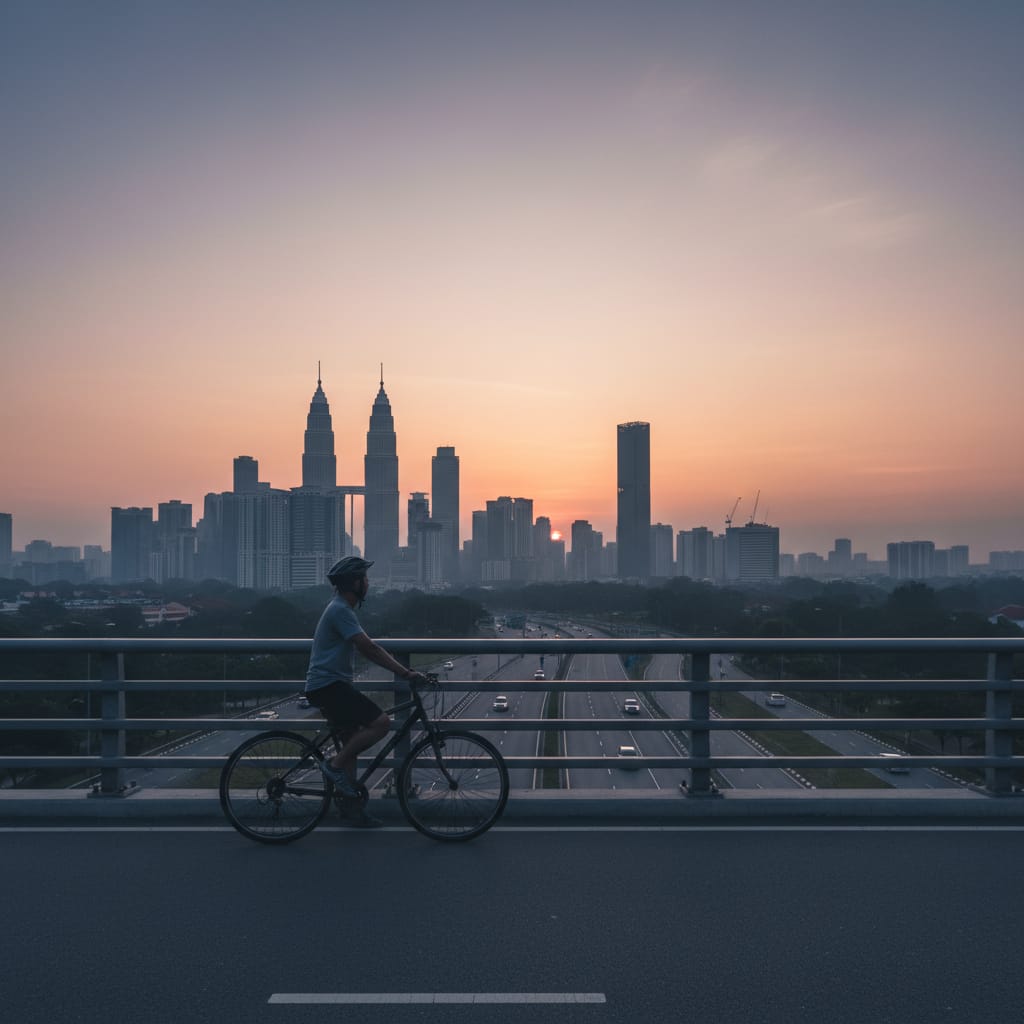
Cycle and or drive around KL on different occasions and time.
Recently, Minister for FT, Hannah Yeoh introduced the Bangun KL: Ke Arah Kuala Lumpur Yang Lebih Sejahtera, which aims to reduce morning rush-hour traffic congestion in the morning by encouraging motorists to enter the capital earlier.
She said a good city is not just about how it looks, but how it functions in people’s daily lives and this initiative focuses on behavioural change, using incentives and cross-sector collaboration to tackle congestion more holistically.
Dear Minister, you dont urge people top wake up early to go to work to ease traffic jam.
Already, parents in Malaysia, notably in Klang Valley are spending less and less time with their children.
In a survey in 2020 undertaken by Toys R Us Malaysia on more than 4,807 parents in Malaysia, the results revealed that 33.4% of parents spend an average of only 1-4 hours per week of unstructured playtime with their children.
That’s less than an hour a day!
And 36.4% of parents polled were not sure if their children had the appropriate playthings for their stage of development that could strike a balance between fun and learning development.
Do you think things have improved since that survey in 2020?
In 2023, a survey undertaken by malaysian banking giant, RHB, in partnership with FMT, an online news media to understand the importance of time and time management among Malaysians revealed that the lack of time and poor time management resulted in the collapse of relationships and marriages in this country.
The survey also revealed that despite a lapse of 50 years, in 2019, the average worker in Malaysia clocked in 2,197 hours per year (or 45.77 hours per week), where in 1970, they clocked in 2,230 hours per year (about 46.45 hours per week), an insignificant improvement of 0.7 hours.
Many are forced to spend long hours at work to make ends meet.
In the same year in 2023, a survey undertaken by the Employee’s Provident Fund in collaboration with the Social Wellbeing Research Centre, Universiti Malaya, for the Belanjawanku Guide 2022/2023, revealed that a single person who depends on public transport and lives within 30km of the centre of the Klang Valley needs at least RM1,930 a month. If he has a car, the budget is RM2,600. A family with one child needs RM5,980 while one with two children would require about RM6,890.
And if a parent were to follow your program, it means additional costs for them as they would also have to leave their children earlier with a separate baby sitter as the permanent baby sitter probably starts work much later.
Focus on reducing the total number of vehicles on the road during peak hours, increasing the efficiency of existing infrastructure, and providing viable alternatives to driving.
These are the low hanging fruits for you to pluck.
Don’t go down the road of attempting to change the behaviours of Klites.
Any psychiatrist worth their salt will tell you that changing an established human behavior is notoriously difficult because habits are deeply ingrained in the brain’s neural pathways and often serve to conserve mental energy, acting on "autopilot".
This resistance to change is not simply stubbornness but a natural biological mechanism where the body and brain prefer stability and comfort, perceiving change—even positive change—as a threat to that stability.
If you are hellbent on this, why don’t you pilot your scheme focusing solely to help those mat rempits and mat lajak?
Many cyclists will tell you that cycling, even for the enthusiasts in Malaysia, is not for the faint hearted.
Worse if it is cycling to work, regardless of the distance between the work area and the house.
Malaysian roads are designed for motor vehicles and minimal bicycle infrastructure and are notoriously unforgiving for cyclists.
Cyclists must navigate a gauntlet of challenges as most public roads lack bicycle-friendly features, leaving riders vulnerable to reckless motorist.
Even in areas like in the city of Kuala Lumpur, where dedicated bike lanes exist, the situation is far from ideal.
To make matters worse, motorcyclists frequently speed through these lanes, forcing cyclists into precarious situations where even a minor collision could have dire consequences.
In fact, many die hard cyclists will agree that the satisfaction of arriving at work powered by one’s own effort is hard to beat.
However, bike commuting in Malaysia, especially in Kuala Lumpur, comes with sacrifices.
Even in Putrajaya, which was designed as a "bikeable city" with dedicated infrastructure, including designated bicycle lanes, pedestrian pathways, and scenic routes, the hot weather, sudden heavy rain, and the need to be wary of motorized vehicles on some shared roads puts one off from even contemplating this route of transportation to and from work.
And again, how many other places are built like Putrajaya?
To Ahmad Maslan, take a week off, sit down and just think.
FLK (leekhean.foo@gmail.com) is a content creator under the Newswav Creator programme, where you get to express yourself, be a citizen journalist, and at the same time monetize your content & reach millions of users on Newswav. Log in to creator.newswav.com and become a Newswav Creator now!
The User Content (as defined on Newswav Terms of Use) above including the views expressed and media (pictures, videos, citations etc) were submitted & posted by the author. Newswav is solely an aggregation platform that hosts the User Content. If you have any questions about the content, copyright or other issues of the work, please contact creator@newswav.com.